A leadscrew (or lead screw), pronounced /liːdskruː/, also known as a power screw[1] or translation screw,[2] is a screw used as a linkage in a machine, to translate turning motion into linear motion. Because of the large area of sliding contact between their male and female members, screw threads have larger frictional energy losses compared to other linkages. They are not typically used to carry high power, but more for intermittent use in low power actuator and positioner mechanisms. Leadscrews are commonly used in linear actuators, machine slides (such as in machine tools), vises, presses, and jacks.[3]
The word "lead" – pronounced /liːd/, from the verb "to lead"[4] – refers to the amount of distance travelled per rotation, not the metal.
Leadscrews are manufactured in the same way as other thread forms: they may be rolled, cut, or ground.
A lead screw is sometimes used with a split nut (also called a half nut) which allows the nut to be disengaged from the threads and moved axially, independently of the screw's rotation, when needed (such as in single-point threading on a manual lathe). A split nut can also be used to compensate for wear by compressing the parts of the nut.
A hydrostatic leadscrew overcomes many of the disadvantages of a normal leadscrew, having high positional accuracy, very low friction, and very low wear, but requires continuous supply of high-pressure fluid and high-precision manufacture, leading to significantly greater cost than most other linear motion linkages.[5]
Types
Power screws are classified by the geometry of their thread.
V-thread
V-threads are less suitable for leadscrews than others such as Acme because they have more friction between the threads. Their threads are designed to induce this friction to keep the fastener from loosening. Leadscrews, on the other hand, are designed to minimize friction.[6] Therefore, in most commercial and industrial use, V-threads are avoided for leadscrew use. Nevertheless, V-threads are sometimes successfully used as leadscrews, for example on microlathes and micromills.[7]
Square thread
Square threads are named after their square geometry. They are the most efficient, having the least friction, so they are often used for screws that carry high power; however, they are also the most difficult to machine, and are thus the most expensive.
Acme thread / Trapezoidal thread
An Acme screw
Acme threads have a 29° thread angle, which is easier to machine than square threads. They are not as efficient as square threads, due to the increased friction induced by the thread angle.[3] Acme threads are generally also stronger than square threads due to their trapezoidal thread profile, which provides greater load-bearing capabilities.
Buttress thread
Buttress threads are of a triangular shape. These are used where the load force on the screw is only applied in one direction.[8] They are as efficient as square threads in these applications, but are easier to manufacture.
Advantages and disadvantages
Leadscrews are used to raise and lower the front door of the Boeing 747-8F Freighter aircraft.
The disadvantages are that most are not very efficient. Due to this low efficiency, they cannot be used in continuous power transmission applications. They also have a high degree of friction on the threads, which can wear the threads out quickly. For square threads, the nut must be replaced; for trapezoidal threads, a split nut may be used to compensate for the wear.[6]
Alternatives
Alternatives to actuation by leadscrew include:
Ball screws and roller screws (sometimes categorized as types of leadscrew rather than in contradistinction)
The torque required to lift or lower a load can be calculated by "unwrapping" one revolution of a thread. This is most easily described for a square or buttress thread as the thread angle is 0 and has no bearing on the calculations. The unwrapped thread forms a right angle triangle where the base is
π
d
m
{\displaystyle \pi d_{\text{m}}}
long and the height is the lead (pictured to the right). The force of the load is directed downward, the normal force is perpendicular to the hypotenuse of the triangle, the frictional force is directed in the opposite direction of the direction of motion (perpendicular to the normal force or along the hypotenuse), and an imaginary "effort" force is acting horizontally in the direction opposite the direction of the frictional force. Using this free-body diagram the torque required to lift or lower a load can be calculated:[9][10]
T
raise
=
F
d
m
2
(
l
+
π
μ
d
m
π
d
m
−
μ
l
)
=
F
d
m
2
tan
(
ϕ
+
λ
)
{\displaystyle T_{\text{raise}}={\frac {Fd_{\text{m}}}{2}}\left({\frac {l+\pi \mu d_{\text{m}}}{\pi d_{\text{m}}-\mu l}}\right)={\frac {Fd_{\text{m}}}{2}}\tan {\left(\phi +\lambda \right)}}
T
lower
=
F
d
m
2
(
π
μ
d
m
−
l
π
d
m
+
μ
l
)
=
F
d
m
2
tan
(
ϕ
−
λ
)
{\displaystyle T_{\text{lower}}={\frac {Fd_{\text{m}}}{2}}\left({\frac {\pi \mu d_{\text{m}}-l}{\pi d_{\text{m}}+\mu l}}\right)={\frac {Fd_{\text{m}}}{2}}\tan {\left(\phi -\lambda \right)}}
Coefficient of friction for leadscrew threads[11][12]
Screw material
Nut material
Steel
Bronze
Brass
Cast iron
Steel, dry
0.15–0.25
0.15–0.23
0.15–0.19
0.15–0.25
Steel, machine oil
0.11–0.17
0.10–0.16
0.10–0.15
0.11–0.17
Bronze
0.08–0.12
0.04–0.06
-
0.06–0.09
where
T
{\displaystyle T}
= torque
F
{\displaystyle F}
= load on the screw
d
m
{\displaystyle d_{\text{m}}}
= mean diameter
μ
{\displaystyle \mu \,}
= coefficient of friction (common values are found in the adjacent table)
Based on the
T
lower
{\displaystyle T_{\text{lower}}}
equation, it can be found that the screw is self-locking when the coefficient of friction is greater than the tangent of the lead angle. An equivalent comparison is when the friction angle is greater than the lead angle (
ϕ
>
λ
{\displaystyle \phi >\lambda }
).[13] However, this self-locking property is not absolute. Under dynamic conditions—particularly in the presence of vibration or shock loading—the effective coefficient of friction may drop to dynamic levels (which are typically lower than static), allowing the screw to back-drive unexpectedly. For this reason, safety-critical applications often require a secondary holding brake rather than relying solely on the lead screw geometry.[9]
Efficiency
The efficiency, calculated using the torque equations above, is:[14][15]
efficiency
=
T
0
T
raise
=
F
l
2
π
T
raise
=
tan
λ
tan
(
ϕ
+
λ
)
{\displaystyle {\mbox{efficiency}}={\frac {T_{0}}{T_{\text{raise}}}}={\frac {Fl}{2\pi T_{\text{raise}}}}={\frac {\tan {\lambda }}{\tan {\left(\phi +\lambda \right)}}}}
Non-zero thread angle
For screws that have a thread angle other than zero, such as a trapezoidal thread, this must be compensated as it increases the frictional forces. The equations below take this into account:[14][16]
T
raise
=
F
d
m
2
(
l
+
π
μ
d
m
sec
α
π
d
m
−
μ
l
sec
α
)
=
F
d
m
2
(
μ
sec
α
+
tan
λ
1
−
μ
sec
α
tan
λ
)
{\displaystyle T_{\text{raise}}={\frac {Fd_{\text{m}}}{2}}\left({\frac {l+\pi \mu d_{\text{m}}\sec {\alpha }}{\pi d_{\text{m}}-\mu l\sec {\alpha }}}\right)={\frac {Fd_{\text{m}}}{2}}\left({\frac {\mu \sec {\alpha }+\tan {\lambda }}{1-\mu \sec {\alpha }\tan {\lambda }}}\right)}
T
lower
=
F
d
m
2
(
π
μ
d
m
sec
α
−
l
π
d
m
+
μ
l
sec
α
)
=
F
d
m
2
(
μ
sec
α
−
tan
λ
1
+
μ
sec
α
tan
λ
)
{\displaystyle T_{\text{lower}}={\frac {Fd_{\text{m}}}{2}}\left({\frac {\pi \mu d_{\text{m}}\sec {\alpha }-l}{\pi d_{\text{m}}+\mu l\sec {\alpha }}}\right)={\frac {Fd_{\text{m}}}{2}}\left({\frac {\mu \sec {\alpha }-\tan {\lambda }}{1+\mu \sec {\alpha }\tan {\lambda }}}\right)}
where
α
{\displaystyle \alpha \,}
is one half the thread angle.
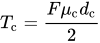
If the leadscrew has a collar which the load rides on, then the frictional forces between the interface must be accounted for in the torque calculations as well. For the following equation the load is assumed to be concentrated at the mean collar diameter (
d
c
{\displaystyle d_{\text{c}}}
):[14]
Plot of square lead screw efficiency against lead angle for different coefficients of friction
T
c
=
F
μ
c
d
c
2
{\displaystyle T_{\text{c}}={\frac {F\mu _{\text{c}}d_{\text{c}}}{2}}}
where
μ
c
{\displaystyle \mu _{\text{c}}}
is the coefficient of friction between the collar on the load and
d
c
{\displaystyle d_{\text{c}}}
is the mean collar diameter. For collars that use thrust bearings, the frictional loss is negligible and the above equation can be ignored.[17]
Efficiency for non-zero thread angles can be written as follows:[18]
η
=
cos
α
−
μ
tan
λ
cos
α
+
μ
cot
λ
{\displaystyle \eta ={\frac {\cos \alpha \ -\ \mu \tan \lambda }{\cos \alpha \ +\ \mu \cot \lambda }}}
Safe running speeds for various nut materials and loads on a steel screw[19]
Nut material
Safe loads (psi)
Safe loads (bar)
Speed (fpm)
Speed (m/s)
Bronze
2,500–3,500psi
170–240bar
Low speed
Bronze
1,600–2,500psi
110–170bar
10 fpm
0.05m/s
Cast iron
1,800–2,500psi
120–170bar
8 fpm
0.04m/s
Bronze
800–1,400psi
55–97bar
20–40 fpm
0.10–0.20m/s
Cast iron
600–1,000psi
41–69bar
20–40 fpm
0.10–0.20m/s
Bronze
150–240psi
10–17bar
50 fpm
0.25m/s
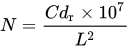
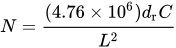
The running speed for a leadscrew (or ball screw) is typically limited to, at most, 80% of the calculated critical speed. The critical speed is the speed that excites the natural frequency of the screw. For a steel leadscrew or steel ballscrew, the critical speed is approximately[20]
N
=
(
4.76
×
10
6
)
d
r
C
L
2
{\displaystyle N={(4.76\times 10^{6})d_{\text{r}}C \over L^{2}}}
where
N
{\displaystyle N}
= critical speed in RPM
d
r
{\displaystyle d_{\text{r}}}
= smallest (root) diameter of the leadscrew in inches
L
{\displaystyle L}
= length between bearing supports in inches
C
{\displaystyle C}
= .36 for one end fixed, one end free
C
{\displaystyle C}
= 1.00 for both ends simple
C
{\displaystyle C}
= 1.47 for one end fixed, one end simple
US 5499942,Pflager, William W.,"Hydrostatic nut and lead screw assembly, and method of forming said nut",published 1996-03-19, assigned to Western Atlas Inc.
Childs, Peter R. N. (24 November 2018). Mechanical design engineering handbook (Seconded.). Oxford, United Kingdom. p.803. ISBN978-0-08-102368-6. OCLC1076269063.{{cite book}}: CS1 maint: location missing publisher (link)
Moritz, Frederick G. F. (2014). Electromechanical motion systems: design and simulation. Chichester, England: Wiley. p.121. ISBN978-1-118-35967-9. OCLC873995457.
Martin, Joe (2004), Tabletop Machining: A Basic Approach to Making Small Parts on Miniature Machine Tools, Vista, California, USA: Sherline, Inc., ISBN978-0-9665433-0-8. Originally published in 1998; content updated with each print run, similar to a "revised edition". Currently in the fourth print run.




= torque
= load on the screw
= mean diameter
= coefficient of friction (common values are found in the adjacent table)
= lead
= angle of friction
= lead angle









= critical speed in RPM
= smallest (root) diameter of the leadscrew in inches
= length between bearing supports in inches
= .36 for one end fixed, one end free