In algebra, a locally compact field is a topological field whose topology forms a locally compact Hausdorff space.[1] These kinds of fields were originally introduced in p-adic analysis since the fields
Q
p
{\displaystyle \mathbb {Q} _{p}}


Structure
Finite dimensional vector spaces
One of the useful structure theorems for vector spaces over locally compact fields is that the finite dimensional vector spaces have only one equivalence class of norms: the sup norm.[2] pg. 58-59
Finite field extensions
Given a finite field extension
K
/
F
{\displaystyle K/F}


| f | K = | f | F {\displaystyle |f|_{K}=|f|_{F}}

for all
f
∈
K
{\displaystyle f\in K}


‖ x ‖ 1 < ‖ x ‖ 2 {\displaystyle \|x\|_{1}<\|x\|_{2}}

then for a fixed constant
c
1
{\displaystyle c_{1}}


( ‖ x ‖ 1 ‖ x ‖ 2 ) N < 1 c 1 {\displaystyle \left({\frac {\|x\|_{1}}{\|x\|_{2}}}\right)^{N}<{\frac {1}{c_{1}}}}

for all
N
≥
N
0
{\displaystyle N\geq N_{0}}


Finite Galois extensions
If the extension is of degree
n
=
[
K
:
F
]
{\displaystyle n=[K:F]}
![{\displaystyle n=[K:F]}](https://wikimedia.org/api/rest_v1/media/math/render/svg/b4e03baa87063bfd9df9f2702dea72a0a646724a)

| a | K = | N K / F ( a ) | 1 / n {\displaystyle |a|_{K}=|N_{K/F}(a)|^{1/n}}

Note the n-th root is required in order to have a well-defined field norm extending the one over
F
{\displaystyle F}
N K / F ( f ) = det m f = f n {\displaystyle N_{K/F}(f)=\det m_{f}=f^{n}}

since it acts as scalar multiplication on the
F
{\displaystyle F}
Examples
Finite fields
All finite fields are locally compact since they can be equipped with the discrete topology. In particular, any field with the discrete topology is locally compact since every point is the neighborhood of itself, and also the closure of the neighborhood, hence is compact.
Local fields
The main examples of locally compact fields are the p-adic rationals
Q
p
{\displaystyle \mathbb {Q} _{p}}


Field extensions of Qp
Field extensions
K
/
Q
p
{\displaystyle K/\mathbb {Q} _{p}}


d d x ( x 2 − 5 ) = 2 x {\displaystyle {\frac {d}{dx}}(x^{2}-5)=2x}
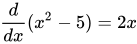
only equals zero mod
p
{\displaystyle p}


See also
- Complete field
- Locally compact group – Type of topological group in mathematics
- Ramification of local fields
- Topological abelian group
- Topological group – Group that is a topological space with continuous group operations
- Topological ring
References
- Narici, Lawrence (1971), Functional Analysis and Valuation Theory, CRC Press, pp. 21–22, ISBN 9780824714840.
- Koblitz, Neil. p-adic Numbers, p-adic Analysis, and Zeta-Functions. pp. 57–74.
External links
- Inequality trick https://math.stackexchange.com/a/2252625