Locally constant sheaf

☆ Save On Wikipedia ↗

In algebraic topology, a locally constant sheaf on a topological space X is a sheaf F {\displaystyle {\mathcal {F}}} {\displaystyle {\mathcal {F}}} on X such that for each x in X, there is an open neighborhood U of x such that the restriction F | U {\displaystyle {\mathcal {F}}|_{U}} {\displaystyle {\mathcal {F}}|_{U}} is a constant sheaf on U. It is also called a local system. When X is a stratified space, a constructible sheaf is roughly a sheaf that is locally constant on each member of the stratification.

A basic example is the orientation sheaf on a manifold since each point of the manifold admits an orientable open neighborhood (while the manifold itself may not be orientable).

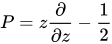
For another example, let X = C {\displaystyle X=\mathbb {C} } {\displaystyle X=\mathbb {C} }, O X {\displaystyle {\mathcal {O}}_{X}} {\displaystyle {\mathcal {O}}_{X}} be the sheaf of holomorphic functions on X and P : O X → O X {\displaystyle P:{\mathcal {O}}_{X}\to {\mathcal {O}}_{X}} {\displaystyle P:{\mathcal {O}}_{X}\to {\mathcal {O}}_{X}} given by P = z ∂ ∂ z − 1 2 {\displaystyle P=z{\partial \over \partial z}-{1 \over 2}} {\displaystyle P=z{\partial  \over \partial z}-{1 \over 2}}. Then the kernel of P is a locally constant sheaf on X − { 0 } {\displaystyle X-\{0\}} {\displaystyle X-\{0\}} but not constant there (since it has no nonzero global section).[1]

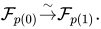
If F {\displaystyle {\mathcal {F}}} {\displaystyle {\mathcal {F}}} is a locally constant sheaf of sets on a space X, then each path p : [ 0 , 1 ] → X {\displaystyle p:[0,1]\to X} {\displaystyle p:[0,1]\to X} in X determines a bijection F p ( 0 ) → ∼ F p ( 1 ) . {\displaystyle {\mathcal {F}}_{p(0)}{\overset {\sim }{\to }}{\mathcal {F}}_{p(1)}.} {\displaystyle {\mathcal {F}}_{p(0)}{\overset {\sim }{\to }}{\mathcal {F}}_{p(1)}.} Moreover, two homotopic paths determine the same bijection. Hence, there is the well-defined functor

Π 1 X → S e t , x ↦ F x {\displaystyle \Pi _{1}X\to \mathbf {Set} ,\,x\mapsto {\mathcal {F}}_{x}} {\displaystyle \Pi _{1}X\to \mathbf {Set} ,\,x\mapsto {\mathcal {F}}_{x}}

where Π 1 X {\displaystyle \Pi _{1}X} {\displaystyle \Pi _{1}X} is the fundamental groupoid of X: the category whose objects are points of X and whose morphisms are homotopy classes of paths. Moreover, if X is path-connected, locally path-connected and semi-locally simply connected (so X has a universal cover), then every functor Π 1 X → S e t {\displaystyle \Pi _{1}X\to \mathbf {Set} } {\displaystyle \Pi _{1}X\to \mathbf {Set} } is of the above form; i.e., the functor category F c t ( Π 1 X , S e t ) {\displaystyle \mathbf {Fct} (\Pi _{1}X,\mathbf {Set} )} {\displaystyle \mathbf {Fct} (\Pi _{1}X,\mathbf {Set} )} is equivalent to the category of locally constant sheaves on X.

If X is locally connected, the adjunction between the category of presheaves and bundles restricts to an equivalence between the category of locally constant sheaves and the category of covering spaces of X.[2][3]

References

  1. Kashiwara & Schapira 2002, Example 2.9.14.
  2. Szamuely, Tamás (2009). "Fundamental Groups in Topology". Galois Groups and Fundamental Groups. Cambridge University Press. p. 57. ISBN 9780511627064.
  3. Mac Lane, Saunders; Moerdijk, Ieke (1992). "Sheaves of sets". Sheaves in geometry and logic : a first introduction to topos theory. New York: Springer-Verlag. p. 104. ISBN 0-387-97710-4. OCLC 24428855.