Log area ratios (LAR) can be used to represent reflection coefficients (another form for linear prediction coefficients)[1] for transmission over a channel.[2] While not as efficient as line spectral pairs (LSPs), log area ratios are much simpler to compute. Let
r
k
{\displaystyle r_{k}}

-
A
k
=
log
1
−
r
k
1
+
r
k
{\displaystyle A_{k}=\log {1-r_{k} \over 1+r_{k}}}
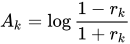
Use of Log Area Ratios have now been mostly replaced by Line Spectral Pairs, but older codecs, such as GSM-FR use LARs.
See also
References
- Chow, David; Abdulla, Waleed (January 2004). Speaker Identification Based on Log Area Ratio and Gaussian Mixture Models in Narrow-Band Speech: Speech Understanding / Interaction. Lecture Notes in Computer Science. Vol. 3157. pp. 901–908. doi:10.1007/978-3-540-28633-2_95. ISBN 978-3-540-22817-2 – via ResearchGate.
- Strube, H. (October 1977). "Synthesis part of a "Log area ratio" vocoder in analog hardware". IEEE Transactions on Acoustics, Speech, and Signal Processing. 25 (5): 387–391. doi:10.1109/TASSP.1977.1162984. ISSN 0096-3518.
- Gutierrez-Osuna, Ricardo. "L7: Linear prediction of speech" (PDF). Introduction to Speech Processing | Ricardo Gutierrez-Osuna | CSE@TAMU. p. 24.