| Named after | Theodore Motzkin |
|---|---|
| Publication year | 1948 |
| Author of publication | Theodore Motzkin |
| No. of known terms | infinity |
| Formula | see Properties |
| First terms | 1, 1, 2, 4, 9, 21, 51 |
| OEIS index |
|
In mathematics, the nth Motzkin number is the number of different ways of drawing non-intersecting chords between n points on a circle (not necessarily touching every point by a chord). The Motzkin numbers are named after Theodore Motzkin and have diverse applications in geometry, combinatorics and number theory.
The Motzkin numbers
M
n
{\displaystyle M_{n}}


Examples
The following figure shows the 9 ways to draw non-intersecting chords between 4 points on a circle (M4 = 9):

The following figure shows the 21 ways to draw non-intersecting chords between 5 points on a circle (M5 = 21):

Properties
The Motzkin numbers satisfy the recurrence relations
-
M
n
=
M
n
−
1
+
∑
i
=
0
n
−
2
M
i
M
n
−
2
−
i
=
2
n
+
1
n
+
2
M
n
−
1
+
3
n
−
3
n
+
2
M
n
−
2
.
{\displaystyle M_{n}=M_{n-1}+\sum _{i=0}^{n-2}M_{i}M_{n-2-i}={\frac {2n+1}{n+2}}M_{n-1}+{\frac {3n-3}{n+2}}M_{n-2}.}

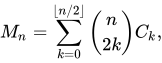
The Motzkin numbers can be expressed in terms of binomial coefficients and Catalan numbers:
-
M
n
=
∑
k
=
0
⌊
n
/
2
⌋
(
n
2
k
)
C
k
,
{\displaystyle M_{n}=\sum _{k=0}^{\lfloor n/2\rfloor }{\binom {n}{2k}}C_{k},}
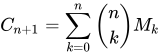
and inversely,[1]
-
C
n
+
1
=
∑
k
=
0
n
(
n
k
)
M
k
{\displaystyle C_{n+1}=\sum _{k=0}^{n}{\binom {n}{k}}M_{k}}
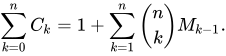
This gives
-
∑
k
=
0
n
C
k
=
1
+
∑
k
=
1
n
(
n
k
)
M
k
−
1
.
{\displaystyle \sum _{k=0}^{n}C_{k}=1+\sum _{k=1}^{n}{\binom {n}{k}}M_{k-1}.}
The generating function
m
(
x
)
=
∑
n
=
0
∞
M
n
x
n
{\displaystyle m(x)=\sum _{n=0}^{\infty }M_{n}x^{n}}

-
x
2
m
(
x
)
2
+
(
x
−
1
)
m
(
x
)
+
1
=
0
{\displaystyle x^{2}m(x)^{2}+(x-1)m(x)+1=0}

and is explicitly expressed as
-
m
(
x
)
=
1
−
x
−
1
−
2
x
−
3
x
2
2
x
2
.
{\displaystyle m(x)={\frac {1-x-{\sqrt {1-2x-3x^{2}}}}{2x^{2}}}.}

An integral representation of Motzkin numbers is given by
-
M
n
=
2
π
∫
0
π
sin
(
x
)
2
(
2
cos
(
x
)
+
1
)
n
d
x
{\displaystyle M_{n}={\frac {2}{\pi }}\int _{0}^{\pi }\sin(x)^{2}(2\cos(x)+1)^{n}dx}
.
They have the asymptotic behaviour
-
M
n
∼
1
2
π
(
3
n
)
3
/
2
3
n
,
n
→
∞
{\displaystyle M_{n}\sim {\frac {1}{2{\sqrt {\pi }}}}\left({\frac {3}{n}}\right)^{3/2}3^{n},~n\to \infty }
.
A Motzkin prime is a Motzkin number that is prime. Four such primes are known:
Combinatorial interpretations
The Motzkin number for n is also the number of positive integer sequences of length n − 1 in which the opening and ending elements are either 1 or 2, and the difference between any two consecutive elements is −1, 0 or 1. Equivalently, the Motzkin number for n is the number of positive integer sequences of length n + 1 in which the opening and ending elements are 1, and the difference between any two consecutive elements is −1, 0 or 1.
Also, the Motzkin number for n gives the number of routes on the upper right quadrant of a grid from coordinate (0, 0) to coordinate (n, 0) in n steps if one is allowed to move only to the right (up, down or straight) at each step but forbidden from dipping below the y = 0 axis.
For example, the following figure shows the 9 valid Motzkin paths from (0, 0) to (4, 0):

There are at least fourteen different manifestations of Motzkin numbers in different branches of mathematics, as enumerated by Donaghey & Shapiro (1977) in their survey of Motzkin numbers. Guibert, Pergola & Pinzani (2001) showed that vexillary involutions are enumerated by Motzkin numbers.
See also
- Telephone number which represent the number of ways of drawing chords if intersections are allowed
- Delannoy number
- Narayana number
- Schröder number
References
- Yi Wang and Zhi-Hai Zhang (2015). "Combinatorics of Generalized Motzkin Numbers" (PDF). Journal of Integer Sequences (18).
- Bernhart, Frank R. (1999), "Catalan, Motzkin, and Riordan numbers", Discrete Mathematics, 204 (1–3): 73–112, doi:10.1016/S0012-365X(99)00054-0
- Donaghey, R.; Shapiro, L. W. (1977), "Motzkin numbers", Journal of Combinatorial Theory, Series A, 23 (3): 291–301, doi:10.1016/0097-3165(77)90020-6, MR 0505544
- Guibert, O.; Pergola, E.; Pinzani, R. (2001), "Vexillary involutions are enumerated by Motzkin numbers", Annals of Combinatorics, 5 (2): 153–174, doi:10.1007/PL00001297, ISSN 0218-0006, MR 1904383, S2CID 123053532
- Motzkin, T. S. (1948), "Relations between hypersurface cross ratios, and a combinatorial formula for partitions of a polygon, for permanent preponderance, and for non-associative products", Bulletin of the American Mathematical Society, 54 (4): 352–360, doi:10.1090/S0002-9904-1948-09002-4