The mountain pass theorem is an existence theorem from the calculus of variations, originally due to Antonio Ambrosetti and Paul Rabinowitz.[1][2] Given certain conditions on a function, the theorem demonstrates the existence of a saddle point. The theorem is unusual in that there are many other theorems regarding the existence of extrema, but few regarding saddle points.
Statement
The assumptions of the theorem are:
-
I
{\displaystyle I}
is a functional from a Hilbert space H to the reals,
-
I
∈
C
1
(
H
,
R
)
{\displaystyle I\in C^{1}(H,\mathbb {R} )}
and I ′ {\displaystyle I'}
is Lipschitz continuous on bounded subsets of H,
-
I
{\displaystyle I}
-
I
[
0
]
=
0
{\displaystyle I[0]=0}
,
- there exist positive constants r and a such that
I
[
u
]
≥
a
{\displaystyle I[u]\geq a}
if ‖ u ‖ = r {\displaystyle \Vert u\Vert =r}
, and
- there exists
v
∈
H
{\displaystyle v\in H}
with ‖ v ‖ > r {\displaystyle \Vert v\Vert >r}
such that I [ v ] ≤ 0 {\displaystyle I[v]\leq 0}
.
If we define:
-
Γ
=
{
g
∈
C
(
[
0
,
1
]
;
H
)
|
g
(
0
)
=
0
,
g
(
1
)
=
v
}
{\displaystyle \Gamma =\{\mathbf {g} \in C([0,1];H)\,\vert \,\mathbf {g} (0)=0,\mathbf {g} (1)=v\}}

and:
-
c
=
inf
g
∈
Γ
max
0
≤
t
≤
1
I
[
g
(
t
)
]
,
{\displaystyle c=\inf _{\mathbf {g} \in \Gamma }\max _{0\leq t\leq 1}I[\mathbf {g} (t)],}
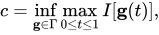
then the conclusion of the theorem is that c is a critical value of I.
Visualization
The intuition behind the theorem is in the name "mountain pass." Consider I as describing elevation. Then we know two low spots in the landscape: the origin because
I
[
0
]
=
0
{\displaystyle I[0]=0}
For a proof, see section 8.5 of Evans.
Weaker formulation
Let
X
{\displaystyle X}

-
Φ
∈
C
(
X
,
R
)
{\displaystyle \Phi \in C(X,\mathbf {R} )}
and have a Gateaux derivative Φ ′ : X → X ∗ {\displaystyle \Phi '\colon X\to X^{*}}
which is continuous when X {\displaystyle X}
are endowed with strong topology and weak* topology respectively.
- There exists
r
>
0
{\displaystyle r>0}
such that one can find certain ‖ x ′ ‖ > r {\displaystyle \|x'\|>r}
with
-
max
(
Φ
(
0
)
,
Φ
(
x
′
)
)
<
inf
‖
x
‖
=
r
Φ
(
x
)
=:
m
(
r
)
{\displaystyle \max \,(\Phi (0),\Phi (x'))<\inf \limits _{\|x\|=r}\Phi (x)=:m(r)}
.
-
Φ
{\displaystyle \Phi }
satisfies weak Palais–Smale condition on { x ∈ X ∣ m ( r ) ≤ Φ ( x ) } {\displaystyle \{x\in X\mid m(r)\leq \Phi (x)\}}
.
In this case there is a critical point
x
¯
∈
X
{\displaystyle {\overline {x}}\in X}


-
Γ
=
{
c
∈
C
(
[
0
,
1
]
,
X
)
∣
c
(
0
)
=
0
,
c
(
1
)
=
x
′
}
{\displaystyle \Gamma =\{c\in C([0,1],X)\mid c\,(0)=0,\,c\,(1)=x'\}}

then
-
Φ
(
x
¯
)
=
inf
c
∈
Γ
max
0
≤
t
≤
1
Φ
(
c
(
t
)
)
.
{\displaystyle \Phi ({\overline {x}})=\inf _{c\,\in \,\Gamma }\max _{0\leq t\leq 1}\Phi (c\,(t)).}

For a proof, see section 5.5 of Aubin and Ekeland.
References
- Ambrosetti, Antonio; Rabinowitz, Paul H. (1973). "Dual variational methods in critical point theory and applications". Journal of Functional Analysis. 14 (4): 349–381. doi:10.1016/0022-1236(73)90051-7.
- Rabinowitz, Paul H. (1982). "The Mountain Pass Theorem: Theme and Variations". In de Figueiredo, D. G.; Hönig, C. S. (eds.). Differential Equations: Proceedings of the 1st Latin American School of Differential Equations. Lecture Notes in Mathematics. Vol. 957. New York: Springer. pp. 237–271. ISBN 0-387-11951-5.
Further reading
- Aubin, Jean-Pierre; Ekeland, Ivar (2006). Applied Nonlinear Analysis. Dover Books. ISBN 0-486-45324-3.
- Bisgard, James (2015). "Mountain Passes and Saddle Points". SIAM Review. 57 (2): 275–292. doi:10.1137/140963510.
- Evans, Lawrence C. (1998). Partial Differential Equations. Providence, Rhode Island: American Mathematical Society. ISBN 0-8218-0772-2.
- Jabri, Youssef (2003). The Mountain Pass Theorem, Variants, Generalizations and Some Applications. Encyclopedia of Mathematics and its Applications. Cambridge University Press. ISBN 0-521-82721-3.
- Mawhin, Jean; Willem, Michel (1989). "The Mountain Pass Theorem and Periodic Solutions of Superlinear Convex Autonomous Hamiltonian Systems". Critical Point Theory and Hamiltonian Systems. New York: Springer-Verlag. pp. 92–97. ISBN 0-387-96908-X.
- McOwen, Robert C. (1996). "Mountain Passes and Saddle Points". Partial Differential Equations: Methods and Applications. Upper Saddle River, NJ: Prentice Hall. pp. 206–208. ISBN 0-13-121880-8.