| Noncentral Beta | |||
|---|---|---|---|
| Notation | Beta(α, β, λ) | ||
| Parameters |
α > 0 shape (real) β > 0 shape (real) λ ≥ 0 noncentrality (real) | ||
| Support |
x
∈
[
0
;
1
]
{\displaystyle x\in [0;1]\!}
![{\displaystyle x\in [0;1]\!}](https://wikimedia.org/api/rest_v1/media/math/render/svg/394f69db847ba283727b0bc73bccc019572a72ae) | ||
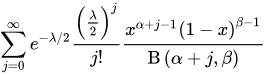
(type I)
∑
j
=
0
∞
e
−
λ
/
2
(
λ
2
)
j
j
!
x
α
+
j
−
1
(
1
−
x
)
β
−
1
B
(
α
+
j
,
β
)
{\displaystyle \sum _{j=0}^{\infty }e^{-\lambda /2}{\frac {\left({\frac {\lambda }{2}}\right)^{j}}{j!}}{\frac {x^{\alpha +j-1}\left(1-x\right)^{\beta -1}}{\mathrm {B} \left(\alpha +j,\beta \right)}}}
 | |||
| CDF |
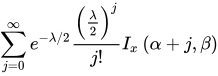
(type I)
∑
j
=
0
∞
e
−
λ
/
2
(
λ
2
)
j
j
!
I
x
(
α
+
j
,
β
)
{\displaystyle \sum _{j=0}^{\infty }e^{-\lambda /2}{\frac {\left({\frac {\lambda }{2}}\right)^{j}}{j!}}I_{x}\left(\alpha +j,\beta \right)}
 | ||
| Mean |
(type I)
e
−
λ
2
Γ
(
α
+
1
)
Γ
(
α
)
Γ
(
α
+
β
)
Γ
(
α
+
β
+
1
)
2
F
2
(
α
+
β
,
α
+
1
;
α
,
α
+
β
+
1
;
λ
2
)
{\displaystyle e^{-{\frac {\lambda }{2}}}{\frac {\Gamma \left(\alpha +1\right)}{\Gamma \left(\alpha \right)}}{\frac {\Gamma \left(\alpha +\beta \right)}{\Gamma \left(\alpha +\beta +1\right)}}{}_{2}F_{2}\left(\alpha +\beta ,\alpha +1;\alpha ,\alpha +\beta +1;{\frac {\lambda }{2}}\right)}
 (see Confluent hypergeometric function) (see Confluent hypergeometric function) | ||
| Variance |
(type I)
e
−
λ
2
Γ
(
α
+
2
)
Γ
(
α
)
Γ
(
α
+
β
)
Γ
(
α
+
β
+
2
)
2
F
2
(
α
+
β
,
α
+
2
;
α
,
α
+
β
+
2
;
λ
2
)
−
μ
2
{\displaystyle e^{-{\frac {\lambda }{2}}}{\frac {\Gamma \left(\alpha +2\right)}{\Gamma \left(\alpha \right)}}{\frac {\Gamma \left(\alpha +\beta \right)}{\Gamma \left(\alpha +\beta +2\right)}}{}_{2}F_{2}\left(\alpha +\beta ,\alpha +2;\alpha ,\alpha +\beta +2;{\frac {\lambda }{2}}\right)-\mu ^{2}}
 where
μ
{\displaystyle \mu } where
μ
{\displaystyle \mu }
 is the mean. (see Confluent hypergeometric function) is the mean. (see Confluent hypergeometric function) | ||
In probability theory and statistics, the noncentral beta distribution is a continuous probability distribution that is a noncentral generalization of the (central) beta distribution.
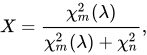
The noncentral beta distribution (Type I) is the distribution of the ratio
-
X
=
χ
m
2
(
λ
)
χ
m
2
(
λ
)
+
χ
n
2
,
{\displaystyle X={\frac {\chi _{m}^{2}(\lambda )}{\chi _{m}^{2}(\lambda )+\chi _{n}^{2}}},}
where
χ
m
2
(
λ
)
{\displaystyle \chi _{m}^{2}(\lambda )}


A Type II noncentral beta distribution is the distribution of the ratio
-
Y
=
χ
n
2
χ
n
2
+
χ
m
2
(
λ
)
,
{\displaystyle Y={\frac {\chi _{n}^{2}}{\chi _{n}^{2}+\chi _{m}^{2}(\lambda )}},}
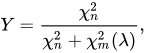
where the noncentral chi-squared variable is in the denominator only.[1] If
Y
{\displaystyle Y}


Cumulative distribution function
The Type I cumulative distribution function is usually represented as a Poisson mixture of central beta random variables:[1]
-
F
(
x
)
=
∑
j
=
0
∞
P
(
j
)
I
x
(
α
+
j
,
β
)
,
{\displaystyle F(x)=\sum _{j=0}^{\infty }P(j)I_{x}(\alpha +j,\beta ),}
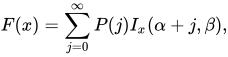
where λ is the noncentrality parameter, P(.) is the Poisson(λ/2) probability mass function, \alpha=m/2 and \beta=n/2 are shape parameters, and
I
x
(
a
,
b
)
{\displaystyle I_{x}(a,b)}

-
F
(
x
)
=
∑
j
=
0
∞
1
j
!
(
λ
2
)
j
e
−
λ
/
2
I
x
(
α
+
j
,
β
)
.
{\displaystyle F(x)=\sum _{j=0}^{\infty }{\frac {1}{j!}}\left({\frac {\lambda }{2}}\right)^{j}e^{-\lambda /2}I_{x}(\alpha +j,\beta ).}

The Type II cumulative distribution function in mixture form is
-
F
(
x
)
=
∑
j
=
0
∞
P
(
j
)
I
x
(
α
,
β
+
j
)
.
{\displaystyle F(x)=\sum _{j=0}^{\infty }P(j)I_{x}(\alpha ,\beta +j).}
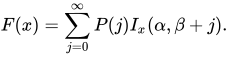
Algorithms for evaluating the noncentral beta distribution functions are given by Posten[2] and Chattamvelli.[1]
Probability density function
The (Type I) probability density function for the noncentral beta distribution is:
-
f
(
x
)
=
∑
j
=
0
∞
1
j
!
(
λ
2
)
j
e
−
λ
/
2
x
α
+
j
−
1
(
1
−
x
)
β
−
1
B
(
α
+
j
,
β
)
.
{\displaystyle f(x)=\sum _{j=0}^{\infty }{\frac {1}{j!}}\left({\frac {\lambda }{2}}\right)^{j}e^{-\lambda /2}{\frac {x^{\alpha +j-1}(1-x)^{\beta -1}}{B(\alpha +j,\beta )}}.}

where
B
{\displaystyle B}


Related distributions
Transformations
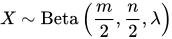
If
X
∼
Beta
(
α
,
β
,
λ
)
{\displaystyle X\sim {\mbox{Beta}}\left(\alpha ,\beta ,\lambda \right)}



If
X
{\displaystyle X}


-
Z
=
μ
2
μ
1
μ
2
μ
1
+
X
−
1
{\displaystyle Z={\cfrac {\cfrac {\mu _{2}}{\mu _{1}}}{{\cfrac {\mu _{2}}{\mu _{1}}}+X^{-1}}}}

follows a noncentral Beta distribution:
-
Z
∼
Beta
(
1
2
μ
1
,
1
2
μ
2
,
λ
)
{\displaystyle Z\sim {\mbox{Beta}}\left({\frac {1}{2}}\mu _{1},{\frac {1}{2}}\mu _{2},\lambda \right)}
.
This is derived from making a straightforward transformation.
Special cases
When
λ
=
0
{\displaystyle \lambda =0}

References
Citations
- Chattamvelli, R. (1995). "A Note on the Noncentral Beta Distribution Function". The American Statistician. 49 (2): 231–234. doi:10.1080/00031305.1995.10476151.
- Posten, H.O. (1993). "An Effective Algorithm for the Noncentral Beta Distribution Function". The American Statistician. 47 (2): 129–131. doi:10.1080/00031305.1993.10475957. JSTOR 2685195.
Sources
- M. Abramowitz and I. Stegun, editors (1965) "Handbook of Mathematical Functions", Dover: New York, NY.
- Hodges, J.L. Jr (1955). "On the noncentral beta-distribution". Annals of Mathematical Statistics. 26 (4): 648–653. doi:10.1214/aoms/1177728424.
- Seber, G.A.F. (1963). "The non-central chi-squared and beta distributions". Biometrika. 50 (3–4): 542–544. doi:10.1093/biomet/50.3-4.542.
- Christian Walck, "Hand-book on Statistical Distributions for experimentalists."