The Onsager–Machlup function is a function that summarizes the dynamics of a continuous stochastic process. It is used to define a probability density for a stochastic process, and it is similar to the Lagrangian of a dynamical system. It is named after Lars Onsager and Stefan Machlup who were the first to consider such probability densities.[1]
The dynamics of a continuous stochastic process X from time t = 0 to t = T in one dimension, satisfying a stochastic differential equation
-
d
X
t
=
b
(
X
t
)
d
t
+
σ
(
X
t
)
d
W
t
{\displaystyle dX_{t}=b(X_{t})\,dt+\sigma (X_{t})\,dW_{t}}

where W is a Wiener process, can in approximation be described by the probability density function of its value xi at a finite number of points in time ti:
-
p
(
x
1
,
…
,
x
n
)
=
(
∏
i
=
1
n
−
1
1
2
π
σ
(
x
i
)
2
Δ
t
i
)
exp
(
−
∑
i
=
1
n
−
1
L
(
x
i
,
x
i
+
1
−
x
i
Δ
t
i
)
Δ
t
i
)
{\displaystyle p(x_{1},\ldots ,x_{n})=\left(\prod _{i=1}^{n-1}{\frac {1}{\sqrt {2\pi \sigma (x_{i})^{2}\Delta t_{i}}}}\right)\exp \left(-\sum _{i=1}^{n-1}L\left(x_{i},{\frac {x_{i+1}-x_{i}}{\Delta t_{i}}}\right)\,\Delta t_{i}\right)}

where
-
L
(
x
,
v
)
=
1
2
(
v
−
b
(
x
)
σ
(
x
)
)
2
{\displaystyle L(x,v)={\frac {1}{2}}\left({\frac {v-b(x)}{\sigma (x)}}\right)^{2}}
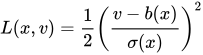
and Δti = ti+1 − ti > 0, t1 = 0 and tn = T. A similar approximation is possible for processes in higher dimensions. The approximation is more accurate for smaller time step sizes Δti, but in the limit Δti → 0 the probability density function becomes ill-defined, one reason being that the product of terms
-
1
2
π
σ
(
x
i
)
2
Δ
t
i
{\displaystyle {\frac {1}{\sqrt {2\pi \sigma (x_{i})^{2}\Delta t_{i}}}}}
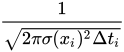
diverges to infinity. In order to nevertheless define a density for the continuous stochastic process X, ratios of probabilities of X lying within a small distance ε from smooth curves φ1 and φ2 are considered:[2]
-
P
(
|
X
t
−
φ
1
(
t
)
|
≤
ε
for every
t
∈
[
0
,
T
]
)
P
(
|
X
t
−
φ
2
(
t
)
|
≤
ε
for every
t
∈
[
0
,
T
]
)
→
exp
(
−
∫
0
T
L
(
φ
1
(
t
)
,
φ
˙
1
(
t
)
)
d
t
+
∫
0
T
L
(
φ
2
(
t
)
,
φ
˙
2
(
t
)
)
d
t
)
{\displaystyle {\frac {P\left(\left|X_{t}-\varphi _{1}(t)\right|\leq \varepsilon {\text{ for every }}t\in [0,T]\right)}{P\left(\left|X_{t}-\varphi _{2}(t)\right|\leq \varepsilon {\text{ for every }}t\in [0,T]\right)}}\to \exp \left(-\int _{0}^{T}L\left(\varphi _{1}(t),{\dot {\varphi }}_{1}(t)\right)\,dt+\int _{0}^{T}L\left(\varphi _{2}(t),{\dot {\varphi }}_{2}(t)\right)\,dt\right)}
![{\displaystyle {\frac {P\left(\left|X_{t}-\varphi _{1}(t)\right|\leq \varepsilon {\text{ for every }}t\in [0,T]\right)}{P\left(\left|X_{t}-\varphi _{2}(t)\right|\leq \varepsilon {\text{ for every }}t\in [0,T]\right)}}\to \exp \left(-\int _{0}^{T}L\left(\varphi _{1}(t),{\dot {\varphi }}_{1}(t)\right)\,dt+\int _{0}^{T}L\left(\varphi _{2}(t),{\dot {\varphi }}_{2}(t)\right)\,dt\right)}](https://wikimedia.org/api/rest_v1/media/math/render/svg/ac20fddc7b4b35007fd6f1fdad2fa15c7f5a16a7)
as ε → 0, where L is the Onsager–Machlup function.
Definition
Consider a d-dimensional Riemannian manifold M and a diffusion process X = {Xt : 0 ≤ t ≤ T} on M with infinitesimal generator 1/2ΔM + b, where ΔM is the Laplace–Beltrami operator and b is a vector field. For any two smooth curves φ1, φ2 : [0, T] → M,
-
lim
ε
↓
0
P
(
ρ
(
X
t
,
φ
1
(
t
)
)
≤
ε
for every
t
∈
[
0
,
T
]
)
P
(
ρ
(
X
t
,
φ
2
(
t
)
)
≤
ε
for every
t
∈
[
0
,
T
]
)
=
exp
(
−
∫
0
T
L
(
φ
1
(
t
)
,
φ
˙
1
(
t
)
)
d
t
+
∫
0
T
L
(
φ
2
(
t
)
,
φ
˙
2
(
t
)
)
d
t
)
{\displaystyle \lim _{\varepsilon \downarrow 0}{\frac {P\left(\rho (X_{t},\varphi _{1}(t))\leq \varepsilon {\text{ for every }}t\in [0,T]\right)}{P\left(\rho (X_{t},\varphi _{2}(t))\leq \varepsilon {\text{ for every }}t\in [0,T]\right)}}=\exp \left(-\int _{0}^{T}L\left(\varphi _{1}(t),{\dot {\varphi }}_{1}(t)\right)\,dt+\int _{0}^{T}L\left(\varphi _{2}(t),{\dot {\varphi }}_{2}(t)\right)\,dt\right)}
![{\displaystyle \lim _{\varepsilon \downarrow 0}{\frac {P\left(\rho (X_{t},\varphi _{1}(t))\leq \varepsilon {\text{ for every }}t\in [0,T]\right)}{P\left(\rho (X_{t},\varphi _{2}(t))\leq \varepsilon {\text{ for every }}t\in [0,T]\right)}}=\exp \left(-\int _{0}^{T}L\left(\varphi _{1}(t),{\dot {\varphi }}_{1}(t)\right)\,dt+\int _{0}^{T}L\left(\varphi _{2}(t),{\dot {\varphi }}_{2}(t)\right)\,dt\right)}](https://wikimedia.org/api/rest_v1/media/math/render/svg/7e4eccad0ef1264fab2d06402d8b6401c514fd0b)
where ρ is the Riemannian distance,
φ
˙
1
,
φ
˙
2
{\displaystyle \scriptstyle {\dot {\varphi }}_{1},{\dot {\varphi }}_{2}}

The Onsager–Machlup function is given by[3][4][5]
-
L
(
x
,
v
)
=
1
2
‖
v
−
b
(
x
)
‖
x
2
+
1
2
div
b
(
x
)
−
1
12
R
(
x
)
,
{\displaystyle L(x,v)={\tfrac {1}{2}}\|v-b(x)\|_{x}^{2}+{\tfrac {1}{2}}\operatorname {div} \,b(x)-{\tfrac {1}{12}}R(x),}

where || ⋅ ||x is the Riemannian norm in the tangent space Tx(M) at x, div b(x) is the divergence of b at x, and R(x) is the scalar curvature at x.
Examples
The following examples give explicit expressions for the Onsager–Machlup function of a continuous stochastic processes.
Wiener process on the real line
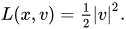
The Onsager–Machlup function of a Wiener process on the real line R is given by[6]
-
L
(
x
,
v
)
=
1
2
|
v
|
2
.
{\displaystyle L(x,v)={\tfrac {1}{2}}|v|^{2}.}
Proof: Let X = {Xt : 0 ≤ t ≤ T} be a Wiener process on R and let φ : [0, T] → R be a twice differentiable curve such that φ(0) = X0. Define another process Xφ = {Xtφ : 0 ≤ t ≤ T} by Xtφ = Xt − φ(t) and a measure Pφ by
-
P
φ
=
exp
(
∫
0
T
φ
˙
(
t
)
d
X
t
φ
+
∫
0
T
1
2
|
φ
˙
(
t
)
|
2
d
t
)
d
P
.
{\displaystyle P^{\varphi }=\exp \left(\int _{0}^{T}{\dot {\varphi }}(t)\,dX_{t}^{\varphi }+\int _{0}^{T}{\tfrac {1}{2}}\left|{\dot {\varphi }}(t)\right|^{2}\,dt\right)\,dP.}

For every ε > 0, the probability that |Xt − φ(t)| ≤ ε for every t ∈ [0, T] satisfies
-
P
(
|
X
t
−
φ
(
t
)
|
≤
ε
for every
t
∈
[
0
,
T
]
)
=
P
(
|
X
t
φ
|
≤
ε
for every
t
∈
[
0
,
T
]
)
=
∫
{
|
X
t
φ
|
≤
ε
for every
t
∈
[
0
,
T
]
}
exp
(
−
∫
0
T
φ
˙
(
t
)
d
X
t
φ
−
∫
0
T
1
2
|
φ
˙
(
t
)
|
2
d
t
)
d
P
φ
.
{\displaystyle {\begin{aligned}P\left(\left|X_{t}-\varphi (t)\right|\leq \varepsilon {\text{ for every }}t\in [0,T]\right)&=P\left(\left|X_{t}^{\varphi }\right|\leq \varepsilon {\text{ for every }}t\in [0,T]\right)\\&=\int _{\left\{\left|X_{t}^{\varphi }\right|\leq \varepsilon {\text{ for every }}t\in [0,T]\right\}}\exp \left(-\int _{0}^{T}{\dot {\varphi }}(t)\,dX_{t}^{\varphi }-\int _{0}^{T}{\tfrac {1}{2}}|{\dot {\varphi }}(t)|^{2}\,dt\right)\,dP^{\varphi }.\end{aligned}}}
![{\displaystyle {\begin{aligned}P\left(\left|X_{t}-\varphi (t)\right|\leq \varepsilon {\text{ for every }}t\in [0,T]\right)&=P\left(\left|X_{t}^{\varphi }\right|\leq \varepsilon {\text{ for every }}t\in [0,T]\right)\\&=\int _{\left\{\left|X_{t}^{\varphi }\right|\leq \varepsilon {\text{ for every }}t\in [0,T]\right\}}\exp \left(-\int _{0}^{T}{\dot {\varphi }}(t)\,dX_{t}^{\varphi }-\int _{0}^{T}{\tfrac {1}{2}}|{\dot {\varphi }}(t)|^{2}\,dt\right)\,dP^{\varphi }.\end{aligned}}}](https://wikimedia.org/api/rest_v1/media/math/render/svg/a27a69ad486f04aa6b0ee617cfee2bf70cbb5db3)
By Girsanov's theorem, the distribution of Xφ under Pφ equals the distribution of X under P, hence the latter can be substituted by the former:
-
P
(
|
X
t
−
φ
(
t
)
|
≤
ε
for every
t
∈
[
0
,
T
]
)
=
∫
{
|
X
t
φ
|
≤
ε
for every
t
∈
[
0
,
T
]
}
exp
(
−
∫
0
T
φ
˙
(
t
)
d
X
t
−
∫
0
T
1
2
|
φ
˙
(
t
)
|
2
d
t
)
d
P
.
{\displaystyle P(|X_{t}-\varphi (t)|\leq \varepsilon {\text{ for every }}t\in [0,T])=\int _{\left\{\left|X_{t}^{\varphi }\right|\leq \varepsilon {\text{ for every }}t\in [0,T]\right\}}\exp \left(-\int _{0}^{T}{\dot {\varphi }}(t)\,dX_{t}-\int _{0}^{T}{\tfrac {1}{2}}|{\dot {\varphi }}(t)|^{2}\,dt\right)\,dP.}
![{\displaystyle P(|X_{t}-\varphi (t)|\leq \varepsilon {\text{ for every }}t\in [0,T])=\int _{\left\{\left|X_{t}^{\varphi }\right|\leq \varepsilon {\text{ for every }}t\in [0,T]\right\}}\exp \left(-\int _{0}^{T}{\dot {\varphi }}(t)\,dX_{t}-\int _{0}^{T}{\tfrac {1}{2}}|{\dot {\varphi }}(t)|^{2}\,dt\right)\,dP.}](https://wikimedia.org/api/rest_v1/media/math/render/svg/d1e0e37c0fb20ea063ef490fc234393a1b1edfca)
By Itō's lemma it holds that
-
∫
0
T
φ
˙
(
t
)
d
X
t
=
φ
˙
(
T
)
X
T
−
∫
0
T
φ
¨
(
t
)
X
t
d
t
,
{\displaystyle \int _{0}^{T}{\dot {\varphi }}(t)\,dX_{t}={\dot {\varphi }}(T)X_{T}-\int _{0}^{T}{\ddot {\varphi }}(t)X_{t}\,dt,}

where
φ
¨
{\displaystyle \scriptstyle {\ddot {\varphi }}}

-
lim
ε
↓
0
P
(
|
X
t
−
φ
(
t
)
|
≤
ε
for every
t
∈
[
0
,
T
]
)
P
(
|
X
t
|
≤
ε
for every
t
∈
[
0
,
T
]
)
=
exp
(
−
∫
0
T
1
2
|
φ
˙
(
t
)
|
2
d
t
)
.
{\displaystyle \lim _{\varepsilon \downarrow 0}{\frac {P(|X_{t}-\varphi (t)|\leq \varepsilon {\text{ for every }}t\in [0,T])}{P(|X_{t}|\leq \varepsilon {\text{ for every }}t\in [0,T])}}=\exp \left(-\int _{0}^{T}{\tfrac {1}{2}}|{\dot {\varphi }}(t)|^{2}\,dt\right).}
![{\displaystyle \lim _{\varepsilon \downarrow 0}{\frac {P(|X_{t}-\varphi (t)|\leq \varepsilon {\text{ for every }}t\in [0,T])}{P(|X_{t}|\leq \varepsilon {\text{ for every }}t\in [0,T])}}=\exp \left(-\int _{0}^{T}{\tfrac {1}{2}}|{\dot {\varphi }}(t)|^{2}\,dt\right).}](https://wikimedia.org/api/rest_v1/media/math/render/svg/e72245036143e5c8d12eaa3a2da1874aa21b15dd)
Diffusion processes with constant diffusion coefficient on Euclidean space
The Onsager–Machlup function in the one-dimensional case with constant diffusion coefficient σ is given by[7]
-
L
(
x
,
v
)
=
1
2
|
v
−
b
(
x
)
σ
|
2
+
1
2
d
b
d
x
(
x
)
.
{\displaystyle L(x,v)={\frac {1}{2}}\left|{\frac {v-b(x)}{\sigma }}\right|^{2}+{\frac {1}{2}}{\frac {db}{dx}}(x).}

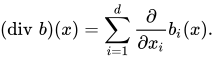
In the d-dimensional case, with σ equal to the unit matrix, it is given by[8]
-
L
(
x
,
v
)
=
1
2
‖
v
−
b
(
x
)
‖
2
+
1
2
(
div
b
)
(
x
)
,
{\displaystyle L(x,v)={\frac {1}{2}}\|v-b(x)\|^{2}+{\frac {1}{2}}(\operatorname {div} \,b)(x),}

where || ⋅ || is the Euclidean norm and
-
(
div
b
)
(
x
)
=
∑
i
=
1
d
∂
∂
x
i
b
i
(
x
)
.
{\displaystyle (\operatorname {div} \,b)(x)=\sum _{i=1}^{d}{\frac {\partial }{\partial x_{i}}}b_{i}(x).}
Generalizations
Generalizations have been obtained by weakening the differentiability condition on the curve φ.[9] Rather than taking the maximum distance between the stochastic process and the curve over a time interval, other conditions have been considered such as distances based on completely convex norms[10] and Hölder, Besov and Sobolev type norms.[11]
Applications
The Onsager–Machlup function can be used for purposes of reweighting and sampling trajectories,[12] as well as for determining the most probable trajectory of a diffusion process.[13][14]
See also
References
- Onsager, L. and Machlup, S. (1953)
- Stratonovich, R. (1971)
- Takahashi, Y. and Watanabe, S. (1980)
- Fujita, T. and Kotani, S. (1982)
- Wittich, Olaf
- Ikeda, N. and Watanabe, S. (1980), Chapter VI, Section 9
- Dürr, D. and Bach, A. (1978)
- Ikeda, N. and Watanabe, S. (1980), Chapter VI, Section 9
- Zeitouni, O. (1989)
- Shepp, L. and Zeitouni, O. (1993)
- Capitaine, M. (1995)
- Adib, A.B. (2008).
- Adib, A.B. (2008).
- Dürr, D. and Bach, A. (1978).
Bibliography
- Adib, A.B. (2008). "Stochastic actions for diffusive dynamics: Reweighting, sampling, and minimization". J. Phys. Chem. B. 112 (19): 5910–5916. arXiv:0712.1255. Bibcode:2008JPCB..112.5910A. doi:10.1021/jp0751458. PMID 17999482. S2CID 16366252.
- Capitaine, M. (1995). "Onsager–Machlup functional for some smooth norms on Wiener space". Probab. Theory Relat. Fields. 102 (2): 189–201. doi:10.1007/bf01213388. S2CID 120675014.
- Dürr, D. & Bach, A. (1978). "The Onsager–Machlup function as Lagrangian for the most probable path of a diffusion process". Commun. Math. Phys. 60 (2): 153–170. Bibcode:1978CMaPh..60..153D. doi:10.1007/bf01609446. S2CID 41249746.
- Fujita, T. & Kotani, S. (1982). "The Onsager–Machlup function for diffusion processes". J. Math. Kyoto Univ. 22: 115–130. doi:10.1215/kjm/1250521863.
- Ikeda, N. & Watanabe, S. (1980). Stochastic differential equations and diffusion processes. Kodansha-John Wiley.
- Onsager, L. & Machlup, S. (1953). "Fluctuations and Irreversible Processes". Physical Review. 91 (6): 1505–1512. Bibcode:1953PhRv...91.1505O. doi:10.1103/physrev.91.1505.
- Shepp, L. & Zeitouni, O. (1993). "Exponential estimates for convex norms and some applications". Barcelona Seminar on Stochastic Analysis. Vol. 32. Berlin: Birkhauser-Verlag. pp. 203–215. CiteSeerX 10.1.1.28.8641. doi:10.1007/978-3-0348-8555-3_11. ISBN 978-3-0348-9677-1.
{{cite book}}: CS1 maint: location missing publisher (link) - Stratonovich, R. (1971). "On the probability functional of diffusion processes". Select. Transl. In Math. Stat. Prob. 10: 273–286.
- Takahashi, Y.; Watanabe, S. (1981). "The probability functionals (Onsager–Machlup functions) of diffusion processes". Stochastic integrals (Proc. Sympos., Univ. Durham, Durham, 1980). Lecture Notes in Mathematics. Vol. 851. Berlin: Springer. pp. 433–463. doi:10.1007/BFb0088735. ISBN 978-3-540-10690-6. MR 0620998.
- Wittich, Olaf. "The Onsager–Machlup Functional Revisited".
{{cite journal}}: Cite journal requires|journal=(help) - Zeitouni, O. (1989). "On the Onsager–Machlup functional of diffusion processes around non C2 curves". Annals of Probability. 17 (3): 1037–1054. doi:10.1214/aop/1176991255.
External links
- Onsager–Machlup function. Encyclopedia of Mathematics. URL: http://www.encyclopediaofmath.org/index.php?title=Onsager-Machlup_function&oldid=22857