
In discrete geometry, the original orchard-planting problem (or the tree-planting problem) asks for the maximum number of 3-point lines attainable by a configuration of a specific number of points in the plane. There are also investigations into how many k-point lines there can be. Hallard T. Croft and Paul Erdős proved
t
k
>
c
n
2
k
3
,
{\displaystyle t_{k}>{\frac {cn^{2}}{k^{3}}},}

Integer sequence

Define
t
3
orchard
(
n
)
{\displaystyle t_{3}^{\text{orchard}}(n)}


The first few values of
t
3
orchard
(
n
)
{\displaystyle t_{3}^{\text{orchard}}(n)}
| n | 4 | 5 | 6 | 7 | 8 | 9 | 10 | 11 | 12 | 13 | 14 |
|---|---|---|---|---|---|---|---|---|---|---|---|
|
t
3
orchard
(
n
)
{\displaystyle t_{3}^{\text{orchard}}(n)}
|
1 | 2 | 4 | 6 | 7 | 10 | 12 | 16 | 19 | 22 | 26 |
Upper and lower bounds
Since no two lines may share two distinct points, a trivial upper-bound for the number of 3-point lines determined by n points is
⌊
(
n
2
)
/
(
3
2
)
⌋
=
⌊
n
2
−
n
6
⌋
.
{\displaystyle \left\lfloor {\binom {n}{2}}{\Big /}{\binom {3}{2}}\right\rfloor =\left\lfloor {\frac {n^{2}-n}{6}}\right\rfloor .}


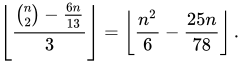
Lower bounds for
t
3
orchard
(
n
)
{\displaystyle t_{3}^{\text{orchard}}(n)}

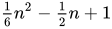
In September 2013, Ben Green and Terence Tao published a paper in which they prove that for all point sets of sufficient size, n > n0, there are at most
n
(
n
−
3
)
6
+
1
=
1
6
n
2
−
1
2
n
+
1
{\displaystyle {\frac {n(n-3)}{6}}+1={\frac {1}{6}}n^{2}-{\frac {1}{2}}n+1}

This is slightly better than the bound that would directly follow from their tight lower bound of
n
2
{\displaystyle {\tfrac {n}{2}}}


Orchard-planting problem has also been considered over finite fields. In this version of the problem, the n points lie in a projective plane defined over a finite field. (Padmanabhan & Shukla 2020).
See also
Notes
- The Handbook of Combinatorics, edited by László Lovász, Ron Graham, et al, in the chapter titled Extremal Problems in Combinatorial Geometry by Paul Erdős and George B. Purdy.
- http://mathworld.wolfram.com/Orchard-PlantingProblem.html
- http://blog.wolfram.com/2018/02/02/cultivating-new-solutions-for-the-orchard-planting-problem
- Green & Tao (2013)
References
- Brass, P.; Moser, W. O. J.; Pach, J. (2005), Research Problems in Discrete Geometry, Springer-Verlag, ISBN 0-387-23815-8.
- Burr, S. A.; Grünbaum, B.; Sloane, N. J. A. (1974), "The Orchard problem", Geometriae Dedicata, 2 (4): 397–424, doi:10.1007/BF00147569, S2CID 120906839.
- Csima, J.; Sawyer, E. (1993), "There exist 6n/13 ordinary points", Discrete and Computational Geometry, 9 (2): 187–202, doi:10.1007/BF02189318.
- Füredi, Z.; Palásti, I. (1984), "Arrangements of lines with a large number of triangles", Proceedings of the American Mathematical Society, 92 (4): 561–566, doi:10.2307/2045427, JSTOR 2045427.
- Green, Ben; Tao, Terence (2013), "On sets defining few ordinary lines", Discrete and Computational Geometry, 50 (2): 409–468, arXiv:1208.4714, doi:10.1007/s00454-013-9518-9, S2CID 15813230
- Padmanabhan, R.; Shukla, Alok (2020), "Orchards in elliptic curves over finite fields", Finite Fields and Their Applications, 68 (2) 101756, arXiv:2003.07172, doi:10.1016/j.ffa.2020.101756, S2CID 212725631