The gamma function is an important special function in mathematics. Its particular values can be expressed in closed form for integer, half-integer, and some other rational arguments, but no simple expressions are known for the values at rational points in general. Other fractional arguments can be approximated through efficient infinite products, infinite series, and recurrence relations.
Integers and half-integers
For positive integer arguments, the gamma function coincides with the factorial. That is,
-
Γ
(
n
)
=
(
n
−
1
)
!
,
{\displaystyle \Gamma (n)=(n-1)!,}

and hence
-
Γ
(
1
)
=
1
,
Γ
(
2
)
=
1
,
Γ
(
3
)
=
2
,
Γ
(
4
)
=
6
,
Γ
(
5
)
=
24
,
{\displaystyle {\begin{aligned}\Gamma (1)&=1,\\\Gamma (2)&=1,\\\Gamma (3)&=2,\\\Gamma (4)&=6,\\\Gamma (5)&=24,\end{aligned}}}

and so on. For non-positive integers, the gamma function is not defined.
For positive half-integers
k
2
{\displaystyle {\frac {k}{2}}}


-
Γ
(
k
2
)
=
π
(
k
−
2
)
!
!
2
k
−
1
2
,
{\displaystyle \Gamma \left({\tfrac {k}{2}}\right)={\sqrt {\pi }}{\frac {(k-2)!!}{2^{\frac {k-1}{2}}}}\,,}

or equivalently, for non-negative integer values of n:
-
Γ
(
1
2
+
n
)
=
(
2
n
−
1
)
!
!
2
n
π
=
(
2
n
)
!
4
n
n
!
π
Γ
(
1
2
−
n
)
=
(
−
2
)
n
(
2
n
−
1
)
!
!
π
=
(
−
4
)
n
n
!
(
2
n
)
!
π
{\displaystyle {\begin{aligned}\Gamma \left({\tfrac {1}{2}}+n\right)&={\frac {(2n-1)!!}{2^{n}}}\,{\sqrt {\pi }}={\frac {(2n)!}{4^{n}n!}}{\sqrt {\pi }}\\\Gamma \left({\tfrac {1}{2}}-n\right)&={\frac {(-2)^{n}}{(2n-1)!!}}\,{\sqrt {\pi }}={\frac {(-4)^{n}n!}{(2n)!}}{\sqrt {\pi }}\end{aligned}}}

where n!! denotes the double factorial. In particular,
Γ ( 1 2 ) {\displaystyle \Gamma \left({\tfrac {1}{2}}\right)\,} = π {\displaystyle ={\sqrt {\pi }}\,} ≈ 1.772 453 850 905 516 0273 , {\displaystyle \approx 1.772\,453\,850\,905\,516\,0273\,,} OEIS: A002161 Γ ( 3 2 ) {\displaystyle \Gamma \left({\tfrac {3}{2}}\right)\,} = 1 2 π {\displaystyle ={\tfrac {1}{2}}{\sqrt {\pi }}\,} ≈ 0.886 226 925 452 758 0137 , {\displaystyle \approx 0.886\,226\,925\,452\,758\,0137\,,} OEIS: A019704 Γ ( 5 2 ) {\displaystyle \Gamma \left({\tfrac {5}{2}}\right)\,} = 3 4 π {\displaystyle ={\tfrac {3}{4}}{\sqrt {\pi }}\,} ≈ 1.329 340 388 179 137 0205 , {\displaystyle \approx 1.329\,340\,388\,179\,137\,0205\,,} OEIS: A245884 Γ ( 7 2 ) {\displaystyle \Gamma \left({\tfrac {7}{2}}\right)\,} = 15 8 π {\displaystyle ={\tfrac {15}{8}}{\sqrt {\pi }}\,} ≈ 3.323 350 970 447 842 5512 , {\displaystyle \approx 3.323\,350\,970\,447\,842\,5512\,,} OEIS: A245885


and by means of the reflection formula,
Γ ( − 1 2 ) {\displaystyle \Gamma \left(-{\tfrac {1}{2}}\right)\,} = − 2 π {\displaystyle =-2{\sqrt {\pi }}\,} ≈ − 3.544 907 701 811 032 0546 , {\displaystyle \approx -3.544\,907\,701\,811\,032\,0546\,,} OEIS: A019707 Γ ( − 3 2 ) {\displaystyle \Gamma \left(-{\tfrac {3}{2}}\right)\,} = 4 3 π {\displaystyle ={\tfrac {4}{3}}{\sqrt {\pi }}\,} ≈ 2.363 271 801 207 354 7031 , {\displaystyle \approx 2.363\,271\,801\,207\,354\,7031\,,} OEIS: A245886 Γ ( − 5 2 ) {\displaystyle \Gamma \left(-{\tfrac {5}{2}}\right)\,} = − 8 15 π {\displaystyle =-{\tfrac {8}{15}}{\sqrt {\pi }}\,} ≈ − 0.945 308 720 482 941 8812 , {\displaystyle \approx -0.945\,308\,720\,482\,941\,8812\,,} OEIS: A245887


General rational argument
In analogy with the half-integer formula,
-
Γ
(
n
+
1
3
)
=
Γ
(
1
3
)
(
3
n
−
2
)
!
!
!
3
n
Γ
(
n
+
1
4
)
=
Γ
(
1
4
)
(
4
n
−
3
)
!
!
!
!
4
n
Γ
(
n
+
1
q
)
=
Γ
(
1
q
)
(
q
n
−
(
q
−
1
)
)
!
(
q
)
q
n
Γ
(
n
+
p
q
)
=
Γ
(
p
q
)
1
q
n
∏
k
=
1
n
(
k
q
+
p
−
q
)
{\displaystyle {\begin{aligned}\Gamma \left(n+{\tfrac {1}{3}}\right)&=\Gamma \left({\tfrac {1}{3}}\right){\frac {(3n-2)!!!}{3^{n}}}\\\Gamma \left(n+{\tfrac {1}{4}}\right)&=\Gamma \left({\tfrac {1}{4}}\right){\frac {(4n-3)!!!!}{4^{n}}}\\\Gamma \left(n+{\tfrac {1}{q}}\right)&=\Gamma \left({\tfrac {1}{q}}\right){\frac {{\big (}qn-(q-1){\big )}!^{(q)}}{q^{n}}}\\\Gamma \left(n+{\tfrac {p}{q}}\right)&=\Gamma \left({\tfrac {p}{q}}\right){\frac {1}{q^{n}}}\prod _{k=1}^{n}(kq+p-q)\end{aligned}}}

where n!(q) denotes the qth multifactorial of n. Numerically,
-
Γ
(
1
3
)
≈
2.678
938
534
707
747
6337
{\displaystyle \Gamma \left({\tfrac {1}{3}}\right)\approx 2.678\,938\,534\,707\,747\,6337}
OEIS: A073005
-
Γ
(
1
4
)
≈
3.625
609
908
221
908
3119
{\displaystyle \Gamma \left({\tfrac {1}{4}}\right)\approx 3.625\,609\,908\,221\,908\,3119}
OEIS: A068466
-
Γ
(
1
5
)
≈
4.590
843
711
998
803
0532
{\displaystyle \Gamma \left({\tfrac {1}{5}}\right)\approx 4.590\,843\,711\,998\,803\,0532}
OEIS: A175380
-
Γ
(
1
6
)
≈
5.566
316
001
780
235
2043
{\displaystyle \Gamma \left({\tfrac {1}{6}}\right)\approx 5.566\,316\,001\,780\,235\,2043}
OEIS: A175379
-
Γ
(
1
7
)
≈
6.548
062
940
247
824
4377
{\displaystyle \Gamma \left({\tfrac {1}{7}}\right)\approx 6.548\,062\,940\,247\,824\,4377}
OEIS: A220086
-
Γ
(
1
8
)
≈
7.533
941
598
797
611
9047
{\displaystyle \Gamma \left({\tfrac {1}{8}}\right)\approx 7.533\,941\,598\,797\,611\,9047}
OEIS: A203142.
Additionally,
-
lim
n
→
∞
(
n
−
Γ
(
1
n
)
)
=
γ
{\displaystyle \lim _{n\to \infty }\left(n-\Gamma \left({\tfrac {1}{n}}\right)\right)=\gamma }

where
γ
{\displaystyle \gamma }

It is unknown whether these constants are transcendental in general, but Γ(1/3) and Γ(1/4) were shown to be transcendental by G. V. Chudnovsky. Γ(1/4) / 4√π has also long been known to be transcendental, and Yuri Nesterenko proved in 1996 that Γ(1/4), π, and eπ are algebraically independent.
For
n
≥
2
{\displaystyle n\geq 2}


The number
Γ
(
1
4
)
{\displaystyle \Gamma \left({\tfrac {1}{4}}\right)}


-
Γ
(
1
4
)
=
2
ϖ
2
π
{\displaystyle \Gamma \left({\tfrac {1}{4}}\right)={\sqrt {2\varpi {\sqrt {2\pi }}}}}

Borwein and Zucker have found that Γ(n/24) can be expressed algebraically in terms of π, K(k(1)), K(k(2)), K(k(3)) and K(k(6)) where K(k(N)) is a complete elliptic integral of the first kind. This permits efficiently approximating the gamma function of rational arguments to high precision using quadratically convergent arithmetic–geometric mean iterations. For example:
-
Γ
(
1
6
)
=
3
π
Γ
(
1
3
)
2
2
3
Γ
(
1
4
)
=
2
K
(
1
2
)
π
Γ
(
1
3
)
=
2
7
/
9
π
K
(
3
−
1
2
2
)
3
3
12
Γ
(
1
8
)
Γ
(
3
8
)
=
8
2
4
(
2
−
1
)
π
K
(
3
−
2
2
)
Γ
(
1
8
)
Γ
(
3
8
)
=
2
(
1
+
2
)
K
(
1
2
)
π
4
{\displaystyle {\begin{aligned}\Gamma \left({\tfrac {1}{6}}\right)&={\frac {{\sqrt {\frac {3}{\pi }}}\Gamma \left({\frac {1}{3}}\right)^{2}}{\sqrt[{3}]{2}}}\\\Gamma \left({\tfrac {1}{4}}\right)&=2{\sqrt {K\left({\tfrac {1}{\sqrt {2}}}\right){\sqrt {\pi }}}}\\\Gamma \left({\tfrac {1}{3}}\right)&={\frac {2^{7/9}{\sqrt[{3}]{\pi K\left({\frac {{\sqrt {3}}-1}{2{\sqrt {2}}}}\right)}}}{\sqrt[{12}]{3}}}\\\Gamma \left({\tfrac {1}{8}}\right)\Gamma \left({\tfrac {3}{8}}\right)&=8{\sqrt[{4}]{2}}{\sqrt {\left({\sqrt {2}}-1\right)\pi }}K\left(3-2{\sqrt {2}}\right)\\{\frac {\Gamma \left({\frac {1}{8}}\right)}{\Gamma \left({\frac {3}{8}}\right)}}&={\frac {2{\sqrt {\left(1+{\sqrt {2}}\right)K\left({\frac {1}{2}}\right)}}}{\sqrt[{4}]{\pi }}}\end{aligned}}}

No similar relations are known for Γ(1/5) or other denominators.
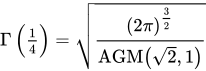
In particular, where AGM() is the arithmetic–geometric mean, we have[2]
-
Γ
(
1
3
)
=
2
1
9
(
2
π
)
2
3
3
1
12
⋅
AGM
(
2
,
2
+
3
)
1
3
{\displaystyle \Gamma \left({\tfrac {1}{3}}\right)={\frac {2^{\frac {1}{9}}(2\pi )^{\frac {2}{3}}}{3^{\frac {1}{12}}\cdot \operatorname {AGM} \left(2,{\sqrt {2+{\sqrt {3}}}}\right)^{\frac {1}{3}}}}}
-
Γ
(
1
4
)
=
(
2
π
)
3
2
AGM
(
2
,
1
)
{\displaystyle \Gamma \left({\tfrac {1}{4}}\right)={\sqrt {\frac {(2\pi )^{\frac {3}{2}}}{\operatorname {AGM} \left({\sqrt {2}},1\right)}}}}
-
Γ
(
1
6
)
=
2
14
9
⋅
3
1
3
⋅
π
5
6
AGM
(
1
+
3
,
8
)
2
3
.
{\displaystyle \Gamma \left({\tfrac {1}{6}}\right)={\frac {2^{\frac {14}{9}}\cdot 3^{\frac {1}{3}}\cdot \pi ^{\frac {5}{6}}}{\operatorname {AGM} \left(1+{\sqrt {3}},{\sqrt {8}}\right)^{\frac {2}{3}}}}.}


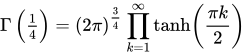
Other formulas include the infinite products
-
Γ
(
1
4
)
=
(
2
π
)
3
4
∏
k
=
1
∞
tanh
(
π
k
2
)
{\displaystyle \Gamma \left({\tfrac {1}{4}}\right)=(2\pi )^{\frac {3}{4}}\prod _{k=1}^{\infty }\tanh \left({\frac {\pi k}{2}}\right)}
and
-
Γ
(
1
4
)
=
A
3
e
−
G
π
2
1
6
π
∏
k
=
1
∞
(
1
−
1
2
k
)
k
(
−
1
)
k
{\displaystyle \Gamma \left({\tfrac {1}{4}}\right)=A^{3}e^{-{\frac {G}{\pi }}}2^{\frac {1}{6}}{\sqrt {\pi }}\prod _{k=1}^{\infty }\left(1-{\frac {1}{2k}}\right)^{k(-1)^{k}}}

where A is the Glaisher–Kinkelin constant and G is Catalan's constant.
The following two representations for Γ(3/4) were given by I. Mező[3]
-
π
e
π
2
1
Γ
(
3
4
)
2
=
i
∑
k
=
−
∞
∞
e
π
(
k
−
2
k
2
)
θ
1
(
i
π
2
(
2
k
−
1
)
,
e
−
π
)
,
{\displaystyle {\sqrt {\frac {\pi {\sqrt {e^{\pi }}}}{2}}}{\frac {1}{\Gamma \left({\frac {3}{4}}\right)^{2}}}=i\sum _{k=-\infty }^{\infty }e^{\pi (k-2k^{2})}\theta _{1}\left({\frac {i\pi }{2}}(2k-1),e^{-\pi }\right),}

and
-
π
2
1
Γ
(
3
4
)
2
=
∑
k
=
−
∞
∞
θ
4
(
i
k
π
,
e
−
π
)
e
2
π
k
2
,
{\displaystyle {\sqrt {\frac {\pi }{2}}}{\frac {1}{\Gamma \left({\frac {3}{4}}\right)^{2}}}=\sum _{k=-\infty }^{\infty }{\frac {\theta _{4}(ik\pi ,e^{-\pi })}{e^{2\pi k^{2}}}},}

where θ1 and θ4 are two of the Jacobi theta functions.
There also exist a number of Malmsten integrals for certain values of the gamma function:[4]
-
∫
1
∞
ln
ln
t
1
+
t
2
=
π
4
(
2
ln
2
+
3
ln
π
−
4
Γ
(
1
4
)
)
{\displaystyle \int _{1}^{\infty }{\frac {\ln \ln t}{1+t^{2}}}={\frac {\pi }{4}}\left(2\ln 2+3\ln \pi -4\Gamma \left({\tfrac {1}{4}}\right)\right)}
-
∫
1
∞
ln
ln
t
1
+
t
+
t
2
=
π
6
3
(
8
ln
2
π
−
3
ln
3
−
12
Γ
(
1
3
)
)
{\displaystyle \int _{1}^{\infty }{\frac {\ln \ln t}{1+t+t^{2}}}={\frac {\pi }{6{\sqrt {3}}}}\left(8\ln 2\pi -3\ln 3-12\Gamma \left({\tfrac {1}{3}}\right)\right)}


One also has (see[5] and [6]):
Ai
(
0
)
=
1
3
2
/
3
Γ
(
2
3
)
{\displaystyle \operatorname {Ai} (0)={\frac {1}{3^{2/3}\,\Gamma \!\left({\frac {2}{3}}\right)}}}


where Ai(x), Bi(x) are Airy functions and
ζ
A
i
(
x
)
{\displaystyle \zeta _{\mathrm {Ai} }(x)}

Products
Some product identities include:
-
∏
r
=
1
2
Γ
(
r
3
)
=
2
π
3
≈
3.627
598
728
468
435
7012
{\displaystyle \prod _{r=1}^{2}\Gamma \left({\tfrac {r}{3}}\right)={\frac {2\pi }{\sqrt {3}}}\approx 3.627\,598\,728\,468\,435\,7012}
OEIS: A186706
-
∏
r
=
1
3
Γ
(
r
4
)
=
2
π
3
≈
7.874
804
972
861
209
8721
{\displaystyle \prod _{r=1}^{3}\Gamma \left({\tfrac {r}{4}}\right)={\sqrt {2\pi ^{3}}}\approx 7.874\,804\,972\,861\,209\,8721}
OEIS: A220610
-
∏
r
=
1
4
Γ
(
r
5
)
=
4
π
2
5
≈
17.655
285
081
493
524
2483
{\displaystyle \prod _{r=1}^{4}\Gamma \left({\tfrac {r}{5}}\right)={\frac {4\pi ^{2}}{\sqrt {5}}}\approx 17.655\,285\,081\,493\,524\,2483}
-
∏
r
=
1
5
Γ
(
r
6
)
=
4
π
5
3
≈
40.399
319
122
003
790
0785
{\displaystyle \prod _{r=1}^{5}\Gamma \left({\tfrac {r}{6}}\right)=4{\sqrt {\frac {\pi ^{5}}{3}}}\approx 40.399\,319\,122\,003\,790\,0785}
-
∏
r
=
1
6
Γ
(
r
7
)
=
8
π
3
7
≈
93.754
168
203
582
503
7970
{\displaystyle \prod _{r=1}^{6}\Gamma \left({\tfrac {r}{7}}\right)={\frac {8\pi ^{3}}{\sqrt {7}}}\approx 93.754\,168\,203\,582\,503\,7970}
-
∏
r
=
1
7
Γ
(
r
8
)
=
4
π
7
≈
219.828
778
016
957
263
6207
{\displaystyle \prod _{r=1}^{7}\Gamma \left({\tfrac {r}{8}}\right)=4{\sqrt {\pi ^{7}}}\approx 219.828\,778\,016\,957\,263\,6207}


In general:
-
∏
r
=
1
n
Γ
(
r
n
+
1
)
=
(
2
π
)
n
n
+
1
{\displaystyle \prod _{r=1}^{n}\Gamma \left({\tfrac {r}{n+1}}\right)={\sqrt {\frac {(2\pi )^{n}}{n+1}}}}

From those products can be deduced other values, for example, from the former equations for
∏
r
=
1
3
Γ
(
r
4
)
{\displaystyle \prod _{r=1}^{3}\Gamma \left({\tfrac {r}{4}}\right)}


Γ
(
3
4
)
=
(
π
2
)
1
4
AGM
(
2
,
1
)
1
2
{\displaystyle \Gamma \left({\tfrac {3}{4}}\right)=\left({\tfrac {\pi }{2}}\right)^{\tfrac {1}{4}}{\operatorname {AGM} \left({\sqrt {2}},1\right)}^{\tfrac {1}{2}}}

Other rational relations include
-
Γ
(
1
5
)
Γ
(
4
15
)
Γ
(
1
3
)
Γ
(
2
15
)
=
2
3
20
5
6
5
−
7
5
+
6
−
6
5
4
{\displaystyle {\frac {\Gamma \left({\tfrac {1}{5}}\right)\Gamma \left({\tfrac {4}{15}}\right)}{\Gamma \left({\tfrac {1}{3}}\right)\Gamma \left({\tfrac {2}{15}}\right)}}={\frac {{\sqrt {2}}\,{\sqrt[{20}]{3}}}{{\sqrt[{6}]{5}}\,{\sqrt[{4}]{5-{\frac {7}{\sqrt {5}}}+{\sqrt {6-{\frac {6}{\sqrt {5}}}}}}}}}}

-
Γ
(
1
20
)
Γ
(
9
20
)
Γ
(
3
20
)
Γ
(
7
20
)
=
5
4
(
1
+
5
)
2
{\displaystyle {\frac {\Gamma \left({\tfrac {1}{20}}\right)\Gamma \left({\tfrac {9}{20}}\right)}{\Gamma \left({\tfrac {3}{20}}\right)\Gamma \left({\tfrac {7}{20}}\right)}}={\frac {{\sqrt[{4}]{5}}\left(1+{\sqrt {5}}\right)}{2}}}
[7]
-
Γ
(
1
5
)
2
Γ
(
1
10
)
Γ
(
3
10
)
=
1
+
5
2
7
10
5
4
{\displaystyle {\frac {\Gamma \left({\frac {1}{5}}\right)^{2}}{\Gamma \left({\frac {1}{10}}\right)\Gamma \left({\frac {3}{10}}\right)}}={\frac {\sqrt {1+{\sqrt {5}}}}{2^{\tfrac {7}{10}}{\sqrt[{4}]{5}}}}}

and many more relations for Γ(n/d) where the denominator d divides 24 or 60.[8]
Gamma quotients with algebraic values must be "poised" in the sense that the sum of arguments is the same (modulo 1) for the denominator and the numerator.
A more sophisticated example:
-
Γ
(
11
42
)
Γ
(
2
7
)
Γ
(
1
21
)
Γ
(
1
2
)
=
8
sin
(
π
7
)
sin
(
π
21
)
sin
(
4
π
21
)
sin
(
5
π
21
)
2
1
42
3
9
28
7
1
3
{\displaystyle {\frac {\Gamma \left({\frac {11}{42}}\right)\Gamma \left({\frac {2}{7}}\right)}{\Gamma \left({\frac {1}{21}}\right)\Gamma \left({\frac {1}{2}}\right)}}={\frac {8\sin \left({\frac {\pi }{7}}\right){\sqrt {\sin \left({\frac {\pi }{21}}\right)\sin \left({\frac {4\pi }{21}}\right)\sin \left({\frac {5\pi }{21}}\right)}}}{2^{\frac {1}{42}}3^{\frac {9}{28}}7^{\frac {1}{3}}}}}
[9]
Imaginary and complex arguments
The gamma function at the imaginary unit i = √−1 gives OEIS: A212877, OEIS: A212878:
-
Γ
(
i
)
=
(
−
1
+
i
)
!
≈
−
0.1549
−
0.4980
i
.
{\displaystyle \Gamma (i)=(-1+i)!\approx -0.1549-0.4980i.}

It may also be given in terms of the Barnes G-function:
-
Γ
(
i
)
=
G
(
1
+
i
)
G
(
i
)
=
e
−
log
G
(
i
)
+
log
G
(
1
+
i
)
.
{\displaystyle \Gamma (i)={\frac {G(1+i)}{G(i)}}=e^{-\log G(i)+\log G(1+i)}.}

Γ
(
i
)
{\displaystyle \Gamma (i)}

-
∫
0
π
/
2
{
cot
(
x
)
}
d
x
=
1
−
π
2
+
i
2
log
(
π
sinh
(
π
)
Γ
(
i
)
2
)
.
{\displaystyle \int _{0}^{\pi /2}\{\cot(x)\}\,dx=1-{\frac {\pi }{2}}+{\frac {i}{2}}\log \left({\frac {\pi }{\sinh(\pi )\Gamma (i)^{2}}}\right).}

Here
{
⋅
}
{\displaystyle \{\cdot \}}

Because of the Euler Reflection Formula, and the fact that
Γ
(
z
¯
)
=
Γ
¯
(
z
)
{\displaystyle \Gamma ({\bar {z}})={\bar {\Gamma }}(z)}

-
|
Γ
(
i
κ
)
|
2
=
π
κ
sinh
(
π
κ
)
{\displaystyle \left|\Gamma (i\kappa )\right|^{2}={\frac {\pi }{\kappa \sinh(\pi \kappa )}}}

The above integral therefore relates to the phase of
Γ
(
i
)
{\displaystyle \Gamma (i)}
The gamma function with other complex arguments returns
-
Γ
(
1
+
i
)
=
i
Γ
(
i
)
≈
0.498
−
0.155
i
{\displaystyle \Gamma (1+i)=i\Gamma (i)\approx 0.498-0.155i}
-
Γ
(
1
−
i
)
=
−
i
Γ
(
−
i
)
≈
0.498
+
0.155
i
{\displaystyle \Gamma (1-i)=-i\Gamma (-i)\approx 0.498+0.155i}
-
Γ
(
1
2
+
1
2
i
)
≈
0.818
163
9995
−
0.763
313
8287
i
{\displaystyle \Gamma ({\tfrac {1}{2}}+{\tfrac {1}{2}}i)\approx 0.818\,163\,9995-0.763\,313\,8287\,i}
-
Γ
(
1
2
−
1
2
i
)
≈
0.818
163
9995
+
0.763
313
8287
i
{\displaystyle \Gamma ({\tfrac {1}{2}}-{\tfrac {1}{2}}i)\approx 0.818\,163\,9995+0.763\,313\,8287\,i}
-
Γ
(
5
+
3
i
)
≈
0.016
041
8827
−
9.433
293
2898
i
{\displaystyle \Gamma (5+3i)\approx 0.016\,041\,8827-9.433\,293\,2898\,i}
-
Γ
(
5
−
3
i
)
≈
0.016
041
8827
+
9.433
293
2898
i
.
{\displaystyle \Gamma (5-3i)\approx 0.016\,041\,8827+9.433\,293\,2898\,i.}


Other constants
The gamma function has a local minimum on the positive real axis
-
x
min
=
1.461
632
144
968
362
341
262
659
5423
…
{\displaystyle x_{\min }=1.461\,632\,144\,968\,362\,341\,262\,659\,5423\ldots \,}
OEIS: A030169
with the value
-
Γ
(
x
min
)
=
0.885
603
194
410
888
700
278
815
9005
…
{\displaystyle \Gamma \left(x_{\min }\right)=0.885\,603\,194\,410\,888\,700\,278\,815\,9005\ldots \,}
OEIS: A030171.
Integrating the reciprocal gamma function along the positive real axis also gives the Fransén–Robinson constant.
On the negative real axis, the first local maxima and minima (zeros of the digamma function) are:
| x | Γ(x) | OEIS |
|---|---|---|
| −0.5040830082644554092582693045 | −3.5446436111550050891219639933 | OEIS: A175472 |
| −1.5734984731623904587782860437 | −2.3024072583396801358235820396 | OEIS: A175473 |
| −2.6107208684441446500015377157 | −0.8881363584012419200955280294 | OEIS: A175474 |
| −3.6352933664369010978391815669 | −0.2451275398343662504382300889 | OEIS: A256681 |
| −4.6532377617431424417145981511 | −0.0527796395873194007604835708 | OEIS: A256682 |
| −5.6671624415568855358494741745 | −0.0093245944826148505217119238 | OEIS: A256683 |
| −6.6784182130734267428298558886 | −0.0013973966089497673013074887 | OEIS: A256684 |
| −7.6877883250316260374400988918 | −0.0001818784449094041881014174 | OEIS: A256685 |
| −8.6957641638164012664887761608 | −0.0000209252904465266687536973 | OEIS: A256686 |
| −9.7026725400018637360844267649 | −0.0000021574161045228505405031 | OEIS: A256687 |
The only values of x > 0 for which Γ(x) = x are x = 1 and x ≈ 3.5623822853908976914156443427... OEIS: A218802.
See also
References
- Waldschmidt, Michel (2006). "Transcendence of periods: the state of the art". Pure and Applied Mathematics Quarterly. 2 (2): 435–463. doi:10.4310/PAMQ.2006.v2.n2.a3.
- "Archived copy". Retrieved 2015-03-09.
- Mező, István (2013), "Duplication formulae involving Jacobi theta functions and Gosper's q-trigonometric functions", Proceedings of the American Mathematical Society, 141 (7): 2401–2410, doi:10.1090/s0002-9939-2013-11576-5
- Blagouchine, Iaroslav V. (2014-10-01). "Rediscovery of Malmsten's integrals, their evaluation by contour integration methods and some related results". The Ramanujan Journal. 35 (1): 21–110. doi:10.1007/s11139-013-9528-5. ISSN 1572-9303.
- "Airy and Related Function". dlmf.nist.gov. Retrieved 9 October 2022.
- Weisstein, Eric W. "Airy Zeta Function". MathWorld.
- Weisstein, Eric W. "Gamma Function". MathWorld.
- Raimundas Vidūnas, Expressions for Values of the Gamma Function
- math.stackexchange.com
- The webpage of István Mező
Further reading
- Gramain, F. (1981). "Sur le théorème de Fukagawa-Gel'fond". Invent. Math. 63 (3): 495–506. Bibcode:1981InMat..63..495G. doi:10.1007/BF01389066. S2CID 123079859.
- Borwein, J. M.; Zucker, I. J. (1992). "Fast Evaluation of the Gamma Function for Small Rational Fractions Using Complete Elliptic Integrals of the First Kind". IMA Journal of Numerical Analysis. 12 (4): 519–526. doi:10.1093/imanum/12.4.519. MR 1186733.
- X. Gourdon & P. Sebah. Introduction to the Gamma Function
- Weisstein, Eric W. "Gamma Function". MathWorld.
- Vidunas, Raimundas (2005). "Expressions for values of the gamma function". Kyushu Journal of Mathematics. 59 (2): 267–283. arXiv:math.CA/0403510. doi:10.2206/kyushujm.59.267. S2CID 119623635.
- Vidunas, Raimundas (2005). "Expressions for values of the gamma function". Kyushu J. Math. 59 (2): 267–283. arXiv:math/0403510. doi:10.2206/kyushujm.59.267. MR 2188592. S2CID 119623635.
- Adamchik, V. S. (2005). "Multiple Gamma Function and Its Application to Computation of Series" (PDF). The Ramanujan Journal. 9 (3): 271–288. arXiv:math/0308074. doi:10.1007/s11139-005-1868-3. MR 2173489. S2CID 15670340.
- Duke, W.; Imamoglu, Ö. (2006). "Special values of multiple gamma functions" (PDF). Journal de Théorie des Nombres de Bordeaux. 18 (1): 113–123. doi:10.5802/jtnb.536. MR 2245878.