In number theory, a perfect digit-to-digit invariant (PDDI; also known as a Munchausen number[1]) is a natural number in a given number base
b
{\displaystyle b}


Definition
Let
n
{\displaystyle n}




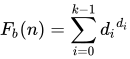


F
b
(
1
)
=
1
{\displaystyle F_{b}(1)=1}


A natural number
n
{\displaystyle n}


All natural numbers
n
{\displaystyle n}





The number of iterations
i
{\displaystyle i}


Perfect digit-to-digit invariants and cycles of Fb for specific b
All numbers are represented in base
b
{\displaystyle b}
Convention 00 = 1
| Base | Nontrivial perfect digit-to-digit invariants (
n
≠
1
{\displaystyle n\neq 1}
 ) ) |
Cycles |
|---|---|---|
| 2 | 10 |
∅
{\displaystyle \varnothing }
 |
| 3 | 12, 22 | 2 → 11 → 2 |
| 4 | 131, 313 | 2 → 10 → 2 |
| 5 |
∅
{\displaystyle \varnothing }
|
2 → 4 → 2011 → 12 → 10 → 2 104 → 2013 → 113 → 104 |
| 6 | 22352, 23452 |
4 → 1104 → 1111 → 4 23445 → 24552 → 50054 → 50044 → 24503 → 23445 |
| 7 | 13454 | 12066 → 536031 → 265204 → 265623 → 551155 → 51310 → 12125 → 12066 |
| 8 |
∅
{\displaystyle \varnothing }
|
405 → 6466 → 421700 → 3110776 → 6354114 → 142222 → 421 → 405 |
| 9 | 31, 156262, 1656547 | |
| 10 | 3435 | |
| 11 | 18453278, 18453487 | |
| 12 | 3A67A54832 | |
| 13 | 33661, 2AA834668A, 4CA92A233518, 4CA92A233538 | |
| 14 | 23, 26036, 45A0A04513CC, A992B5D96720D | |
| 15 | 4B1648420DCD0, 5A99E538339A43, 5ACBC41C19E333, 5ACBC41C19E400, 5D0B197C25E056 | |
| 16 | C4EF722B782C26F, C76712FFC311E6E | |
| 17 | 33 | |
| 18 | ||
| 19 | ||
| 20 | 6534 | |
| 21 | ||
| 22 | ||
| 23 | ||
| 24 | ||
| 25 | 13, 513 |
Convention 00 = 0
| Base | Nontrivial perfect digit-to-digit invariants (
n
≠
0
{\displaystyle n\neq 0}
 ,
n
≠
1
{\displaystyle n\neq 1}
)[1] ,
n
≠
1
{\displaystyle n\neq 1}
)[1] |
Cycles |
|---|---|---|
| 2 |
∅
{\displaystyle \varnothing }
|
∅
{\displaystyle \varnothing }
|
| 3 | 12, 22 | 2 → 11 → 2 |
| 4 | 130, 131, 313 |
∅
{\displaystyle \varnothing }
|
| 5 | 103, 2024 |
2 → 4 → 2011 → 11 → 2 9 → 2012 → 9 |
| 6 | 22352, 23452 |
5 → 22245 → 23413 → 1243 → 1200 → 5 53 → 22332 → 150 → 22250 → 22305 → 22344 → 2311 → 53 |
| 7 | 13454 | |
| 8 | 400, 401 | |
| 9 | 30, 31, 156262, 1647063, 1656547, 34664084 | |
| 10 | 3435, 438579088 | |
| 11 |
∅
{\displaystyle \varnothing }
|
∅
{\displaystyle \varnothing }
|
| 12 | 3A67A54832 |
Programming examples
The following program in Python determines whether an integer number is a Munchausen Number / Perfect Digit to Digit Invariant or not, following the convention
0
0
=
1
{\displaystyle 0^{0}=1}

num = int(input("Enter number:"))
temp = num
s = 0.0
while num > 0:
     digit = num % 10
     num //= 10
     s+= pow(digit, digit)

if s == temp:
    print("Munchausen Number")
else:
    print("Not Munchausen Number")
The examples below implement the perfect digit-to-digit invariant function described in the definition above to search for perfect digit-to-digit invariants and cycles in Python for the two conventions.
Convention 00 = 1
def pddif(x: int, b: int) -> int:
    total = 0
    while x > 0:
        total = total + pow(x % b, x % b)
        x = x // b
    return total

def pddif_cycle(x: int, b: int) -> list[int]:
    seen = []
    while x not in seen:
        seen.append(x)
        x = pddif(x, b)
    cycle = []
    while x not in cycle:
        cycle.append(x)
        x = pddif(x, b)
    return cycle
Convention 00 = 0
def pddif(x: int, b: int) -> int:
    total = 0
    while x > 0:
        if x % b > 0:
            total = total + pow(x % b, x % b)
        x = x // b
    return total

def pddif_cycle(x: int, b: int) -> list[int]:
    seen = []
    while x not in seen:
        seen.append(x)
        x = pddif(x, b)
    cycle = []
    while x not in cycle:
        cycle.append(x)
        x = pddif(x, b)
    return cycle
See also
References
- van Berkel, Daan (2009). "On a curious property of 3435". arXiv:0911.3038 [math.HO].
- Olry, Regis and Duane E. Haines. "Historical and Literary Roots of Münchhausen Syndromes", from Literature, Neurology, and Neuroscience: Neurological and Psychiatric Disorders, Stanley Finger, Francois Boller, Anne Stiles, eds. Elsevier, 2013. p.136.
- Daan van Berkel, On a curious property of 3435.
- Parker, Matt (2014). Things to Make and Do in the Fourth Dimension. Penguin UK. p. 28. ISBN 9781846147654. Retrieved 2 May 2015.
- Narcisstic Number, Harvey Heinz
- Wells, David (1997). The Penguin Dictionary of Curious and Interesting Numbers. London: Penguin. p. 185. ISBN 0-14-026149-4.
External links
- Parker, Matt. "3435". Numberphile. Brady Haran. Archived from the original on 2017-04-13. Retrieved 2013-04-01.