
Unlike most other elementary shapes, such as the circle and square, there is no closed-form expression for the perimeter of an ellipse. Throughout history, a large number of closed-form approximations and expressions in terms of integrals or series have been given for the perimeter of an ellipse.
Exact value
Elliptic integral
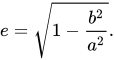
An ellipse is defined by two axes: the major axis (the longest diameter) of length
2
a
{\displaystyle 2a}




Infinite sums
Another solution for the perimeter, this time using the sum of an infinite series, is[3]
P
=
2
a
π
(
1
−
∑
n
=
1
∞
(
2
n
!
)
2
(
2
n
⋅
n
!
)
4
⋅
e
2
n
2
n
−
1
)
,
{\displaystyle P=2a\pi \left(1-\sum _{n=1}^{\infty }{\frac {(2n!)^{2}}{(2^{n}\cdot n!)^{4}}}\cdot {\frac {e^{2n}}{2n-1}}\right),}

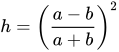
More rapid convergence may be obtained by expanding in terms of
h
=
(
a
−
b
)
2
/
(
a
+
b
)
2
{\displaystyle h=(a-b)^{2}/(a+b)^{2}}



Approximations
Exact evaluation of elliptic integrals may be impractical in some cases due to their computational complexity. As a result, several approximation methods have been developed over time.
Ramanujan's approximations
Indian mathematician Srinivasa Ramanujan proposed multiple approximations.[8][9]
First approximation
P
≈
π
(
3
(
a
+
b
)
−
(
3
a
+
b
)
(
a
+
3
b
)
)
.
{\displaystyle P\approx \pi \left(3(a+b)-{\sqrt {(3a+b)(a+3b)}}\right).}

Second approximation
P
≈
π
(
a
+
b
)
(
1
+
3
h
10
+
4
−
3
h
)
,
{\displaystyle P\approx \pi (a+b)\left(1+{\frac {3h}{10+{\sqrt {4-3h}}}}\right),}


Final approximation
The final approximation in Ramanujan's notes was an improvement on his second approximation. It is regarded as one of his most mysterious equations.
P
≈
π
(
(
a
+
b
)
(
1
+
3
h
10
+
4
−
3
h
)
+
ε
)
≈
π
(
(
a
+
b
)
+
3
(
a
−
b
)
2
10
(
a
+
b
)
+
a
2
+
14
a
b
+
b
2
+
ε
)
{\displaystyle {\begin{aligned}P&\approx \pi \left((a+b)\left(1+{\frac {3h}{10+{\sqrt {4-3h}}}}\right)+\varepsilon \right)\\&\approx \pi \left((a+b)+{\frac {3(a-b)^{2}}{10(a+b)+{\sqrt {a^{2}+14ab+b^{2}}}}}+\varepsilon \right)\end{aligned}}}


Ramanujan did not provide any rationale for this formula.
Derivation of Ramanujan's approximations |
|---|
|
Second Approximation Ramanujan's second approximation formula follows from the series representation of the perimeter of an ellipse. The expansion of the general form,
1
+
A
h
B
+
1
−
C
h
=
1
+
A
B
+
1
h
+
A
C
2
(
B
+
1
)
2
h
2
+
A
C
2
(
B
+
3
)
8
(
B
+
1
)
3
h
3
+
⋯
,
{\displaystyle 1+{\frac {Ah}{B+{\sqrt {1-Ch}}}}=1+{\frac {A}{B+1}}h+{\frac {AC}{2(B+1)^{2}}}h^{2}+{\frac {AC^{2}(B+3)}{8(B+1)^{3}}}h^{3}+\cdots ,}
can be compared to the first three terms of the infinite series,
P
π
(
a
+
b
)
=
1
+
1
4
h
+
1
64
h
2
+
1
256
h
3
+
25
16384
h
4
+
49
65536
h
5
⋯
,
{\displaystyle {\frac {P}{\pi (a+b)}}=1+{\frac {1}{4}}h+{\frac {1}{64}}h^{2}+{\frac {1}{256}}h^{3}+{\frac {25}{16384}}h^{4}+{\frac {49}{65536}}h^{5}\cdots ,}
to show that
A
B
+
1
=
1
4
,
A
C
2
(
B
+
1
)
2
=
1
64
,
A
C
2
(
B
+
3
)
8
(
B
+
1
)
3
=
1
256
.
{\displaystyle {\frac {A}{B+1}}={\frac {1}{4}},\quad {\frac {AC}{2(B+1)^{2}}}={\frac {1}{64}},\quad {\frac {AC^{2}(B+3)}{8(B+1)^{3}}}={\frac {1}{256}}.}
Solving the system of equations, we find
A
=
3
2
,
B
=
5
,
C
=
3
4
.
{\displaystyle A={\frac {3}{2}},\quad B=5,\quad C={\frac {3}{4}}.}
Substituting the values into the original equation and simplifying algebraically yields Ramanujan's second approximation formula. This formula is accurate up to the fourth coefficient of the series expansion for the perimeter of an ellipse. Final Approximation Mathematician Mark Villarino demonstrated that each coefficient in the series representation of Ramanujan's approximation, beyond the fourth, is less than that of the exact perimeter's series representation. He also proved that the error in Ramanujan's approximation is
ε
=
π
(
a
+
b
)
⋅
θ
(
a
−
b
a
+
b
)
⋅
(
a
−
b
a
+
b
)
10
{\displaystyle \varepsilon =\pi (a+b)\cdot \theta \left({\frac {a-b}{a+b}}\right)\cdot \left({\frac {a-b}{a+b}}\right)^{10}}
where
θ
{\textstyle \theta }
3
2
17
<
θ
(
a
−
b
a
+
b
)
≤
14
11
(
22
7
−
π
)
.
{\displaystyle {\frac {3}{2^{17}}}<\theta \left({\frac {a-b}{a+b}}\right)\leq {\frac {14}{11}}\left({\frac {22}{7}}-\pi \right).}
[9] By taking
θ
{\textstyle \theta }
ε
≈
π
(
a
+
b
)
⋅
(
3
2
17
)
⋅
(
e
2
4
)
10
=
π
(
a
+
b
)
⋅
3
a
e
20
2
36
.
{\displaystyle \varepsilon \approx \pi (a+b)\cdot \left({\frac {3}{2^{17}}}\right)\cdot \left({\frac {e^{2}}{4}}\right)^{10}=\pi (a+b)\cdot {\dfrac {3ae^{20}}{2^{36}}}.}
A slightly more precise approximate form can be produced by leaving the
(
a
−
b
a
+
b
)
10
{\textstyle \left({\frac {a-b}{a+b}}\right)^{10}}
P
≈
π
(
a
+
b
)
(
1
+
3
h
10
+
4
−
3
h
+
3
h
5
2
17
)
{\displaystyle P\approx \pi (a+b)\left(1+{\frac {3h}{10+{\sqrt {4-3h}}}}+{\frac {3h^{5}}{2^{17}}}\right)}
where
h
=
(
a
−
b
a
+
b
)
2
{\displaystyle h=\left({\frac {a-b}{a+b}}\right)^{2}}
|


See also
References
- Chandrupatla, Tirupathi; Osler, Thomas (2010). "The Perimeter of an Ellipse" (PDF). The Mathematical Scientist. 35 (2): 122–131.
- Abbott, Paul (2009). "On the Perimeter of an Ellipse" (PDF). The Mathematica Journal. 11 (2): 2. doi:10.3888/tmj.11.2-4.
- "Perimeter of Ellipse". www.mathsisfun.com. Retrieved 2025-01-25.
- Ivory, James (1798). "A new series for the rectification of the ellipsis". Transactions of the Royal Society of Edinburgh. 4 (2): 177–190. doi:10.1017/s0080456800030817. S2CID 251572677.
- Bessel, F. W. (2010) [1825]. "The calculation of longitude and latitude from geodesic measurements". Astron. Nachr. 331 (8). Translated by Karney, Charles F. F.; Deakin, Rodney E.: 852–861. arXiv:0908.1824. Bibcode:2010AN....331..852K. doi:10.1002/asna.201011352. S2CID 118760590. English translation of Bessel, F. W. (1825). "Über die Berechnung der geographischen Längen und Breiten aus geodätischen Vermesssungen". Astron. Nachr. (in German). 4 (16): 241–254. arXiv:0908.1823. Bibcode:1825AN......4..241B. doi:10.1002/asna.18260041601. S2CID 118630614.
- Linderholm, Carl E.; Segal, Arthur C. (June 1995). "An Overlooked Series for the Elliptic Perimeter". Mathematics Magazine. 68 (3): 216–220. doi:10.1080/0025570X.1995.11996318.
The authors recently found a power series for the perimeter of an ellipse whose variable is not eccentricity and which converges considerably faster than the standard series. Not finding it in the references available to us, we imagined it might be new. However, the referee informed us that we had rediscovered one of Kummer's quadratic transformations of Gauss's hypergeometric series, dating back to 1837.
which cites to Kummer, Ernst Eduard (1836). "Uber die Hypergeometrische Reihe" [About the hypergeometric series]. Journal für die Reine und Angewandte Mathematik (in German). 15 (1, 2): 39–83, 127–172. doi:10.1515/crll.1836.15.39. - Cook, John D. (28 May 2023). "Comparing approximations for ellipse perimeter". John D. Cook Consulting blog. Retrieved 2024-09-16.
- Roberts, Martin (2019-02-11). "A Formula for the Perimeter of an Ellipse". Extreme Learning. Retrieved 2025-01-25.
- Villarino, Mark B. (20 June 2005). "Ramanujan's Perimeter of an Ellipse". arXiv:math/0506384.