In mathematics, persymmetric matrix may refer to:
- a square matrix which is symmetric with respect to the northeast-to-southwest diagonal (anti-diagonal); or
- a square matrix such that the values on each line perpendicular to the main diagonal are the same for a given line.
The first definition is the most common in the recent literature. The designation "Hankel matrix" is often used for matrices satisfying the property in the second definition.
Definition 1

Let A = (aij) be an n × n matrix. The first definition of persymmetric requires that
a
i
j
=
a
n
−
j
+
1
,
n
−
i
+
1
{\displaystyle a_{ij}=a_{n-j+1,\,n-i+1}}

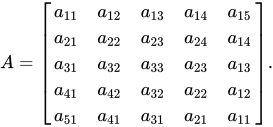
This can be equivalently expressed as AJ = JAT where J is the exchange matrix.
A third way to express this is seen by post-multiplying AJ = JAT with J on both sides, showing that AT rotated 180 degrees is identical to A:
A
=
J
A
T
J
.
{\displaystyle A=JA^{\mathsf {T}}J.}

A symmetric matrix is a matrix whose values are symmetric in the northwest-to-southeast diagonal. If a symmetric matrix is rotated by 90°, it becomes a persymmetric matrix. Symmetric persymmetric matrices are sometimes called bisymmetric matrices.
Definition 2
The second definition is due to Thomas Muir.[2] It says that the square matrix A = (aij) is persymmetric if aij depends only on i + j. Persymmetric matrices in this sense, or Hankel matrices as they are often called, are of the form
A
=
[
r
1
r
2
r
3
⋯
r
n
r
2
r
3
r
4
⋯
r
n
+
1
r
3
r
4
r
5
⋯
r
n
+
2
⋮
⋮
⋮
⋱
⋮
r
n
r
n
+
1
r
n
+
2
⋯
r
2
n
−
1
]
.
{\displaystyle A={\begin{bmatrix}r_{1}&r_{2}&r_{3}&\cdots &r_{n}\\r_{2}&r_{3}&r_{4}&\cdots &r_{n+1}\\r_{3}&r_{4}&r_{5}&\cdots &r_{n+2}\\\vdots &\vdots &\vdots &\ddots &\vdots \\r_{n}&r_{n+1}&r_{n+2}&\cdots &r_{2n-1}\end{bmatrix}}.}
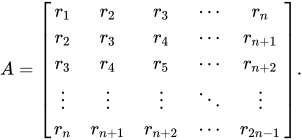
A matrix for which the values on each line parallel to the main diagonal are constant is called a Toeplitz matrix.
See also
References
- Golub, Gene H.; Van Loan, Charles F. (1996), Matrix Computations (3rd ed.), Baltimore: Johns Hopkins, ISBN 978-0-8018-5414-9. See page 193.
- Muir, Thomas; Metzler, William H. (2003) [1933], Treatise on the Theory of Determinants, Dover Press, p. 419, ISBN 978-0-486-49553-8, OCLC 52203124