The planar reentry equations are the equations of motion governing the unpowered reentry of a spacecraft, based on the assumptions of planar motion and constant mass, in an Earth-fixed reference frame.[1]
Definition
The equations are given by:
{
d
V
d
t
=
−
ρ
V
2
2
β
+
g
sin
γ
d
γ
d
t
=
−
V
cos
γ
r
−
ρ
V
2
β
(
L
D
)
cos
σ
+
g
cos
γ
V
d
h
d
t
=
−
V
sin
γ
{\displaystyle {\begin{cases}{\frac {dV}{dt}}&=-{\frac {\rho V^{2}}{2\beta }}+g\sin \gamma \\{\frac {d\gamma }{dt}}&=-{\frac {V\cos \gamma }{r}}-{\frac {\rho V}{2\beta }}\left({\frac {L}{D}}\right)\cos \sigma +{\frac {g\cos \gamma }{V}}\\{\frac {dh}{dt}}&=-V\sin \gamma \end{cases}}}
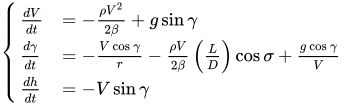
where the quantities in these equations are:
-
V
{\displaystyle V}
is the velocity
-
γ
>
0
{\displaystyle \gamma >0}
is the flight path angle
-
h
{\displaystyle h}
is the altitude
-
ρ
{\displaystyle \rho }
is the atmospheric density
-
β
{\displaystyle \beta }
is the ballistic coefficient
-
g
{\displaystyle g}
is the gravitational acceleration
-
r
=
r
e
+
h
{\displaystyle r=r_{e}+h}
is the radius from the center of a planet with equatorial radius r e {\displaystyle r_{e}}
-
L
/
D
{\displaystyle L/D}
is the lift-to-drag ratio
-
σ
{\displaystyle \sigma }
is the bank angle of the spacecraft.

Simplifications
Allen-Eggers solution
Harry Allen and Alfred Eggers, based on their studies of ICBM trajectories, were able to derive an analytical expression for the velocity as a function of altitude.[2] They made several assumptions:
- The spacecraft's entry was purely ballistic
(
L
=
0
)
{\displaystyle (L=0)}
.
- The effect of gravity is small compared to drag, and can be ignored.
- The flight path angle and ballistic coefficient are constant.
- An exponential atmosphere, where
ρ
(
h
)
=
ρ
0
exp
(
−
h
/
H
)
{\displaystyle \rho (h)=\rho _{0}\exp(-h/H)}
, with ρ 0 {\displaystyle \rho _{0}}
being the density at the planet's surface and H {\displaystyle H}
being the scale height.
These assumptions are valid for hypersonic speeds, where the Mach number is greater than 5. Then the planar reentry equations for the spacecraft are:
-
{
d
V
d
t
=
−
ρ
0
2
β
V
2
e
−
h
/
H
d
h
d
t
=
−
V
sin
γ
⟹
d
V
d
h
=
ρ
0
2
β
sin
γ
V
e
−
h
/
H
{\displaystyle {\begin{cases}{\frac {dV}{dt}}&=-{\frac {\rho _{0}}{2\beta }}V^{2}e^{-h/H}\\{\frac {dh}{dt}}&=-V\sin \gamma \end{cases}}\implies {\frac {dV}{dh}}={\frac {\rho _{0}}{2\beta \sin \gamma }}Ve^{-h/H}}

Rearranging terms and integrating from the atmospheric interface conditions at the start of reentry
(
V
atm
,
h
atm
)
{\displaystyle (V_{\text{atm}},h_{\text{atm}})}

-
d
V
V
=
ρ
0
2
β
sin
γ
e
−
h
/
H
d
h
⟹
log
(
V
V
atm
)
=
−
ρ
0
H
2
β
sin
γ
(
e
−
h
/
H
−
e
−
h
atm
/
H
)
{\displaystyle {\frac {dV}{V}}={\frac {\rho _{0}}{2\beta \sin \gamma }}e^{-h/H}dh\implies \log \left({\frac {V}{V_{\text{atm}}}}\right)=-{\frac {\rho _{0}H}{2\beta \sin \gamma }}\left(e^{-h/H}-e^{-h_{\text{atm}}/H}\right)}

The term
exp
(
−
h
atm
/
H
)
{\displaystyle \exp(-h_{\text{atm}}/H)}

-
V
(
h
)
=
V
atm
exp
(
−
ρ
0
H
2
β
sin
γ
e
−
h
/
H
)
{\displaystyle V(h)=V_{\text{atm}}\exp \left(-{\frac {\rho _{0}H}{2\beta \sin \gamma }}e^{-h/H}\right)}

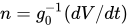
Allen and Eggers were also able to calculate the deceleration along the trajectory, in terms of the number of g's experienced
n
=
g
0
−
1
(
d
V
/
d
t
)
{\displaystyle n=g_{0}^{-1}(dV/dt)}

-
h
n
max
=
H
log
(
−
ρ
0
H
β
sin
γ
)
,
V
n
max
=
V
atm
e
−
1
/
2
⟹
n
max
=
−
V
atm
2
sin
γ
2
g
0
e
H
{\displaystyle h_{n_{\max }}=H\log \left(-{\frac {\rho _{0}H}{\beta \sin \gamma }}\right),\quad V_{n_{\max }}=V_{\text{atm}}e^{-1/2}\implies n_{\max }=-{\frac {V_{\text{atm}}^{2}\sin \gamma }{2g_{0}eH}}}

It is also possible to compute the maximum stagnation point convective heating with the Allen-Eggers solution and a heat transfer correlation; the Sutton-Graves correlation[3] is commonly chosen. The heat rate
q
˙
″
{\displaystyle {\dot {q}}''}

-
q
˙
″
=
k
(
ρ
r
n
)
1
/
2
V
3
∼
W
/
m
2
{\displaystyle {\dot {q}}''=k\left({\frac {\rho }{r_{n}}}\right)^{1/2}V^{3}\sim {\text{W}}/{\text{m}}^{2}}

where
r
n
{\displaystyle r_{n}}


-
h
q
˙
max
″
=
H
log
(
−
β
sin
γ
3
H
ρ
0
)
⟹
q
˙
max
″
=
k
−
β
sin
γ
3
H
r
n
e
V
atm
3
{\displaystyle h_{{\dot {q}}_{\max }''}=H\log \left(-{\frac {\beta \sin \gamma }{3H\rho _{0}}}\right)\implies {\dot {q}}_{\max }''=k{\sqrt {-{\frac {\beta \sin \gamma }{3Hr_{n}e}}}}V_{\text{atm}}^{3}}

Equilibrium glide condition
Another commonly encountered simplification is a lifting entry with a shallow, slowly-varying, flight path angle.[4] The velocity as a function of altitude can be derived from two assumptions:
- The flight path angle is shallow, meaning that:
cos
γ
≈
1
,
sin
γ
≈
γ
{\displaystyle \cos \gamma \approx 1,\sin \gamma \approx \gamma }
.
- The flight path angle changes very slowly, such that
d
γ
/
d
t
≈
0
{\displaystyle d\gamma /dt\approx 0}
.
From these two assumptions, we may infer from the second equation of motion that:
[
1
r
+
ρ
2
β
(
L
D
)
cos
σ
]
V
2
=
g
⟹
V
(
h
)
=
g
r
1
+
ρ
r
2
β
(
L
D
)
cos
σ
{\displaystyle \left[{\frac {1}{r}}+{\frac {\rho }{2\beta }}\left({\frac {L}{D}}\right)\cos \sigma \right]V^{2}=g\implies V(h)={\sqrt {\frac {gr}{1+{\frac {\rho r}{2\beta }}\left({\frac {L}{D}}\right)\cos \sigma }}}}
![{\displaystyle \left[{\frac {1}{r}}+{\frac {\rho }{2\beta }}\left({\frac {L}{D}}\right)\cos \sigma \right]V^{2}=g\implies V(h)={\sqrt {\frac {gr}{1+{\frac {\rho r}{2\beta }}\left({\frac {L}{D}}\right)\cos \sigma }}}}](https://wikimedia.org/api/rest_v1/media/math/render/svg/43046fe5bbc5c464ea7c2b9dd2c4920899ecee9f)
Unified Analytical Survival Index for Ballistic Re-entry
Classical mechanics frameworks for calculating entry heating, such as the Allen-Eggers model, frequently rely on simplified isothermal atmospheric conditions and assumptions to evaluate trajectory deceleration and aerodynamic heating.[2] While these simplified models provide useful early approximations for stagnation point heat transfer, real atmospheres and planetary entry involves complex hypersonic gas dynamics and substantial temperature and density gradients.
In order to bridge the gap between simplified models and real-world atmospheres, a survival index was developed, known as the Unified Analytical Survival Index for Ballistic Re-entry, which uses polytropic and non-isothermal atmospheres. This survival index is a closed-form analytical frameworks used to evaluate whether objects will undergo complete thermal ablation, or whether they will maintain enough structural integrity to survive until ground impact.[5]
Limitations
This analytical model for ballistic re-entry has various limitations and assumptions[5]:
- Assumes a zero-lift trajectory (
L
/
D
=
0
{\displaystyle {L/D}=0}
) and constant ballistic coefficient ( ∂ β ∂ t = 0 {\displaystyle {\partial \beta \over \partial t}=0}
) which restricts the framework to non-lifting, non-ablating vehicles
- Uses a flat-Earth approximation (
g
(
z
)
≈
g
0
{\displaystyle g(z)\thickapprox g_{0}}
)
- Uses a static polytrophic gas assumption (
P
∝
ρ
1
+
1
n
{\displaystyle P\varpropto \rho ^{1+{\frac {1}{n}}}}
- Focuses only on stagnation-point heating (
q
∝
ρ
R
×
v
3
{\displaystyle q\varpropto {\sqrt {\frac {\rho }{R}}}\times v^{3}}
) which limits its applicability to steep and short-duration trajectories.

Proof
The proof beings by modelling the atmosphere with a non-isothermal polytropic density profile. For a constant lapse rate
L
{\displaystyle L}


ρ
(
h
)
=
ρ
0
(
1
−
L
h
T
0
)
g
/
(
R
L
)
−
1
⟹
ρ
(
u
)
=
ρ
0
u
2
δ
,
δ
≡
1
2
(
1
−
R
L
g
)
>
0
{\displaystyle \rho (h)=\rho _{0}\left(1-{\frac {Lh}{T_{0}}}\right)^{g/(RL)-1}\quad \Longrightarrow \quad \rho (u)=\rho _{0}\,u^{2\delta },\qquad \delta \equiv {\frac {1}{2}}\left(1-{\frac {RL}{g}}\right)>0}

where
u
(
h
)
=
(
1
−
L
h
T
0
)
g
/
(
R
L
)
{\displaystyle u(h)=\left(1-{\frac {Lh}{T_{0}}}\right)^{g/(RL)}}

Substituting this density into the ballistic deceleration equation
d
(
ln
V
)
d
h
=
ρ
(
h
)
2
β
sin
γ
{\displaystyle {\frac {d(\ln V)}{dh}}={\frac {\rho (h)}{2\beta \sin \gamma }}}


d
(
ln
V
)
=
−
ρ
0
R
T
0
2
β
g
sin
γ
u
2
δ
+
R
L
/
g
−
1
d
u
{\displaystyle d(\ln V)=-{\frac {\rho _{0}RT_{0}}{2\beta g\sin \gamma }}\,u^{\,2\delta +RL/g-1}\,du}

The key algebraic cancellation
2
δ
+
R
L
g
−
1
=
(
1
−
R
L
g
)
+
R
L
g
−
1
=
0
{\displaystyle 2\delta +{\frac {RL}{g}}-1=\left(1-{\frac {RL}{g}}\right)+{\frac {RL}{g}}-1=0}

V
(
u
)
=
V
E
exp
[
Λ
(
u
E
−
u
)
]
,
Λ
≡
ρ
0
R
T
0
2
β
g
sin
γ
,
{\displaystyle V(u)=V_{E}\,\exp {\bigl [}\Lambda (u_{E}-u){\bigr ]},\qquad \Lambda \equiv {\frac {\rho _{0}RT_{0}}{2\beta g\sin \gamma }},}
![{\displaystyle V(u)=V_{E}\,\exp {\bigl [}\Lambda (u_{E}-u){\bigr ]},\qquad \Lambda \equiv {\frac {\rho _{0}RT_{0}}{2\beta g\sin \gamma }},}](https://wikimedia.org/api/rest_v1/media/math/render/svg/afd534a6c6b27a57473713a514aa91821d719bb4)


This velocity profile is then fed into the Fay-Riddell stagnation-point convective heating correlation[6]
q
˙
(
u
)
=
C
ρ
(
u
)
V
(
u
)
3
,
C
=
k
F
R
R
n
,
{\displaystyle {\dot {q}}(u)=C{\sqrt {\rho (u)}}\,V(u)^{3},\qquad C={\frac {k_{\mathrm {FR} }}{\sqrt {R_{n}}}},}

q
˙
(
u
)
=
C
ρ
0
V
E
3
u
δ
exp
[
3
Λ
(
u
E
−
u
)
]
{\displaystyle {\dot {q}}(u)=C{\sqrt {\rho _{0}}}\,V_{E}^{3}\,u^{\delta }\exp {\bigl [}3\Lambda (u_{E}-u){\bigr ]}}
![{\displaystyle {\dot {q}}(u)=C{\sqrt {\rho _{0}}}\,V_{E}^{3}\,u^{\delta }\exp {\bigl [}3\Lambda (u_{E}-u){\bigr ]}}](https://wikimedia.org/api/rest_v1/media/math/render/svg/6bbddce88418563d34e5b49e8526b6b6f911b3e8)
The peak heat flux
q
˙
p
{\displaystyle {\dot {q}}_{p}}


By defining the dimensionless Thermal Protection System capacity as
Q
≡
q
˙
l
i
m
e
δ
C
ρ
0
V
E
3
δ
δ
u
E
δ
,
{\displaystyle Q\equiv {\frac {{\dot {q}}_{\mathrm {lim} }\,e^{\delta }}{C{\sqrt {\rho _{0}}}\,V_{E}^{3}\,\delta ^{\delta }u_{E}^{\delta }}},}


This inequality is solved exactly using the Lambert
W
{\displaystyle W}


The Unified Analytical Survival Index for Ballistic Re-entry is defined as:[5]
Ψ
≡
q
˙
l
i
m
q
˙
p
.
{\displaystyle \Psi \equiv {\frac {{\dot {q}}_{\mathrm {lim} }}{{\dot {q}}_{p}}}.}

Thermal survival requires
Ψ
≥
1
{\displaystyle \Psi \geq 1}

![{\displaystyle \Psi (x)=Q\,x^{\delta }e^{-x},\qquad x\in [\delta u_{E},\delta ],}](https://wikimedia.org/api/rest_v1/media/math/render/svg/448de7b4ac02c86d7f959e83067c0ed460627b12)

Ψ
max
=
Q
δ
δ
e
−
δ
=
q
˙
l
i
m
C
ρ
0
V
E
3
u
E
δ
.
{\displaystyle \Psi _{\max }=Q\,\delta ^{\delta }e^{-\delta }={\frac {{\dot {q}}_{\mathrm {lim} }}{C{\sqrt {\rho _{0}}}\,V_{E}^{3}\,u_{E}^{\delta }}}.}

Hence the proof establishes a direct, closed-form relationship between the atmospheric parameters
ρ
0
,
T
0
,
L
{\displaystyle \rho _{0},T_{0},L}


See also
References
- Wang, Kenneth; Ting, Lu (1961). "Approximate Solutions for Reentry Trajectories With Aerodynamic Forces" (PDF). PIBAL Report No. 647: 5–7.
- Allen, H. Julian; Eggers, Jr., A.J. (1958). "A study of the motion and aerodynamic heating of ballistic missiles entering the earth's atmosphere at high supersonic speeds" (PDF). NACA Technical Report 1381. National Advisory Committee for Aeronautics.
- Sutton, K.; Graves, R. A. (1971-11-01). "A general stagnation-point convective heating equation for arbitrary gas mixtures". NASA Technical Report R-376.
- Eggers, Jr., A.J.; Allen, H.J.; Niece, S.E. (1958). "A Comparative Analysis of the Performance of Long-Range Hypervelocity Vehicles" (PDF). NACA Technical Report 1382. National Advisory Committee for Aeronautics.
- Sharma, Prayaan (2026-06-14), A Unified Analytical Survival Index for Ballistic Reentry in Non-Isothermal Polytropic Atmospheres, Zenodo, doi:10.5281/ZENODO.20688959, retrieved 2026-06-18
- Fay, J. A.; Riddell, F. R. (February 1958). "Theory of Stagnation Point Heat Transfer in Dissociated Air". Journal of the Aerospace Sciences. 25 (2): 73–85. doi:10.2514/8.7517. ISSN 1936-9999.
Further reading
- Regan, F.J.; Anandakrishnan, S.M. (1993). Dynamics of Atmospheric Re-Entry. AIAA Education Series. pp. 180-184.