This is a Featured article, which represents some of the best content on English Wikipedia.
Image 1
Corsair fighters and Barracuda bombers ranged on the flight deck of HMSFormidable during operations off Norway in July 1944
Operation Mascot was an unsuccessful British carrier air raid conducted against the German battleship Tirpitz at her anchorage in Kaafjord, Norway, on 17 July 1944. The attack was one of a series of strikes against the battleship launched from aircraft carriers between April and August 1944, and was initiated after Allied intelligence determined that the damage inflicted during the Operation Tungsten raid on 3 April had been repaired.
A force of 44 British dive bombers and 40 fighters took off from three aircraft carriers in the early hours of 17 July. German radar stations detected these aircraft while they were en route to Kaafjord, and Tirpitz was protected by a smoke screen by the time the strike force arrived. Few of the British airmen were able to spot the battleship, and their attacks did not inflict any significant damage. German losses were limited to a patrol craft, and three British aircraft were destroyed or damaged beyond repair by Kaafjord's defenders. A group of German submarines attempted to intercept the carrier force as it returned to base, without success. Two U-boats were sunk near the carriers by British patrol aircraft and several others were damaged. (Full article...)
Image 2
Bosse as Indra's daughter at the 1907 première of A Dream Play(1902) by August Strindberg
Harriet Sofie Bosse (19 February 1878 – 2 November 1961) was a Swedish–Norwegian actress. A celebrity in her day, Bosse is now most commonly remembered as the third wife of the playwright August Strindberg. Bosse began her career in a minor company run by her forceful older sister Alma Fahlstrøm in Kristiania (now Oslo, the capital of Norway). Having secured an engagement at the Royal Dramatic Theatre, the main drama venue of Sweden's capital Stockholm, Bosse caught the attention of Strindberg with her intelligent acting and exotic "oriental" appearance.
After a whirlwind courtship, which unfolds in detail in Strindberg's letters and diary, Strindberg and Bosse were married in 1901, when he was 52 and she 23. Strindberg wrote a number of major roles for Bosse during their short and stormy relationship, especially in 1900–01, a period of great creativity and productivity for him. Like his previous two marriages, the relationship failed as a result of Strindberg's jealousy, which some biographers have characterized as paranoid. (Full article...)
Image 3
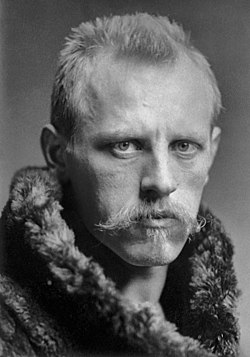
Fram leaves Bergen on 2 July 1893, bound for the Arctic Ocean Nansen's Fram expedition of 1893–1896 was an attempt by the Norwegian explorer Fridtjof Nansen to reach the geographical North Pole by harnessing the natural east–west current of the Arctic Ocean. In the face of much discouragement from other polar explorers, Nansen took his ship Fram to the New Siberian Islands in the eastern Arctic Ocean, froze her into the pack ice, and waited for the drift to carry her towards the pole. Impatient with the slow speed and erratic character of the drift, after 18 months Nansen and a chosen companion, Hjalmar Johansen, left the ship with a team of Samoyed dogs and sledges and made for the pole. They did not reach it, but they achieved a record Farthest North latitude of 86°13.6′N before a long retreat over ice and water to reach safety in Franz Josef Land. Meanwhile, Fram continued to drift westward, finally emerging in the North Atlantic Ocean.
The idea for the expedition had arisen after items from the American vessel Jeannette, which had sunk off the north coast of Siberia in 1881, were discovered three years later off the south-west coast of Greenland. The wreckage had obviously been carried across the polar ocean, perhaps across the pole itself. Based on this and other debris recovered from the Greenland coast, the meteorologist Henrik Mohn developed a theory of transpolar drift, which led Nansen to believe that a specially designed ship could be frozen in the pack ice and follow the same track as Jeannette wreckage, thus reaching the vicinity of the pole. (Full article...)
The 1952 Winter Olympics, officially known as the VI Olympic Winter Games (Norwegian: De 6. olympiske vinterleker; Nynorsk: Dei 6. olympiske vinterleikane) and commonly known as Oslo 1952, were a winter multi-sport event held from 14 to 25February 1952 in Oslo, the capital of Norway.
Discussions about Oslo hosting the Winter Olympic Games began as early as 1935; the city was keen to host the 1948 Winter Olympics, but that was made impossible by World War II. Instead, Oslo won the right to host the 1952 Games in a contest that included Cortina d'Ampezzo in Italy and Lake Placid in the United States. All of the Olympic venues were in Oslo's metropolitan area, except for the alpine skiing events, which were held at Norefjell, 113km (70mi) from the capital. A new hotel was built for the press and dignitaries, along with three dormitories to house athletes and coaches, creating the first modern athlete's village. Oslo bore the financial burden of hosting the Games in return for the revenue they generated. The 1952 Winter Olympics was the first of the two consecutive Olympics to be held in Northern Europe, preceding the 1952 Summer Olympics in Helsinki, Finland. (Full article...)
Image 6
Amundsen, Hanssen, Hassel, and Wisting at Polheim at the South Pole
The first expedition to reach the Geographic South Pole was led by the Norwegian explorer Roald Amundsen. He and four other crew members made it to the geographical South Pole on 14December 1911, which was to be five weeks ahead of the British party led by Robert Falcon Scott as part of the Terra Nova Expedition. Amundsen and his team returned safely to their base, and about a year later heard that Scott and his four companions had perished on their return journey.
Amundsen's initial plans had focused on the Arctic and the conquest of the North Pole by means of an extended drift in an icebound ship. He obtained the use of Fridtjof Nansen's polar exploration ship Fram, and undertook extensive fundraising in a country that had gained its independence only some six years earlier. Preparations for this expedition were disrupted when, in 1909, the rival American explorers Frederick Cook and Robert Peary each claimed to have reached the North Pole - both claims are highly disputed. Amundsen then changed his plan and began to prepare for a conquest of the South Pole; uncertain of the extent to which the public and his backers would support him, he kept this revised objective secret. When he set out in June1910, he led even his crew to believe they were embarking on an Arctic drift, and revealed their true Antarctic destination only when Fram was leaving their last port of call, Madeira, on 9 September 1910. (Full article...)
Operation Tungsten was a Second World War air raid by the Fleet Air Arm of the Royal Navy against the German battleship Tirpitz. The operation sought to damage or destroy Tirpitz at her base in Kaafjord in the far north of Norway before she could become fully operational again following a period of repairs.
The British decision to strike Kaafjord was motivated by fears that the battleship, upon re-entering service, would attack strategically important convoys carrying supplies to the Soviet Union. Removing the threat posed by Tirpitz would also allow the Allies to redeploy the capital ships which had to be held in the North Sea to counter her. After four months of training and preparations, the British Home Fleet sailed on 30 March 1944 and aircraft launched from five aircraft carriers struck Kaafjord on 3 April. The raid achieved surprise, and the British aircraft met little opposition. Fifteen bombs hit the battleship, and strafing by fighter aircraft inflicted heavy casualties on her gun crews. Four British aircraft and nine airmen were lost during the operation. (Full article...)
Image 8
The orca (Orcinus orca), or killer whale, is a toothed whale and the largest member of the oceanic dolphin family. The only extant species in the genus Orcinus, it is recognizable by its distinct pigmentation; being mostly black on top, white on the bottom and having recognizable white eye patches. A cosmopolitan species, it inhabits a wide range of marine environments, from Arctic to Antarctic regions to tropical seas, but is more commonly documented in temperate or cooler coastal waters. Scientists have proposed dividing the global population into races, subspecies, or possibly even species.
Orcas are apex predators with a diverse diet. Individual populations often specialize in particular types of prey, including bony fish, sharks, rays, and marine mammals such as seals, dolphins, and whales. They are highly social, with some populations forming stable matrilineal family groups (pods). Their sophisticated hunting techniques and vocal behaviors, often unique to specific groups and passed down from generation to generation, are considered to be manifestations of animal culture. The most studied populations are off the west coast of North America, which include fish-eating "residents", mammal-eating "transients", and offshores. (Full article...)
Frozen 2 was greenlit in March 2015 after a company debate about whether it would be perceived as inferior to the original. It used more-complex, enhanced animation technology compared to the first film, and was an interdepartmental collaboration. Anderson-Lopez and Lopez returned as the film's songwriters, and Christophe Beck again composed the score. The film was translated into 46 languages and was accompanied by Into the Unknown: Making Frozen 2, a documentary series. (Full article...)
The song received positive reviews. Chuck Taylor from Billboard said it was "absolutely enchanting" and would appeal to both young and mature listeners. It reached number 2 in Norway, number 4 in both Australia and New Zealand, number 16 in the UK and number 21 on the US Billboard Hot 100. It was certified gold in the US and Australia and remained M2M's biggest hit. M2M performed the song on episodes of the television series One World, Top of the Pops and Disney Channel in Concert. Two similar music videos were released for the song, with one showing clips from Pokémon: The First Movie. (Full article...)
Image 11
A British Lancaster bomber over Kaafjord during Operation Paravane
A British Lancaster bomber over Kaafjord during Operation Paravane
Operation Paravane was a British air raid of World War II that inflicted heavy damage on the German battleship Tirpitz, at anchor in Kaafjord in the far north of German-occupied Norway. The attack was conducted on 15 September 1944 by 21 Royal Air Forceheavy bombers, which flew from an airfield in the north of the Soviet Union. The battleship was struck by one bomb, and further damaged by several near misses. This damage rendered Tirpitz unfit for combat, and she could not be repaired as it was no longer possible for the Germans to sail her to a major port.
The attack on 15 September followed a series of raids conducted against Tirpitz with limited success by Royal Navy carrier aircraft between April and August 1944, seeking to sink or disable the battleship at her anchorage, so that she no longer posed a threat to Allied convoys travelling to and from the Soviet Union. The first of these raids was successful, but the other attacks failed due to shortcomings with the Fleet Air Arm's strike aircraft and the formidable German defences. As a result, the task of attacking the battleship was transferred to the RAF's Bomber Command. Avro Lancaster bombers from the Command's two elite squadrons flew to their staging airfield in the Soviet Union on the night of 11/12 September, and attacked on 15 September using heavy bombs and air-dropped mines. All of the British aircraft returned to base, though one of the Lancasters later crashed during its flight back to the United Kingdom. (Full article...)
Image 12
Amundsen's Norwegian party stand at the South Pole, 17 December 1911. They had reached 90°S two days earlier.
Significant steps on the road to the pole were the discovery of lands south of Cape Horn in 1619, Captain James Cook's crossing of the Antarctic Circle in 1773, and the earliest confirmed sightings of the Antarctic mainland in 1820. From the late 19th century onward, the quest for Farthest South latitudes became a race to reach the pole, which culminated in Roald Amundsen's success in December 1911. (Full article...)
In September 1967, Denmark, Norway, Sweden and the Netherlands brought the Greek case to the European Commission of Human Rights, alleging violations of the European Convention of Human Rights (ECHR) by the Greek junta, which had taken power earlier that year. In 1969, the Commission found serious violations, including torture; the junta reacted by withdrawing from the Council of Europe. The case received significant press coverage and was "one of the most famous cases in the Convention's history", according to legal scholar Ed Bates.
On 21April 1967, right-wing army officers staged a military coup that ousted the Greek government and used mass arrests, purges and censorship to suppress their opposition. These tactics soon became the target of criticism in the Parliamentary Assembly of the Council of Europe, but Greece claimed they were necessary as a response to alleged Communist subversion and justified under Article15 of the ECHR. In September 1967, Denmark, Norway, Sweden, and the Netherlands filed identical cases against Greece alleging violations of most of the articles in the ECHR that protect individual rights. The case was declared admissible in January 1968; a second case filed by Denmark, Norway and Sweden for additional violations, especially of Article3 forbidding torture, was declared admissible in May of that year. (Full article...)
He led the team that made the first crossing of the Greenland interior in 1888, traversing the island on cross-country skis. He won international fame after reaching a record northern latitude of 86°14′ during his Fram expedition of 1893–1896. Although he retired from exploration after his return to Norway, his techniques of polar travel and his innovations in equipment and clothing influenced a generation of subsequent Arctic and Antarctic expeditions. He was elected an International Member of the American Philosophical Society in 1897. (Full article...)
Borchgrevink was born and raised in Christiania (now Oslo) as the son of a Norwegian lawyer and an English-born immigrant mother. He began his exploring career in 1894 by joining a Norwegian whaling expedition, during which he became one of the first people to set foot on the Antarctic mainland. This achievement helped him to obtain backing for his Southern Cross expedition, which became the first to overwinter on the Antarctic mainland, and the first to visit the Great Ice Barrier since the expedition of Sir James Clark Ross nearly sixty years earlier. (Full article...)
Image 17
Z33 under attack by Allied aircraft on 9 February 1945
On 9February 1945, near the end of the Second World War, a force of Allied Bristol Beaufighter aircraft suffered many losses during an attack on the German destroyer Z33 and its escorting vessels; the operation was called Black Friday by the survivors. The German ships were sheltering in a strong defensive position in the Førde Fjord in Sogn og Fjordane county, Norway, forcing the Allied aircraft to attack through massed anti-aircraft fire (FlaK).
The Beaufighters and their escort of Mustang Mk III fighters from 65 Squadron RAF were intercepted by twelve Focke-Wulf Fw 190s of Jagdgeschwader 5 (Fighter Wing 5) of the Luftwaffe. The Allies damaged at least two of the German ships for the loss of seven Beaufighters shot down by FlaK. Two Beaufighters and a Mustang were shot down by the Fw 190s and four or five of the German aircraft were shot down by the Allied aircraft, including that of the ace Rudi Linz. (Full article...)
The second daughter of King Frederick II of Denmark and Sophie of Mecklenburg-Güstrow, Anne married James at age 14. They had three children who survived infancy: Henry Frederick, Prince of Wales, who predeceased his parents; Princess Elizabeth, who became Queen of Bohemia; and James's future successor, Charles I. Anne demonstrated an independent streak and a willingness to use factional Scottish politics in her conflicts with James over the custody of Prince Henry and his treatment of her friend Beatrix Ruthven. Anne appears to have loved James at first, but the couple gradually drifted and eventually lived apart, though mutual respect and a degree of affection survived. (Full article...)
Image 19
The black-throated loon (Gavia arctica), also known as the Arctic loon and the black-throated diver, is a migratoryaquatic bird found in the Northern Hemisphere, primarily breeding in freshwater lakes in northern Europe and Asia. It winters along sheltered, ice-free coasts of the north-east Atlantic Ocean and the eastern and western Pacific Ocean. This loon was first described by Carl Linnaeus in 1758 and has two subspecies. It was previously considered to be the same species as the Pacific loon, of which it is traditionally considered to be a sister species, although this is debated. In a study that used mitochondrial and nuclear intron DNA, the black-throated loon was found to be sister to a clade consisting of the Pacific loon and two sister species, the common loon and the yellow-billed loon.
The black-throated loon measures about 70cm (28in) in length and can weigh anywhere from 1.3 to 3.4 kilograms (2.9 to 7.5lb). In breeding plumage, the adult of the nominate subspecies has mostly black upperparts, with the exception of some of the mantle and scapulars, which have white squares. The head and hindneck are grey, and the sides white and striped black. Most of the throat is also black, giving this bird the name "black-throated loon". The colour of the throat patch can be used to distinguish the two subspecies; the throat patch of the other subspecies, G. a. viridigularis, is green. The underparts are mostly white, including the bottom of the throat. The flanks are also white, a feature that can be used to separate this bird from the Pacific loon. When the bird is not breeding, the black patch on the throat is absent, replaced with white; most of the black lines on the throat are also missing, except those on the bottom sides, and the upperparts are unpatterned except for a few white spots on the upperwing. The juvenile is similar to the non-breeding adult, except that it is overall browner. (Full article...)
A skilful pilot, Hull dedicated much of his pre-war service to aerobatics, flying Hawker Audaxes, Furies and Hurricanes. He reacted to the outbreak of war with enthusiasm and achieved No. 43 Squadron's first victory of the conflict in late January 1940. Reassigned to Norway in May 1940 to command a flight of Gloster Gladiator biplanes belonging to No. 263 Squadron, he downed four German aircraft in an hour over the Bodø area south-west of Narvik on 26 May, a feat that earned him the Distinguished Flying Cross. He was shot down the next day, and invalided back to England. Hull returned to action at the end of August, when he was made commander of No. 43 Squadron with the rank of squadron leader. A week later, he died in a dogfight over south London. (Full article...)
Operation Goodwood was a series of British carrierair raids conducted against the German battleship Tirpitz at her anchorage in Kaafjord in occupied Norway during late August 1944. It was the last of several attacks made by the Home Fleet during 1944 which sought to damage or sink Tirpitz and thereby eliminate the threat it posed to Allied shipping. Previous raids on Kaafjord conducted by Fleet Air Arm aircraft had involved only one air attack; in Operation Goodwood several attacks were made in a single week. The Royal Navy hoped that these raids would wear down the formidable German defences.
The British fleet departed its base on 18 August and launched the first raid against Kaafjord on the morning of 22 August. The attack failed, and a small raid that evening inflicted little damage. Attacks were conducted on 24 and 29 August and were also failures. Tirpitz had been hit by two bombs during the raid on 24 August, but neither caused significant damage. British losses during Operation Goodwood were 17 aircraft to all causes, a frigate sunk by a submarine, and an escort carrier badly damaged. German forces suffered the loss of 12 aircraft and damage to 7 ships. (Full article...)
Image 22
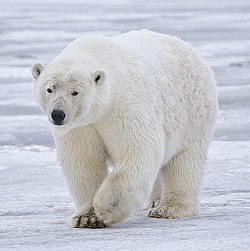
Female near Kaktovik, Barter Island, Alaska, United States
The polar bear (Ursus maritimus) is a large bear native to the Arctic and nearby areas. It is closely related to the brown bear, and the two species can interbreed. The polar bear is the largest extant species of bear and land carnivore by body mass, with adult males weighing 300–800kg (660–1,760lb). The species is sexually dimorphic, as adult females are much smaller. The polar bear is white or yellowish-furred with black skin and a thick layer of fat. It is more slender than the brown bear, with a narrower skull, longer neck and lower shoulder hump. Its teeth are sharper and more adapted to cutting meat. The paws are large and allow the bear to walk on ice and paddle in the water.
Polar bears are both terrestrial and pagophilic (ice-living) and are considered marine mammals because of their dependence on marine ecosystems. They prefer the annual sea ice but live on land when the ice melts in the summer. They are mostly carnivorous and specialized for preying on seals, particularly ringed seals. Such prey is typically taken by ambush; the bear may stalk its prey on the ice or in the water, but also will stay at a breathing hole or ice edge to wait for prey to swim by. The bear primarily feeds on the seal's energy-rich blubber. Other prey include walruses, beluga whales and some terrestrial animals. Polar bears are usually solitary but can be found in groups when on land. During the breeding season, male bears guard females and defend them from rivals. Mothers give birth to cubs in maternity dens during the winter. Young stay with their mother for up to two and a half years. (Full article...)
{{/box-footer|
Selected article –
The Nobel Institute in Oslo, Norway
The 2010 Nobel Peace Prize was awarded to imprisoned Chinese human rights activistLiu Xiaobo "for his long and non-violent struggle for fundamental human rights in China". The laureate, once an eminent scholar, was reportedly little-known inside the People's Republic of China (PRC) at the time of the award due to official censorship; he is a veteran of the Tiananmen Square protests of 1989, and a co-author of the Charter 08 manifesto for which he was sentenced to 11 years in prison on 25 December 2009. Liu, who was backed by Václav Havel and Desmond Tutu, received the award among a record field of more than 200 nominees. The decision, while widely praised by foreign intellectuals and politicians, was attacked by the Chinese government and the state media. A number of countries, including Saudi Arabia and Russia, also denounced the award and what they regarded as interference in China's domestic affairs. Following the announcement, official censorship was applied within China—on the Internet, television, and in print media. The government strongly denounced the award, and summoned the Norwegian ambassador in Beijing to make a formal protest. The Chinese authorities arrested citizens who attempted to celebrate. Liu's wife was put under house-arrest before the decision of the Nobel Committee was announced. (Fullarticle...)
The line had up to ten daily round trips with diesel multiple units, until passenger traffic was terminated in 1955. Freight traffic remained until 1988, when most of the line was abandoned in 1988, although 3 kilometers (2mi) was used until 2001. The line is owned by the Norwegian National Rail Administration. The station at Figgjo has been converted to a museum, and the 3-kilometer (2mi) section from there to Ålgård is used for recreational draisines. There have been proposals to reopen the line either as part of the Jæren Commuter Rail or the planned light rail for Greater Stavanger. (Full article...)
Image 4
LN‑OFU wreck at crash site at Skoddevarre
On 31 August 2019, an Airbus AS350 helicopter operated by a contracted Helitrans pilot from Sweden crashed in the mountains of Skoddevarre in Alta Municipality in Finnmark county, Norway. The crash happened during a sightseeing tour, killing all six people on board. The tour was offered by a local music festival, Høstsprell, who had been providing the service for seven years. The helicopter, registered as LN‑OFU, had recently been delivered and had undergone security checks hours before takeoff.
An investigation by the Norwegian Safety Investigation Authority (NSIA) found no technical faults with the machinery, and concluded that LN‑OFU had entered servo transparency; the stresses on the rotors had exceeded the hydraulic servomotor's capacity, causing the controls to lock up. This was caused by the helicopter's heavy load and rapid fluctuations in velocity and height. The pilot tried to regain control, but was ultimately unable to do so and crashed into the terrain. As the aircraft did not have a crash-resistant fuel system (CRFS), the wreck promptly caught fire, destroying most of it and inflicting lethal burns to the people on board; autopsies of the victims' bodies suggested that they died from their burns. The NSIA consequently called for the ban of commercial flights on rotorcraft without CRFSs in the European Union. Airworthiness certificates in the Euoropean Union were amended in 2024 to require CRFSs on helicopters. (Full article...)
Image 5
Modern artistic representation of Leif Erikson in Leif Erikson Park, Duluth, Minnesota
Leif Erikson, also known as Leif the Lucky (c.970s– c.1018 to 1025), was a Norse explorer who is thought to have been the first European to set foot on continental America, approximately half a millennium before Christopher Columbus. According to the sagas of Icelanders, he established a Norse settlement at Vinland, which is usually interpreted as being coastal North America. There is ongoing speculation that the settlement made by Leif and his crew corresponds to the remains of a Norse settlement found in Newfoundland, Canada, called L'Anse aux Meadows, which was occupied approximately 1,000 years ago.
Leif's place of birth is unknown, although it is assumed to have been in Iceland. His father, Erik the Red, founded the first Norse settlement in Greenland, where Leif was later raised. Following his voyage to Vinland and the subsequent death of his father, Leif became chief of the Greenland settlement. He had two known sons: Thorgils, born in the Hebrides; and Thorkell, who succeeded him as Greenland's chieftain. (Full article...)
Image 6
.sj is the Internetcountry code top-level domain (ccTLD) reserved for the designation Svalbard and Jan Mayen. The domain name registry is Norid, but .sj is not open for registration. The issuing of the domain was based on the ISO 3166 designation of Svalbard and Jan Mayen, which consists of two separately administrated integrated territories of Norway: the Arctic archipelago Svalbard and the nearly uninhabited volcanic island Jan Mayen. .sj was designated on 21 August 1997, at the same time as Bouvet Island was allocated .bv. Both were placed under the .no registry Norid, which is also the sponsor. Norwegian policy states that .no is sufficient for those institutions connected to both Svalbard and Jan Mayen, and therefore the domain is not open to registration. It is Norwegian policy not to commercialize domain resources, so there are no plans to sell .sj. Should the domain later come into use, it will be under regulation of the Norwegian Communications Authority and follow the same policy as .no. There are two second-level domains reserved for the two areas: svalbard.no and jan-mayen.no, but other web addresses are also used. (Full article...)
Svalbard is an archipelago in the Arctic Ocean under the sovereignty of Norway, but is subject to the special status granted by the Svalbard Treaty. Jan Mayen is a remote island in the Arctic Ocean; it has no permanent population and is administered by the County Governor of Nordland. Svalbard and Jan Mayen have in common that they are the only integrated parts of Norway not allocated to counties. Births, and burials (because of permafrost) only take place in mainland Norway. (Full article...)
The Hardanger Line (Norwegian: Hardangerbana or Hardangerbanen) was a 27.45-kilometre (17.06mi) railway between Vossevangen and Granvin in Hordaland county, Norway. The line connected to the Bergen Line in Voss Municipality and ran to the Hardangerfjord and the district of Hardanger. Construction started in 1921, but the line did not open until 1 April 1935. Owned and operated by Norwegian State Railways (NSB), passenger transport was provided by three NSB Class 64electric multiple units. They remained in use until 1985 when passenger transport was terminated. All transport ceased in 1988, and 21 kilometres (13mi) of the line was demolished in 1991. The 3 kilometres (2mi) from Voss to Palmafoss is still intact and is owned by the Norwegian National Rail Administration. The line featured six stations, fourteen halts and four tunnels and was one of Norway's steepest railways. It was NSB's first line to be electrified. The line was known as the Granvin Line (Granvinbanen) until February 1936. In 2016, Palmafoss established an emergency freight terminal and the tracks were re-established. (Full article...)
Immediately upon entering service, Blücher was assigned to the task force that supported the invasion of Norway in April 1940. Blücher served as the flagship of Konteradmiral (Rear Admiral) Oskar Kummetz, the commander of Group 5. The ship led the flotilla of warships into the Oslofjord on the night of 8 April, to seize Oslo, the capital of Norway. Two old 28cm (11in) coastal guns in the Oscarsborg Fortress engaged the ship at very close range, scoring two hits, as did several smaller guns in other batteries. Two torpedoes fired by a torpedo battery in the fortress struck the ship, causing serious damage. A major fire broke out aboard Blücher, which could not be contained. The fire spread to one of her anti-aircraft gun magazines, causing a large explosion, and then spread further to the ship's fuel bunkers. Blücher then capsized and sank with major loss of life. (Full article...)
Image 11
Aerial photo from 1962 of Nordberg station and surroundings
Nordberg was a station on the Sognsvann Line of the Oslo Metro in Oslo, Norway. It was opened on 10 October 1934, and was located between Østhorn and Holstein stations, in a level crossing with the steep road Borgestadveien. The station saw several accidents, and was closed on 5 May 1992 when the Sognsvann Line was upgraded to rapid transit standard. An underpass was constructed to allow pedestrians pass under the tracks. (Full article...)
Image 12
Ringerriksbanen utkast 2016
Draft of Ringeriksbanen from 2016. Simplified version of the route adopted by the Storting.
The Ringerike Line (Bokmål: Ringeriksbanen, Nynorsk: Ringeriksbana) is a proposed 40-kilometre (25mi) extension of the Bergen Line from Jong, Sandvika to Hønefoss, Norway. In 2022, the project was postponed; the government has no commitment to any timeframe (as of Q1 2026). Regional authorities and political groups continue to advocate for the project, which is fully planned but lacks funding and a construction start. If construction eventually begins, it is estimated to take 10–12 years to complete due to extensive tunnelling and civil works.
LN-SUG, the hijacked aircraft photographed in 1982
Braathens SAFE Flight 139 was an aircraft hijacking that occurred in Norway on 21 June 1985. The incident took place on a Boeing 737-205 belonging to Braathens SAFE that was on a scheduled domestic flight from Trondheim Airport, Værnes to Oslo Airport, Fornebu. The hijacker was Stein Arvid Huseby, who was drunk during most of the incident. It was the first plane hijacking to take place in Norway; there were no deaths and no injuries. Huseby was sentenced to three years' imprisonment and five years' detention.
Armed with an air gun, Huseby threatened a cabin attendant and told the captain to proceed as planned to Fornebu. He claimed (falsely) to have placed explosives on board. His demands were to make a political statement and talk to Prime Minister Kåre Willoch and Minister of Justice Mona Røkke. The plane landed at 15:30 at Fornebu and was surrounded by the police. After one hour, Huseby released 70 hostages in exchange for having the aircraft moved closer to the terminal building. Thirty minutes later, Huseby released the remaining passengers. He drank throughout the incident, and at 17:30, after he consumed the plane's beer supply, he surrendered his weapon in exchange for more beer. The plane was immediately stormed and Huseby arrested. (Full article...)
Image 14
A preserved Gullfisk
Class B and Class E, normally referred to as Gullfisk (Norwegian for "goldfish"), were a class of 46 trams built by Strømmens Værksted and Skabo Jernbanevognfabrikk for Oslo Sporveier and Bærumsbanen of Oslo, Norway, in 1937 and 1939. They were the first aluminium trams to operate on the Oslo Tramway and the first bogie trams to operate on street lines. They had contemporary modern electronic equipment, a streamlined shape, and comfortable accommodation. Until 1964, they were also faster than any other Norwegian tramcar or suburban railcar.
Six prototype trams were delivered by Strømmen in 1937, with four different motor solutions, from AEG, Siemens, Vickers and Norsk Elektrisk & Brown Boveri (NEBB). None of these were particularly successful, and the 40 serial production trams used conventional motors from ELIN. These were delivered in 1939, with 20 (class E) being used by Oslo Sporveier mainly on the Kjelsås Line, but also on other services. The remaining 20 trams (class B) were leased to Bærumsbanen, that used them on the Kolsås and Østensjø Lines, and later on the Ekeberg Line. (Full article...)
.bv is the Internetcountry code top-level domain (ccTLD) reserved for the uninhabited Norwegiandependent territory of Bouvet Island. The domain name registry and sponsor is Norid, but .bv is not open for registration. .bv was designated on 21 August 1997 and was placed under the .no registry Norid. Norwegian policy states that .no is sufficient for those institutions connected to Bouvet Island, and therefore the domain is not open to registration. It is Norwegian policy not to commercialize domain resources, so there are no plans to sell .bv. Should the domain later come into use, it will be under the regulation of the Norwegian Communications Authority and follow the same policy as .no. (Full article...)
Guttorm Sigurdsson (Old Norse: Guttormr Sigurðarson; 1199– 11 August 1204) was the king of Norway from January to August 1204, during the Norwegian civil war era. As a grandson of King Sverre, he was proclaimed king by the Birkebeiner faction when he was just four years old. Although obviously not in control of the events surrounding him, Guttorm's accession to the throne under the effective regency of Haakon the Crazy led to renewed conflict between the Birkebeiner and the Bagler factions, the latter supported militarily by Valdemar II of Denmark.
Guttorm's reign ended abruptly when the child king suddenly became ill and died. Rumours among the Birkebeiner held that Guttorm's illness and death had been caused by Haakon the Crazy's future wife Christina Nilsdatter, a claim considered dubious by modern historians. Low-intensity civil war followed Guttorm's death, until a settlement was reached in 1207, temporarily dividing the kingdom. (Full article...)
Founded in 1957, the company started a service between Venneshamn, Kjerringvik, Vangshylla, Hokstad, and Levanger. The initial owners of the company were a mixture of municipalities, the county, and private individuals and companies. In 1964, the company's operations were split into two services, each with a single crossing. Following the opening of the Skarnsund Bridge in 1991, the Vangshylla–Kjerringvik Ferry was terminated. In 2005, the company was taken over by Fosen Trafikklag, after the state decided that the route would be subject to public service obligation. The company lost the bid to Nor-Ferjer, and operation ceased at the end of 2006. (Full article...)
Image 20
Nels Nelsen in 1925
Nels Nelsen (3 June 1894 – 3 June 1943), born Nils Johan Nilsen and sometimes referred to as Nels Nelson, was a Norwegian-born Canadianski jumper active between 1916 and 1932. Later he was ski jumping organizer. He was among the world's best ski jumpers during the 1920s, and held the world record of 73 meters from 1925 to 1930. He was born in Salangen Municipality in Troms county, Norway. He moved with his family to Revelstoke, British Columbia, in 1912. Credited with bringing the sport of ski jumping to Canada, he made his debut on the nearby Big Hill in 1915. He competed throughout Canada and the United States, and became Canadian champion five times. Despite holding the world record at the time, he was not allowed to participate in the 1928 Winter Olympics because the officials did not find it suitable for him to have to work his way to Switzerland.
T1000 unit at Mortensrud The rolling stock of Oslo Metro, Norway, has consisted of three classes: T1000/T1300, T2000 and MX3000. The T1000 was built as 162 single cars from 1964 to 1978. From 1979 to 1985, 33 new T1300 trains were built, followed by the conversion of 16 T1000s. Six two-car T2000 units were delivered in 1994. Since 2005, the first 83 three-car MX3000 units have been replacing the older stock, and the last T1000 was retired in 2007. From 2010, only MX3000-trains are in use. The T1000/T1300 and T2000 were built by Strømmens Værksted, with motors from Norsk Elektrisk & Brown Boveri (NEBB) and AEG, respectively, and the MX3000 were built by Siemens.
All trains receive 750V DC from a third rail shoe, while the T1300 and T2000 also have pantographs. This allows the latter to also operate on the suburban lines of the Oslo Tramway, which the western part of the current metro was part of until 1995. All trains feature automatic train protection and step-free access from the platforms. Trains can operate up to six cars in length. The T1000/T1300 and MX3000 are capable of 70 kilometres per hour (43mph), while the T2000 can operate at 100 kilometres per hour (62mph). The T2000 introduced articulated cars, while the MX3000 introduced regenerative brakes and air conditioning. The T1000/T1300 and MX3000 can be run in multiple with each other, but not with the T2000. The MX3000 replaced the red color scheme with a white livery. (Full article...)
Image 22
Pitfalls is the sixth studio album by Norwegian progressive metal band Leprous, released on 25 October 2019 via Inside Out Music and preceded by the singles "Below", "Alleviate", and "Distant Bells". It was recorded over six months at Ghostward Studios. A cellist, violinist, and classical choir were recruited for the production. Most of the songs were written and composed by Leprous vocalist Einar Solberg.
A majority of critics approved of the album, bestowing particular esteem on the singing as well as the songs "Below", "Observe the Train", "At the Bottom", and "The Sky Is Red". Solberg's creative control was for some a point of contention. Pitfalls charted higher than its predecessor Malina in the Wallonia region of Belgium, Finland, France, the UK (rock and metal releases), and Top Heatseekers in the US. (Full article...)
Between 1925 and 1928, Ny-Ålesund saw four air expeditions to the North Pole, two of which required the construction of an airship hangar and mast. The first proposal for an airport in Ny-Ålesund was launched in 1956 by Norsk Polar Navigasjon, who proposed an airport at Kvadehuksletta. Soviet protests against the airport caused the Norwegian authorities to oppose the plans, which were abandoned in the early 1960s. Construction at Hamnerabben started in 1965 following the decision to build Kongsfjord Telemetry Station. The airport first hosted service to temporary landing strips near Longyearbyen, but from 1975 served Svalbard Airport. Lufttransport started flights with helicopters in the 1980s, but from 1989 has flown with fixed-wing aircraft. (Full article...)
The station opened as Raastad, later Råstad, in 1881. It had a single building, designed by Balthazar Lange. It was upgraded with a passing loop in 1910, but this was removed in 1971, and the station was closed in 1978. In 2008, the station reopened to serve the airport. The station is owned by the Norwegian National Rail Administration. (Full article...)


_(-mini_map_-rivers).svg)
 Featured article –
 Image 1
 Corsair fighters and Barracuda bombers ranged on the flight deck of HMS Formidable during operations off Norway in July 1944
 Bosse as Indra's daughter at the 1907 première of A Dream Play (1902) by August Strindberg

 Amundsen, Hanssen, Hassel, and Wisting at Polheim at the South Pole
 A Fleet Air Arm crewman chalks a message on the 1,600-pound bomb carried by a Fairey Barracuda of HMS Furious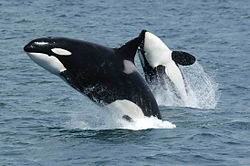


 Nansen in 1890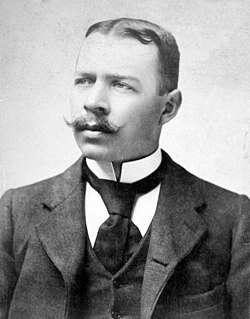
 Z33 under attack by Allied aircraft on 9 February 1945
 1605 portrait
 Hull at RAF Wick in Scotland in early 1940
 Barracuda bombers and Corsair fighters being armed on the flight deck of HMS Formidable during Operation Goodwood
 Female near Kaktovik, Barter Island, Alaska, United States


.jpg)


.jpg)




 Image 4Battle of Alvøen between the frigate HMS Tartar and Norwegian gunboats near Bergen in 1808 (from History of Norway)

 Image 7Homann's map of the Scandinavian Peninsula and Fennoscandia with their surrounding territories: northern Germany, northern Poland, the Baltic region, Livonia, Belarus, and parts of Northwest Russia. Johann Baptist Homann (1664–1724) was a German geographer and cartographer; map dated around 1730. (from History of Norway)
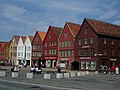 Image 9Bryggen in Bergen, once the centre of trade in Norway under the Hanseatic League trade network, now preserved as a World Heritage Site (from History of Norway)
 Image 10Edvard Munch's The Scream (1893) (from Culture of Norway)
 Image 13Map of Denmark–Norway (from History of Norway)
 Image 14Norwegian Prime Minister Kjell Magne Bondevik met with U.S. President George W. Bush at the Oval Office in White House, on 27 May 2003. (from History of Norway)

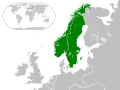 Image 17Map of Sweden–Norway (from History of Norway)
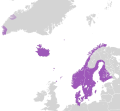


 Image 25Traditional Norwegian St. Hansbål (midsummer) bonfire in Laksevåg, Bergen Municipality (from Culture of Norway)
 Image 27Roald Amundsen, Helmer Hanssen, Sverre Hassel and Oscar Wisting (l–r) at Polheim, the tent erected at the South Pole on 16 December 1911 as the first expedition (from History of Norway)


.jpg)

.jpg)


.jpg)

.jpg)


 Good article –

 Lysgårdsbakken
 Foss-Eikeland
 LN‑OFU wreck at crash site at Skoddevarre
 Modern artistic representation of Leif Erikson in Leif Erikson Park, Duluth, Minnesota

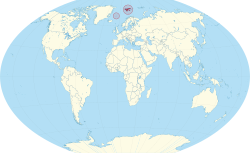 Location of Svalbard and Jan Mayen in the world
 NSB Class 64 train at Granvin
 Blücher while on trials
 Aerial photo from 1962 of Nordberg station and surroundings
 LN-SUG, the hijacked aircraft photographed in 1982
 A preserved Gullfisk

 Nels Nelsen in 1925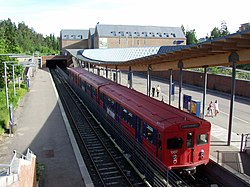


.jpg)


.jpg)

.jpg)
.svg)


_Oppdal.jpg)
_cocoon_Dovrefjell.jpg)


.jpg)


_with_its_prey.jpg)

_-_Restoration.jpg)


 Commons
 Wikidata
 Wikiquote
 Wikisource
 Wikiversity
 Wikivoyage
 Wiktionary


