The Numismatics Portal

Numismatics is the study or collection of currency, including coins, tokens, paper money, medals, and related objects. Experts of this study, known as numismatists, are often characterized as students or collectors of coins, but the discipline also includes the broader study of money and other means of payment used to resolve debts and exchange goods.
The earliest forms of money used by people are categorised by collectors as "odd and curious", but the use of other goods in barter exchange is excluded, even where used as a circulating currency (e.g., cigarettes or instant noodles in prison). As an example, the Kyrgyz people used horses as the principal currency unit, and gave small change in lambskins; the lambskins may be suitable for numismatic study, but the horses are not. Many objects have been used for centuries, such as cowry shells, precious metals, cocoa beans, large stones, and gems. (Full article...)
 Featured article -

 Image 1
The three-dollar piece was a gold coin produced by the United States Bureau of the Mint from 1854 to 1889. Authorized by the Act of February 21, 1853, the coin was designed by Mint Chief Engraver James B. Longacre. The obverse bears a representation of Lady Liberty wearing a headdress of a Native American princess and the reverse a wreath of corn, wheat, cotton, and tobacco.
In 1851, Congress had authorized a silver three-cent piece so that postage stamps of that value could be purchased without using the widely disliked copper cents. Two years later, a bill was passed which authorized a three-dollar coin. By some accounts, the three-dollar coin was introduced to make it easier to buy a full sheet of 100 three-cent stamps in a single transaction. Longacre, in designing the piece, sought to make it as different as possible from the quarter eagle or $2.50 piece, striking it on a thinner planchet and using a distinctive design. (Full article...)- Image 2

The Buffalo nickel or Indian Head nickel is a copper–nickel five-cent piece that was struck by the United States Mint from 1913 to 1938. It was designed by sculptor James Earle Fraser.
As part of a drive to beautify the coinage, five denominations of US coins had received new designs between 1907 and 1909. In 1911, Taft administration officials decided to replace Charles E. Barber's Liberty Head design for the nickel, and they commissioned Fraser to do the work. They were impressed by Fraser's designs showing a Native American and an American bison. The designs were approved in 1912, but were delayed several months because of objections from the Hobbs Manufacturing Company, which made mechanisms to detect slugs in nickel-operated machines. The company was not satisfied by changes made in the coin by Fraser, and, in February 1913, Treasury Secretary Franklin MacVeagh decided to issue the coins despite the objections. (Full article...) - Image 3

The Huguenot-Walloon half dollar or Huguenot-Walloon Tercentenary half dollar is a commemorative coin issued by the United States Bureau of the Mint in 1924. It marks the 300th anniversary of the voyage of the Nieuw Nederlandt which landed in the New York area in 1624. Many of the passengers were Huguenots from France or French-speaking Walloons from what is now Belgium; they became early settlers of New York State and the surrounding area.
A commission run by the Federal Council of Churches in America sought issuance of a half dollar to mark the anniversary, and the bill passed through Congress without opposition in 1923 and was signed by President Warren G. Harding. Sketches were prepared by commission chairman Reverend John Baer Stoudt and converted to plaster models by the Mint's aging chief engraver, George T. Morgan. The models were initially rejected by the Commission of Fine Arts, which required revisions under the supervision of Buffalo nickel designer James Earle Fraser. (Full article...) - Image 4

Cameo of Pistrucci (ca. 1850, by his daughter, Elisa)
Benedetto Pistrucci (29 May 1783 – 16 September 1855) was an Italian gem-engraver, medallist and a coin engraver, probably best known for his Saint George and the Dragon design for the British sovereign coin. Pistrucci was commissioned by the British government to create the large Waterloo Medal, a project which took him thirty years to complete.
Born in Rome in 1783, Pistrucci studied briefly with other artists before striking out on his own at age 15. He became prominent as a cameo carver and was patronised by royalty. In 1815, he moved to Britain, where he would live for most of the rest of his life. His talent brought him to the attention of notables including William Wellesley-Pole, the Master of the Mint. Pole engaged Pistrucci to design new coinage, including the sovereign, which was first issued in 1817 to mixed reactions. Although Pole probably promised Pistrucci the post of Chief Engraver, the position could not be awarded as only a British subject could hold it. This slight became a long-term grievance for Pistrucci. (Full article...) - Image 5

The American twenty-cent piece is a coin struck from 1875 to 1878, but only for collectors in the final two years. Proposed by Nevada Senator John P. Jones, it proved a failure due to confusion with the quarter, to which it was close in both size and value.
In 1874, the newly elected Jones began pressing for a twenty-cent piece, which he stated would alleviate the shortage of small change in the Far West. The bill passed Congress, and Mint Director Henry Linderman ordered pattern coins struck. Linderman eventually decided on an obverse and reverse similar to that of other silver coins. (Full article...) - Image 6

The Washington quarter is the present quarter dollar or 25-cent piece issued by the United States Mint. The coin was first struck in 1932; the original version was designed by sculptor John Flanagan.
As the United States prepared to celebrate the 1932 bicentennial of the birth of its first president, George Washington, members of the bicentennial committee established by Congress sought a Washington half dollar. They wanted to displace for that year only the regular issue Walking Liberty half dollar; instead Congress permanently replaced the Standing Liberty quarter, requiring that a depiction of Washington appear on the obverse of the new coin. The committee had engaged sculptor Laura Gardin Fraser to design a commemorative medal, and wanted her to adapt her design for the quarter. Although Fraser's work was supported by the Commission of Fine Arts (CFA) and its chairman, Charles W. Moore, Treasury Secretary Andrew W. Mellon chose a design by Flanagan, and Mellon's successor, Ogden L. Mills, refused to disturb the decision. (Full article...) - Image 7

The Rhode Island Tercentenary half dollar (sometimes called the Providence, Rhode Island, Tercentenary half dollar) is a commemorative fifty-cent piece struck by the United States Bureau of the Mint in 1936. The coin was designed by John Howard Benson and Arthur Graham Carey. Its obverse depicts Roger Williams, founder of the Colony of Rhode Island and Providence Plantations. It was intended to honor the 300th anniversary of Providence, Rhode Island, although it bears no mention of the city.
Members of Rhode Island's congressional delegation sought a coin for the 300th anniversary of Providence, and Senator Jesse Metcalf added authorization for one to a bill for another commemorative coin that had already passed the United States House of Representatives. The amended bill was approved by both houses of Congress, and it was signed by President Franklin D. Roosevelt. A total of 50,000 coins were struck at the three mints then in operation. (Full article...) - Image 8

The Flying Eagle cent is a one-cent piece struck by the Mint of the United States as a pattern coin in 1856 and for circulation in 1857 and 1858. The coin was designed by Mint Chief Engraver James B. Longacre, with the eagle in flight based on the work of Longacre's predecessor, Christian Gobrecht.
By the early 1850s, the large cent (about the size of a half dollar) being issued by the Mint was becoming both unpopular in commerce and expensive to mint. After experimenting with various sizes and compositions, the Mint decided on an alloy of 88% copper and 12% nickel for a new, smaller cent. After the Mint produced patterns with an 1856 date and gave them to legislators and officials, Congress formally authorized the new piece in February 1857. (Full article...) - Image 9The penny of Great Britain and the United Kingdom from 1714 to 1901, the period in which the House of Hanover reigned, saw the transformation of the penny from a little-used small silver coin to the bronze piece recognisable to modern-day Britons. All bear the portrait of the monarch on the obverse; copper and bronze pennies have a depiction of Britannia, the female personification of Britain, on the reverse.
During most of the 18th century, the penny was a small silver coin rarely seen in circulation, and that was principally struck to be used for Maundy money or other royal charity. Beginning in 1787, the chronic shortage of good money resulted in the wide circulation of private tokens, including large coppers valued at one penny. In 1797 industrialist Matthew Boulton gained a contract to produce official pennies at his Soho Mint in Birmingham; he struck millions of pennies over the next decade. After that, it was not until 1825 that pennies were struck again for circulation, and the copper penny continued to be issued until 1860. (Full article...) - Image 10

The California Diamond Jubilee half dollar was a United States commemorative silver fifty-cent piece struck at the San Francisco Mint in 1925. It was issued to celebrate the 75th anniversary of California statehood.
The San Francisco Citizens' Committee wished to issue a commemorative coin as a fundraiser for a celebration of the statehood diamond jubilee. A California congressman attached authorization for it to another coinage bill, which was approved by Congress in early 1925. Designs by sculptor Jo Mora met a hostile reception at the Commission of Fine Arts, but the Citizens' Committee would not change them, and they were approved. The coin has been widely praised for its beauty in the years since. (Full article...) - Image 11

The Franklin half dollar is a coin that was struck by the United States Mint from 1948 to 1963. The fifty-cent piece pictures Founding Father Benjamin Franklin on the obverse and the Liberty Bell on the reverse. A small eagle was placed to the right of the bell to fulfill the legal requirement that half dollars depict the figure of an eagle. Produced in 90 percent silver with a reeded edge, the coin was struck at the Philadelphia, Denver, and San Francisco mints.
Mint director Nellie Tayloe Ross had long admired Franklin, and wanted him to be depicted on a coin. In 1947, she instructed her chief engraver, John R. Sinnock, to prepare designs for a Franklin half dollar. Sinnock's designs were based on his earlier work, but he died before their completion. The designs were completed by Sinnock's successor, Gilroy Roberts. The Mint submitted the new designs to the Commission of Fine Arts ("Commission") for its advisory opinion. The Commission disliked the small eagle and felt that depicting the crack in the Liberty Bell would expose the coinage to jokes and ridicule. Despite the Commission's disapproval, the Mint proceeded with Sinnock's designs. (Full article...) - Image 12
 Mehl c. 1950
Benjamin Maximillian Mehl (November 5, 1884 – September 28, 1957), usually known as B. Max Mehl, was an American dealer in coins, selling them for over half a century. The most prominent dealer in the United States, through much of the first half of the 20th century, he is credited with helping to expand the appeal of coin collecting from a hobby for the wealthy to one enjoyed by many.
Mehl was born in Congress Poland, which was part of the Russian Empire. His family brought him to what is now Lithuania, and then to the United States, settling in Fort Worth, Texas, where he lived for almost all of his adult life. While still a teenager, he began to sell coins, which he had previously collected. Joining the American Numismatic Association (ANA) in 1903 at age 18, he quickly became a full-time coin dealer, and by 1910 was one of the most well known in the country. (Full article...) - Image 13

The British florin, or two-shilling piece (2/– or 2s.), was a coin worth 1⁄10 of one pound, or 24 pence. It was issued from 1849 until 1967, with a final issue for collectors dated 1970. It was the last coin circulating immediately prior to decimalisation to be demonetised, in 1993, having for a quarter of a century circulated alongside the ten-pence coin, identical in specifications and value.
The florin was introduced as part of an experiment in decimalisation that went no further at the time. The original florins, dated 1849, attracted controversy for omitting a reference to God from Queen Victoria's titles; that type is accordingly known as the "Godless florin", and was in 1851 succeeded by the "Gothic florin", for its design and style of lettering. Throughout most of its existence, the florin bore some variation of either the shields of the United Kingdom, or the emblems of its constituent nations on the reverse, a tradition broken between 1902 and 1910, when the coin featured a windswept figure of a standing Britannia. (Full article...) - Image 14

The Long Island Tercentenary half dollar was a commemorative half dollar struck by the United States Bureau of the Mint in 1936. The obverse depicts a male Dutch settler and an Algonquian tribesman, and the reverse shows a Dutch sailing ship. It was designed by Howard Weinman, the son of Mercury dime designer Adolph A. Weinman.
The Long Island Tercentenary Committee wanted a coin to mark the 300th anniversary of the first European settlement there, at modern Flatlands, Brooklyn, New York City. The authorizing bill passed through Congress without opposition. Still, it was amended in the Senate to add protections against past commemorative coin abuses, such as low mintages or an assortment of varieties. On April 13, 1936, the bill became law with the signature of President Franklin D. Roosevelt. (Full article...) - Image 15

The Albany Charter half dollar, also known as the Albany-Dongan half dollar or Albany half dollar, is a commemorative half dollar struck by the United States Bureau of the Mint in 1936. It was designed by sculptor Gertrude K. Lathrop, who lived in Albany, New York's state capital.
In 1936, Congress approved many commemorative coins for issuance, including some of mostly local significance. These included the Albany piece, wanted by city officials to mark the 250th anniversary of the 1686 grant of its municipal charter by Thomas Dongan, governor of colonial New York. The authorizing bill passed through Congress without opposition, though amendments added protections for coin collectors against abuses seen in earlier commemorative issues. Lathrop's designs have generally been praised: she placed a beaver on one side of the coin, modeled from life (one appears on Albany's city seal) and depicted the persons involved in the grant of the charter on the other. After approval of the designs by the Commission of Fine Arts, the Philadelphia Mint coined 25,013 Albany half dollars in October 1936, including 13 pieces for testing by the Assay Commission. (Full article...)


.jpg)
.jpg)

.jpg)

.jpg)

.png)


Selected article -

The banknotes of Zimbabwe are the physical forms of Zimbabwean currency, including the dollar ($ or Z$) and the ZiG. The Reserve Bank of Zimbabwe has issued most of the banknotes and other types of currency notes in its history, including bearer cheques and special agro-cheques ("agro" being short for agricultural) that circulated from September 2003 until December 2008, and bond notes from November 2016 until November 2019: Standard Chartered Zimbabwe also circulated their own emergency cheques from June 2003 to September 2004.
The first Zimbabwean banknotes were rolled out for the first dollar between July 1981 an April 1982, and replaced those of the Rhodesian dollar at par: banknotes (and later bearer cheques) of the first dollar circulated until August 2006, when they were replaced by bearer cheques of the second dollar due to high inflation (which escalated into hyperinflation in March 2007). Cheques (and later agro-cheques) of the second dollar were itself replaced by banknotes of the third dollar in August 2008, which were itself replaced by those of the fourth dollar in February 2009. The power-sharing government of Prime Minister Morgan Tsvangirai abandoned the Zimbabwean dollar in April 2009, and banknotes of the third and fourth dollars were demonetised in September 2015 after over 6 years of disuse. Zimbabwean banknotes were reintroduced in November 2016, initially in response to a shortage of hard currency. (Full article...)
Selected image

Credit: commons:User:Hiàn
The Big Nickel at Dynamic Earth in Sudbury, Ontario.
Did you know...

- ...that with its two-dollar coin (reverse pictured), Newfoundland was the only British colony to issue circulating gold coinage?
- ...that Mount Burgess is nicknamed the Ten Dollar Mountain because it was featured on Canadian currency?
- ...that the American Buffalo gold bullion coin was the first .9999 fine 24-carat gold coin released by the United States Mint?
- ...that the Alabama centennial half dollar was the first commemorative coin minted with the image of a living individual?
- ...that Aksumite currency was the only native coinage to be issued in Africa without direct influence by an outside culture like Roman, Greek, etc...?
Related portals
Selected coin -

The daric was a gold coin which, along with a similar silver coin, the siglos, represented the bimetallic monetary standard of the Achaemenid Empire.
Cyrus the Great (550–530 BC) introduced coins to the Persian Empire after 546 BC, following his conquest of Lydia and the defeat of its king Croesus, who had put in place the first coinage in history. It seems Cyrus initially adopted the Lydian coinage as such, and continued to strike Lydia's lion-and-bull coinage. (Full article...)
Selected banknote image -

Credit: commons:User:Red devil 666
Series of 1886 $1 silver certificates portraying Martha Washington, the only woman in United States history to be featured on its banknotes.
General images -
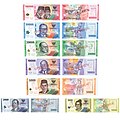 Image 1Many currencies, such as the Indonesian rupiah, vary the sizes of their banknotes by denomination. This is done so that they may be told apart through touch alone. (from Banknote)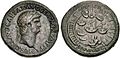
 Image 3Song dynasty Jiaozi, the world's earliest paper money (from Currency)
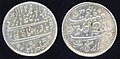

 Image 7Silver stater of Aegina, 550–530 BC. Obverse: sea turtle with large pellets down centre. Reverse: incuse square punch with eight sections. (from Coin)
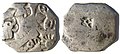 Image 8Silver coin of the Maurya Empire, known as rūpyarūpa, with symbols of wheel and elephant. 3rd century BC (from History of money)
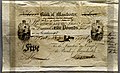 Image 9Collage for banknote design with annotations and additions to show proposed changes (figure rather higher so as to allow room for the No.), Bank of Manchester, UK, 1833. On display at the British Museum in London (from Banknote)
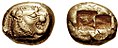 Image 10A 7th century one-third stater coin from Lydia, shown larger (from History of money)
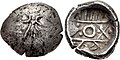 Image 11Punch-marked coin minted in the Kabul Valley under Achaemenid administration, c. 500–380 BC, or c. 350 BC. (from Coin)
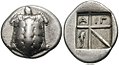 Image 12Greek drachm of Aegina. Obverse: Land turtle. Reverse: ΑΙΓ(INA) and dolphin (from History of money)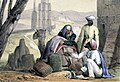

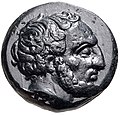 Image 15The Achaemenid Empire satraps and dynasts in Asia Minor developed the usage of portraiture from c. 420 BC. Portrait of the satrap of Lydia, Tissaphernes (c. 445–395 BC). (from Coin)
 Image 16Earliest banknote from China during the Song Dynasty which is known as "Jiaozi" (from History of money)
 Image 17Holographic coin from Liberia features the Statue of Liberty (Liberty Enlightening the World) (from Coin)
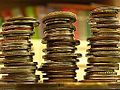 Image 18Coins can be stacked. (from Coin)
 Image 19Genoese 10 doppie, 1641 (from History of money)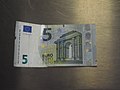
 Image 21A Swiss ten-cent coin from 1879, similar to the oldest coins still in official use today (from Coin)
 Image 22A siglos found in the Kabul valley, 5th century BC. Coins of this type were also found in the Bhir Mound hoard. (from Coin)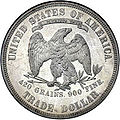
![Image 24Chinese round coins, Eastern Zhou dynasty – Warring States Period, c. 300–220 BC. Four Hua (四化, 30mm, 6.94 g). Legend Yi Si Hua ([City of] Yi Four Hua). (from Coin)](https://upload.wikimedia.org/wikipedia/commons/thumb/f/f9/CHINA%2C_Eastern_Zhou_dynasty_-_Warring_States_Period._State_of_Q%C3%AD._City_of_Yi._Circa_300-220_BC.jpg/120px-CHINA%2C_Eastern_Zhou_dynasty_-_Warring_States_Period._State_of_Q%C3%AD._City_of_Yi._Circa_300-220_BC.jpg) Image 24Chinese round coins, Eastern Zhou dynasty – Warring States Period, c. 300–220 BC. Four Hua (四化, 30mm, 6.94 g). Legend Yi Si Hua ([City of] Yi Four Hua). (from Coin)
Image 24Chinese round coins, Eastern Zhou dynasty – Warring States Period, c. 300–220 BC. Four Hua (四化, 30mm, 6.94 g). Legend Yi Si Hua ([City of] Yi Four Hua). (from Coin) Image 25Timeline of monetary history (from History of money)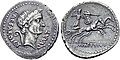
 Image 27An oxhide ingot from Crete. Late Bronze Age metal ingots were given standard shapes, such as the shape of an "ox-hide", suggesting that they represented standardized values. (from Coin)
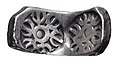 Image 28Gandharan "bent-bar" punch-marked coin minted under Achaemenid administration, of the type found in large quantities in the Chaman Hazouri and the Bhir Mound hoards. (from Coin)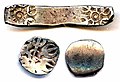
 Image 30The Piloncitos are tiny engraved gold coins found in the Philippines, along with barter rings, which are gold ring-like ingots. These barter rings are bigger than softballs in size and are made of pure gold from the Archaic period (c. 10th to 16th century). (from Coin)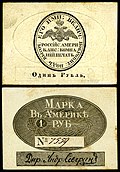
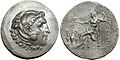 Image 32Alexander the Great Tetradrachm from the Temnos Mint, c. 188–170 BC (from Coin)
 Image 33Five million mark coin (Weimar Republic, 1923). Despite its high denomination, this coin's monetary value dropped to a tiny fraction of a US cent by the end of 1923, substantially less than the value of its metallic content. (from Coin)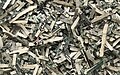
 Image 35French 1992 twenty Franc Tri-Metallic coin (from Coin)
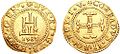 Image 36Genoese doppia, 1589 (from History of money)
 Image 37Obverse and reverse of an old American $100 note (1928) (from Banknote)
 Image 38Name of currency units by country, in Portuguese (from Currency)


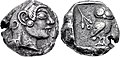 Image 43Athenian coin (c. 500/490–485 BC) discovered in the Shaikhan Dehri hoard in Pushkalavati, Pakistan. This coin is the earliest known example of its type to be found so far east. (from Coin)
 Image 44Egyptian gold stater of Nectanebo II: reverse with hieroglyphs nfr-nb (around 360 BC). (from Currency)
- Image 45Posthumous Alexander the Great tetradrachm from Temnos, Aeolis. Dated 188–170 BC. Obverse: Alexander the Great as Herakles facing right wearing the nemean lionskin. Reverse: Zeus seated on throne to the left holding eagle in right hand and scepter in left; in left field PA monogram and angular sigma above grape vine arching over oinochoe; ALEXANDROU vertical in right field. Reference: Price 1678. (from Coin)
 Image 46Shredded and briquetted US dollar notes from the Federal Reserve Bank of New York (approx. 1000 pieces, 1 kg) (from Banknote)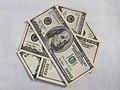

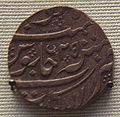 Image 49The French Indies Company issued rupees in the name of Muhammad Shah (1719–1748) for Northern India trade. This was cast in Pondicherry. (from History of money)
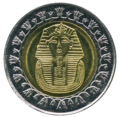 Image 50Bimetallic Egyptian one pound coin featuring King Tutankhamen (from Coin)
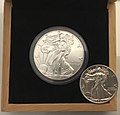 Image 51An American Silver Eagle minted in 2019 (left), an example of a Bullion coin. Its obverse design is based on the older, formerly circulating silver Walking Liberty half dollar (right). (from Coin)
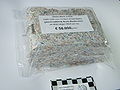 Image 52Shredded and briquetted euro banknotes from the Deutsche Bundesbank, Germany (approx. 1 kg) (from Banknote)
 Image 53Genoese scudo, 1541 (from History of money)
 Image 54A $5 note issued by Citizens Bank of Louisiana in the 1850s. (from Banknote)
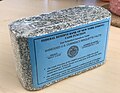 Image 55Shredded and briquetted US dollar notes from the Federal Reserve Bank of New York (approx. 1000 pieces, 1 kg) (from Banknote)


.jpg)


![Image 24Chinese round coins, Eastern Zhou dynasty – Warring States Period, c. 300–220 BC. Four Hua (四化, 30mm, 6.94 g). Legend Yi Si Hua ([City of] Yi Four Hua). (from Coin)](/wiki/page/File%3ACHINA%2C_Eastern_Zhou_dynasty_-_Warring_States_Period._State_of_Q%C3%AD._City_of_Yi._Circa_300-220_BC.jpg)


.jpg)


.jpg)


Numismatic terminology
- Bullion – Precious metals (platinum, gold and silver) in the form of bars, ingots or plate.
- Error – Usually a mis-made coin not intended for circulation, but can also refer to an engraving or die-cutting error not discovered until the coins are released to circulation. This may result is two or more varieties of the coin in the same year.
- Exonumia – The study of coin-like objects such as token coins and medals, and other items used in place of legal currency or for commemoration.
- Fineness – Purity of precious metal content expressed in terms of one thousand parts. 90% is expressed as .900 fine.
- Notaphily – The study of paper money or banknotes.
- Scripophily – The study and collection of stocks and Bonds.
WikiProjects

Numismatic topics
Money - Coins - Banknotes - Electronic money - Exchange rate - Legal tender - Clubs - Terminology
Ancient currency: Asia - Byzantium - Greece - Primitive Money - Roman - Indian coinage
Modern currency: Africa - The Americas - Asia and the Pacific - Europe - Bullion coins - Challenge coin - Commemorative coins - Token coins
Economics: Banking - Bonds - Cheques - Credit Cards - Fiat currency - Gold standard - Mints - Monetary union - Reserve currency - Stocks
Production: Coining (machining) - Designers - Die making - Mint (coin) • Coinage Metals: Aluminum - Bronze - Copper - Gold - Platinum - Silver - Tin
Subcategories

Most traded currencies
| Currency | ISO 4217 code |
Proportion of daily volume | Change (2022–2025) | |
|---|---|---|---|---|
| April 2022 | April 2025 | |||
| U.S. dollar | USD | 88.4% | 89.2% |  0.8pp 0.8pp |
| Euro | EUR | 30.6% | 28.9% |  1.7pp 1.7pp |
| Japanese yen | JPY | 16.7% | 16.8% | 0.1pp |
| Pound sterling | GBP | 12.9% | 10.2% | 2.7pp |
| Renminbi | CNY | 7.0% | 8.5% | 1.5pp |
| Swiss franc | CHF | 5.2% | 6.4% | 1.2pp |
| Australian dollar | AUD | 6.4% | 6.1% | 0.3pp |
| Canadian dollar | CAD | 6.2% | 5.8% | 0.4pp |
| Hong Kong dollar | HKD | 2.6% | 3.8% | 1.2pp |
| Singapore dollar | SGD | 2.4% | 2.4% |  |
| Indian rupee | INR | 1.6% | 1.9% | 0.3pp |
| South Korean won | KRW | 1.8% | 1.8% | |
| Swedish krona | SEK | 2.2% | 1.6% | 0.6pp |
| Mexican peso | MXN | 1.5% | 1.6% | 0.1pp |
| New Zealand dollar | NZD | 1.7% | 1.5% | 0.2pp |
| Norwegian krone | NOK | 1.7% | 1.3% | 0.4pp |
| New Taiwan dollar | TWD | 1.1% | 1.2% | 0.1pp |
| Brazilian real | BRL | 0.9% | 0.9% | |
| South African rand | ZAR | 1.0% | 0.8% | 0.2pp |
| Polish złoty | PLN | 0.7% | 0.8% | 0.1pp |
| Danish krone | DKK | 0.7% | 0.7% | |
| Indonesian rupiah | IDR | 0.4% | 0.7% | 0.3pp |
| Turkish lira | TRY | 0.4% | 0.5% | 0.1pp |
| Thai baht | THB | 0.4% | 0.5% | 0.1pp |
| Israeli new shekel | ILS | 0.4% | 0.4% | |
| Hungarian forint | HUF | 0.3% | 0.4% | 0.1pp |
| Czech koruna | CZK | 0.4% | 0.4% | |
| Chilean peso | CLP | 0.3% | 0.3% | |
| Philippine peso | PHP | 0.2% | 0.2% | |
| Colombian peso | COP | 0.2% | 0.2% | |
| Malaysian ringgit | MYR | 0.2% | 0.2% | |
| UAE dirham | AED | 0.4% | 0.1% | 0.3pp |
| Saudi riyal | SAR | 0.2% | 0.1% | 0.1pp |
| Romanian leu | RON | 0.1% | 0.1% | |
| Peruvian sol | PEN | 0.1% | 0.1% | |
| Other currencies | 2.6% | 3.4% | 0.8pp | |
| Total[a] | 200.0% | 200.0% | ||
References
- Triennial Central Bank Survey Foreign exchange turnover in April 2025 (PDF) (Report). Bank for International Settlements. 30 September 2025. p. 14. Archived (PDF) from the original on 2025-10-12.
Web resources
- NumisWiki
- International Association of Professional Numismatists
- American Numismatic Association
- American Numismatic Society
- British Numismatic Association
- American Vecturist Association
- Challenge Coin Association
- Numismatic Museum of Athens, Greece
- The Perth Mint Australia
- Central Mint of China
- Royal Mint
- The French Mint
- United States Mint
- Bank of Russia
- Royal Canadian Mint
- Exact Change numismatic software
Things you can do
|
|
 |
Here are some tasks awaiting attention:
|
Associated Wikimedia
The following Wikimedia Foundation sister projects provide more on this subject:
-
 Commons
Free media repository -
 Wikidata
Free knowledge base -
 Wikiquote
Collection of quotations -
 Wikisource
Free-content library -
 Wikiversity
Free learning tools -
 Wiktionary
Dictionary and thesaurus


Sources
- The total sum is 200% because each currency trade is counted twice: once for the currency being bought and once for the currency being sold. The percentages above represent the proportion of all trades involving a given currency, regardless of which side of the transaction it is on.


