In computer science, in particular in formal language theory, the pumping lemma for context-free languages, also known as the Bar-Hillel lemma,[1] is a lemma that gives a property shared by all context-free languages and generalizes the pumping lemma for regular languages.
The pumping lemma can be used to construct a refutation by contradiction that a specific language is not context-free. Conversely, the pumping lemma does not suffice to guarantee that a language is context-free; there are other necessary conditions, such as Ogden's lemma, or the Interchange lemma.
Formal statement

 is sufficiently long, its derivation tree w.r.t. a Chomsky normal form grammar must contain some nonterminal
N
{\displaystyle N}
is sufficiently long, its derivation tree w.r.t. a Chomsky normal form grammar must contain some nonterminal
N
{\displaystyle N}
 twice on some tree path (upper picture). Repeating
n
{\displaystyle n}
twice on some tree path (upper picture). Repeating
n
{\displaystyle n}
 times the derivation part
N
{\displaystyle N}
⇒...⇒
v
N
x
{\displaystyle vNx}
times the derivation part
N
{\displaystyle N}
⇒...⇒
v
N
x
{\displaystyle vNx}
 obtains a derivation for
u
v
n
w
x
n
y
{\displaystyle uv^{n}wx^{n}y}
obtains a derivation for
u
v
n
w
x
n
y
{\displaystyle uv^{n}wx^{n}y}
 (lower left and right picture for
n
=
0
{\displaystyle n=0}
(lower left and right picture for
n
=
0
{\displaystyle n=0}
 and
2
{\displaystyle 2}
and
2
{\displaystyle 2}
 , respectively).
If a language
L
{\displaystyle L}


s
=
u
v
w
x
y
{\displaystyle s=uvwxy}
with substrings
u
,
v
,
w
,
x
{\displaystyle u,v,w,x}


-
|
v
x
|
≥
1
{\displaystyle |vx|\geq 1}
,
-
|
v
w
x
|
≤
p
{\displaystyle |vwx|\leq p}
, and
-
u
v
n
w
x
n
y
∈
L
{\displaystyle uv^{n}wx^{n}y\in L}
for all n ≥ 0 {\displaystyle n\geq 0}
.
Below is a formal expression of the Pumping Lemma.
(
∀
L
⊆
Σ
∗
)
(
context free
(
L
)
⇒
(
(
∃
p
≥
1
)
(
(
∀
s
∈
L
)
(
(
|
s
|
≥
p
)
⇒
(
(
∃
u
,
v
,
w
,
x
,
y
∈
Σ
∗
)
(
s
=
u
v
w
x
y
∧
|
v
x
|
≥
1
∧
|
v
w
x
|
≤
p
∧
(
∀
n
≥
0
)
(
u
v
n
w
x
n
y
∈
L
)
)
)
)
)
)
)
{\displaystyle {\begin{array}{l}(\forall L\subseteq \Sigma ^{*})\\\quad ({\mbox{context free}}(L)\Rightarrow \\\quad ((\exists p\geq 1)((\forall s\in L)((|s|\geq p)\Rightarrow \\\quad ((\exists u,v,w,x,y\in \Sigma ^{*})(s=uvwxy\land |vx|\geq 1\land |vwx|\leq p\land (\forall n\geq 0)(uv^{n}wx^{n}y\in L)))))))\end{array}}}

Informal statement and explanation
The pumping lemma for context-free languages (called just "the pumping lemma" for the rest of this article) describes a property that all context-free languages are guaranteed to have.
The property holds for all strings in the language that are of length at least
p
{\displaystyle p}
Say
s
{\displaystyle s}
The pumping lemma states that
s
{\displaystyle s}


Finite languages (which are regular and hence context-free) obey the pumping lemma trivially by having
p
{\displaystyle p}
Usage of the lemma
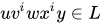
The pumping lemma is often used to prove that a given language L is non-context-free, by showing that arbitrarily long strings s are in L that cannot be "pumped" without producing strings outside L.
For example, if
S
⊂
N
{\displaystyle S\subset \mathbb {N} }


For example, the language
L
=
{
a
n
b
n
c
n
|
n
>
0
}
{\displaystyle L=\{a^{n}b^{n}c^{n}|n>0\}}



-
v
w
x
=
a
j
{\displaystyle vwx=a^{j}}
for some j ≤ p {\displaystyle j\leq p}
.
-
v
w
x
=
a
j
b
k
{\displaystyle vwx=a^{j}b^{k}}
for some j and k with j + k ≤ p {\displaystyle j+k\leq p}
-
v
w
x
=
b
j
{\displaystyle vwx=b^{j}}
for some j ≤ p {\displaystyle j\leq p}
-
v
w
x
=
b
j
c
k
{\displaystyle vwx=b^{j}c^{k}}
for some j and k with j + k ≤ p {\displaystyle j+k\leq p}
.
-
v
w
x
=
c
j
{\displaystyle vwx=c^{j}}
for some j ≤ p {\displaystyle j\leq p}
In each case,
u
v
i
w
x
i
y
{\displaystyle uv^{i}wx^{i}y}


In 1960, Scheinberg proved that
L
=
{
a
n
b
n
a
n
|
n
>
0
}
{\displaystyle L=\{a^{n}b^{n}a^{n}|n>0\}}

While the pumping lemma is often a useful tool to prove that a given language is not context-free, there are languages that are not context-free, but still satisfy the condition given by the pumping lemma, for example
L
=
{
b
j
c
k
d
l
|
j
,
k
,
l
∈
N
}
∪
{
a
i
b
j
c
j
d
j
|
i
,
j
∈
N
,
i
≥
1
}
{\displaystyle L=\{b^{j}c^{k}d^{l}|j,k,l\in \mathbb {N} \}\cup \{a^{i}b^{j}c^{j}d^{j}|i,j\in \mathbb {N} ,i\geq 1\}}

Notes
- Kreowski 1979.
- Berstel et al. 2009.
- Scheinberg 1960, Lemma 3, and its use on pp. 374-375.
- Hopcroft & Ullman 1979, p. 129, sect.6.1.
References
- Bar-Hillel, Y.; Perles, Micha; Shamir, Eli (1961). "On formal properties of simple phrase-structure grammars". Zeitschrift für Phonetik, Sprachwissenschaft, und Kommunikationsforschung. 14 (2): 143–172. — Reprinted in Bar-Hillel (1964)
- Bar-Hillel, Y. (1964). Language and Information: Selected Essays on their Theory and Application. Addison-Wesley series in logic. Addison-Wesley. pp. 116–150. OCLC 783543642.
- Berstel, Jean; Lauve, Aaron; Reutenauer, Christophe; Saliola, Franco V. (2009). Combinatorics on words. Christoffel words and repetitions in words (PDF). CRM Monograph Series. Vol. 27. Providence, RI: American Mathematical Society. p. 90. ISBN 978-0-8218-4480-9. Zbl 1161.68043. — Also see "Aaron Berstel's website".
- Hopcroft, John E.; Ullman, Jeffrey D. (1979). Introduction to Automata Theory, Languages, and Computation. Addison-Wesley. ISBN 0-201-02988-X.
- Kreowski, Hans-Jörg (1979). "A pumping lemma for context-free graph languages". In Claus, Volker; Ehrig, Hartmut; Rozenberg, Grzegorz (eds.). Graph-Grammars and Their Application to Computer Science and Biology. Lecture Notes in Computer Science. Vol. 73. Berlin, Heidelberg: Springer. pp. 270–283. doi:10.1007/BFb0025726. ISBN 978-3-540-35091-0.
- Scheinberg, Stephen (1960). "Note on the Boolean Properties of Context Free Languages" (PDF). Information and Control. 3 (4): 372–375. doi:10.1016/s0019-9958(60)90965-7.
- Sipser, Michael (1997). Introduction to the Theory of Computation. PWS Publishing. pp. 77–83, 115–119. ISBN 0-534-94728-X.
Section 1.4: Nonregular Languages, resp. Section 2.3: Non-context-free Languages