In statistics, the Q-function is the tail distribution function of the standard normal distribution.[1][2] In other words,
Q
(
x
)
{\displaystyle Q(x)}
is the probability that a normal (Gaussian) random variable will obtain a value larger than
x
{\displaystyle x}
standard deviations. Equivalently,
Q
(
x
)
{\displaystyle Q(x)}
is the probability that a standard normal random variable takes a value larger than
x
{\displaystyle x}
.
If
Y
{\displaystyle Y}
is a Gaussian random variable with mean
μ
{\displaystyle \mu }
and variance
σ
2
{\displaystyle \sigma ^{2}}
, then
X
=
Y
−
μ
σ
{\displaystyle X={\frac {Y-\mu }{\sigma }}}
is standard normal and
P
(
Y
>
y
)
=
P
(
X
>
x
)
=
Q
(
x
)
{\displaystyle P(Y>y)=P(X>x)=Q(x)}
where
x
=
y
−
μ
σ
{\displaystyle x={\frac {y-\mu }{\sigma }}}
.
Other definitions of the Q-function, all of which are simple transformations of the normal cumulative distribution function, are also used occasionally.[3]
Because of its relation to the cumulative distribution function of the normal distribution, the Q-function can also be expressed in terms of the error function, which is an important function in applied mathematics and physics.
Definition and basic properties
Formally, the Q-function is defined as
Q
(
x
)
=
1
2
π
∫
x
∞
exp
(
−
u
2
2
)
d
u
.
{\displaystyle Q(x)={\frac {1}{\sqrt {2\pi }}}\int _{x}^{\infty }\exp \left(-{\frac {u^{2}}{2}}\right)\,du.}
Thus,
Q
(
x
)
=
1
−
Q
(
−
x
)
=
1
−
Φ
(
x
)
,
{\displaystyle Q(x)=1-Q(-x)=1-\Phi (x)\,\!,}
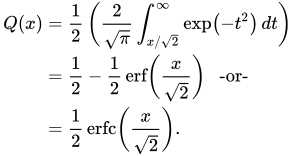
The Q-function can be expressed in terms of the error function, or the complementary error function, as[2]
Q
(
x
)
=
1
2
(
2
π
∫
x
/
2
∞
exp
(
−
t
2
)
d
t
)
=
1
2
−
1
2
erf
(
x
2
)
-or-
=
1
2
erfc
(
x
2
)
.
{\displaystyle {\begin{aligned}Q(x)&={\frac {1}{2}}\left({\frac {2}{\sqrt {\pi }}}\int _{x/{\sqrt {2}}}^{\infty }\exp \left(-t^{2}\right)\,dt\right)\\&={\frac {1}{2}}-{\frac {1}{2}}\operatorname {erf} \left({\frac {x}{\sqrt {2}}}\right)~~{\text{ -or-}}\\&={\frac {1}{2}}\operatorname {erfc} \left({\frac {x}{\sqrt {2}}}\right).\end{aligned}}}
An alternative form of the Q-function known as Craig's formula, after its discoverer, is expressed as:[4]
Q
(
x
)
=
1
π
∫
0
π
2
exp
(
−
x
2
2
sin
2
θ
)
d
θ
.
{\displaystyle Q(x)={\frac {1}{\pi }}\int _{0}^{\frac {\pi }{2}}\exp \left(-{\frac {x^{2}}{2\sin ^{2}\theta }}\right)d\theta .}
The above proper integral form of Q-function, has been incorrectly credited to Craig. This form of Q-function was implied in earlier works by Wiesten[5] , and explicitly stated by Pawula, Rice and Roberts[6].
This expression is valid only for positive values of x, but it can be used in conjunction with Q(x) = 1 − Q(−x) to obtain Q(x) for negative values. This form is advantageous in that the range of integration is fixed and finite.
Craig's formula was later extended by Behnad (2020)[7] for the Q-function of the sum of two non-negative variables, as follows:
the Q-function plotted in the complex plane
Q
(
x
+
y
)
=
1
π
∫
0
π
2
exp
(
−
x
2
2
sin
2
θ
−
y
2
2
cos
2
θ
)
d
θ
,
x
,
y
⩾
0.
{\displaystyle Q(x+y)={\frac {1}{\pi }}\int _{0}^{\frac {\pi }{2}}\exp \left(-{\frac {x^{2}}{2\sin ^{2}\theta }}-{\frac {y^{2}}{2\cos ^{2}\theta }}\right)d\theta ,\quad x,y\geqslant 0.}
(
x
1
+
x
2
)
ϕ
(
x
)
<
Q
(
x
)
<
ϕ
(
x
)
x
,
x
>
0
,
{\displaystyle \left({\frac {x}{1+x^{2}}}\right)\phi (x)<Q(x)<{\frac {\phi (x)}{x}},\qquad x>0,}
where
ϕ
(
x
)
{\displaystyle \phi (x)}
is the density function of the standard normal distribution, and the bounds become increasingly tight for large x.
Using the substitutionv =u2/2, the upper bound is derived as follows:
Q
(
x
)
=
∫
x
∞
ϕ
(
u
)
d
u
<
∫
x
∞
u
x
ϕ
(
u
)
d
u
=
∫
x
2
2
∞
e
−
v
x
2
π
d
v
=
−
e
−
v
x
2
π
|
x
2
2
∞
=
ϕ
(
x
)
x
.
{\displaystyle Q(x)=\int _{x}^{\infty }\phi (u)\,du<\int _{x}^{\infty }{\frac {u}{x}}\phi (u)\,du=\int _{\frac {x^{2}}{2}}^{\infty }{\frac {e^{-v}}{x{\sqrt {2\pi }}}}\,dv=-{\biggl .}{\frac {e^{-v}}{x{\sqrt {2\pi }}}}{\biggr |}_{\frac {x^{2}}{2}}^{\infty }={\frac {\phi (x)}{x}}.}
Similarly, using
ϕ
′
(
u
)
=
−
u
ϕ
(
u
)
{\displaystyle \phi '(u)=-u\phi (u)}
and the quotient rule,
(
1
+
1
x
2
)
Q
(
x
)
=
∫
x
∞
(
1
+
1
x
2
)
ϕ
(
u
)
d
u
>
∫
x
∞
(
1
+
1
u
2
)
ϕ
(
u
)
d
u
=
−
ϕ
(
u
)
u
|
x
∞
=
ϕ
(
x
)
x
.
{\displaystyle \left(1+{\frac {1}{x^{2}}}\right)Q(x)=\int _{x}^{\infty }\left(1+{\frac {1}{x^{2}}}\right)\phi (u)\,du>\int _{x}^{\infty }\left(1+{\frac {1}{u^{2}}}\right)\phi (u)\,du=-{\biggl .}{\frac {\phi (u)}{u}}{\biggr |}_{x}^{\infty }={\frac {\phi (x)}{x}}.}
Solving for Q(x) provides the lower bound.
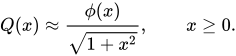
The geometric mean of the upper and lower bound gives a suitable approximation for
Q
(
x
)
{\displaystyle Q(x)}
:
Q
(
x
)
≈
ϕ
(
x
)
1
+
x
2
,
x
≥
0.
{\displaystyle Q(x)\approx {\frac {\phi (x)}{\sqrt {1+x^{2}}}},\qquad x\geq 0.}
Tighter bounds and approximations of
Q
(
x
)
{\displaystyle Q(x)}
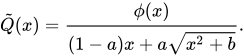
can also be obtained by optimizing the following expression [9]
Q
~
(
x
)
=
ϕ
(
x
)
(
1
−
a
)
x
+
a
x
2
+
b
.
{\displaystyle {\tilde {Q}}(x)={\frac {\phi (x)}{(1-a)x+a{\sqrt {x^{2}+b}}}}.}
For
x
≥
0
{\displaystyle x\geq 0}
, the best upper bound is given by
a
=
0.344
{\displaystyle a=0.344}
and
b
=
5.334
{\displaystyle b=5.334}
with maximum absolute relative error of 0.44%. Likewise, the best approximation is given by
a
=
0.339
{\displaystyle a=0.339}
and
b
=
5.510
{\displaystyle b=5.510}
with maximum absolute relative error of 0.27%. Finally, the best lower bound is given by
a
=
1
/
π
{\displaystyle a=1/\pi }
and
b
=
2
π
{\displaystyle b=2\pi }
with maximum absolute relative error of 1.17%.
Q
(
x
)
≤
e
−
x
2
2
,
x
>
0
{\displaystyle Q(x)\leq e^{-{\frac {x^{2}}{2}}},\qquad x>0}
Improved exponential bounds and a pure exponential approximation are [10]
Q
(
x
)
≤
1
4
e
−
x
2
+
1
4
e
−
x
2
2
≤
1
2
e
−
x
2
2
,
x
>
0
{\displaystyle Q(x)\leq {\tfrac {1}{4}}e^{-x^{2}}+{\tfrac {1}{4}}e^{-{\frac {x^{2}}{2}}}\leq {\tfrac {1}{2}}e^{-{\frac {x^{2}}{2}}},\qquad x>0}
Q
(
x
)
≈
1
12
e
−
x
2
2
+
1
4
e
−
2
3
x
2
,
x
>
0
{\displaystyle Q(x)\approx {\frac {1}{12}}e^{-{\frac {x^{2}}{2}}}+{\frac {1}{4}}e^{-{\frac {2}{3}}x^{2}},\qquad x>0}
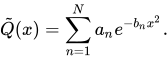
The above were generalized by Tanash & Riihonen (2020),[11] who showed that
Q
(
x
)
{\displaystyle Q(x)}
can be accurately approximated or bounded by
Q
~
(
x
)
=
∑
n
=
1
N
a
n
e
−
b
n
x
2
.
{\displaystyle {\tilde {Q}}(x)=\sum _{n=1}^{N}a_{n}e^{-b_{n}x^{2}}.}
In particular, they presented a systematic methodology to solve the numerical coefficients
{
(
a
n
,
b
n
)
}
n
=
1
N
{\displaystyle \{(a_{n},b_{n})\}_{n=1}^{N}}
that yield a minimax approximation or bound:
Q
(
x
)
≈
Q
~
(
x
)
{\displaystyle Q(x)\approx {\tilde {Q}}(x)}
,
Q
(
x
)
≤
Q
~
(
x
)
{\displaystyle Q(x)\leq {\tilde {Q}}(x)}
, or
Q
(
x
)
≥
Q
~
(
x
)
{\displaystyle Q(x)\geq {\tilde {Q}}(x)}
for
x
≥
0
{\displaystyle x\geq 0}
. With the example coefficients tabulated in the paper for
N
=
20
{\displaystyle N=20}
, the relative and absolute approximation errors are less than
2.831
⋅
10
−
6
{\displaystyle 2.831\cdot 10^{-6}}
and
1.416
⋅
10
−
6
{\displaystyle 1.416\cdot 10^{-6}}
, respectively. The coefficients
{
(
a
n
,
b
n
)
}
n
=
1
N
{\displaystyle \{(a_{n},b_{n})\}_{n=1}^{N}}
for many variations of the exponential approximations and bounds up to
N
=
25
{\displaystyle N=25}
have been released to open access as a comprehensive dataset.[12]
Another approximation of
Q
(
x
)
{\displaystyle Q(x)}
for
x
∈
[
0
,
∞
)
{\displaystyle x\in [0,\infty )}
is given by Karagiannidis & Lioumpas (2007)[13] who showed for the appropriate choice of parameters
{
A
,
B
}
{\displaystyle \{A,B\}}
that
f
(
x
;
A
,
B
)
=
(
1
−
e
−
A
x
)
e
−
x
2
B
π
x
≈
erfc
(
x
)
.
{\displaystyle f(x;A,B)={\frac {\left(1-e^{-Ax}\right)e^{-x^{2}}}{B{\sqrt {\pi }}x}}\approx \operatorname {erfc} \left(x\right).}
The absolute error between
f
(
x
;
A
,
B
)
{\displaystyle f(x;A,B)}
and
erfc
(
x
)
{\displaystyle \operatorname {erfc} (x)}
over the range
[
0
,
R
]
{\displaystyle [0,R]}
is minimized by evaluating
{
A
,
B
}
=
arg
min
{
A
,
B
}
1
R
∫
0
R
|
f
(
x
;
A
,
B
)
−
erfc
(
x
)
|
d
x
.
{\displaystyle \{A,B\}={\underset {\{A,B\}}{\arg \min }}{\frac {1}{R}}\int _{0}^{R}|f(x;A,B)-\operatorname {erfc} (x)|dx.}
Using
R
=
20
{\displaystyle R=20}
and numerically integrating, they found the minimum error occurred when
{
A
,
B
}
=
{
1.98
,
1.135
}
,
{\displaystyle \{A,B\}=\{1.98,1.135\},}
which gave a good approximation for
∀
x
≥
0.
{\displaystyle \forall x\geq 0.}
Substituting these values and using the relationship between
Q
(
x
)
{\displaystyle Q(x)}
and
erfc
(
x
)
{\displaystyle \operatorname {erfc} (x)}
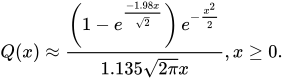
from above gives
Q
(
x
)
≈
(
1
−
e
−
1.98
x
2
)
e
−
x
2
2
1.135
2
π
x
,
x
≥
0.
{\displaystyle Q(x)\approx {\frac {\left(1-e^{\frac {-1.98x}{\sqrt {2}}}\right)e^{-{\frac {x^{2}}{2}}}}{1.135{\sqrt {2\pi }}x}},x\geq 0.}
Alternative coefficients are also available for the above 'Karagiannidis–Lioumpas approximation' for tailoring accuracy for a specific application or transforming it into a tight bound.[14]
A tighter and more tractable approximation of
Q
(
x
)
{\displaystyle Q(x)}
for positive arguments
x
∈
[
0
,
∞
)
{\displaystyle x\in [0,\infty )}
is given by López-Benítez & Casadevall (2011)[15] based on a second-order exponential function:
Q
(
x
)
≈
e
−
a
x
2
−
b
x
−
c
,
x
≥
0.
{\displaystyle Q(x)\approx e^{-ax^{2}-bx-c},\qquad x\geq 0.}
The fitting coefficients
(
a
,
b
,
c
)
{\displaystyle (a,b,c)}
can be optimized over any desired range of arguments in order to minimize the sum of square errors (
a
=
0.3842
{\displaystyle a=0.3842}
,
b
=
0.7640
{\displaystyle b=0.7640}
,
c
=
0.6964
{\displaystyle c=0.6964}
for
x
∈
[
0
,
20
]
{\displaystyle x\in [0,20]}
) or minimize the maximum absolute error (
a
=
0.4920
{\displaystyle a=0.4920}
,
b
=
0.2887
{\displaystyle b=0.2887}
,
c
=
1.1893
{\displaystyle c=1.1893}
for
x
∈
[
0
,
20
]
{\displaystyle x\in [0,20]}
). This approximation offers some benefits such as a good trade-off between accuracy and analytical tractability (for example, the extension to any arbitrary power of
Q
(
x
)
{\displaystyle Q(x)}
is trivial and does not alter the algebraic form of the approximation).
A pair of tight lower and upper bounds on the Gaussian Q-function for positive arguments
x
∈
[
0
,
∞
)
{\displaystyle x\in [0,\infty )}
was introduced by Abreu (2012)[16] based on a simple algebraic expression with only two exponential terms:
Q
(
x
)
≥
1
12
e
−
x
2
+
1
2
π
(
x
+
1
)
e
−
x
2
/
2
,
x
≥
0
,
{\displaystyle Q(x)\geq {\frac {1}{12}}e^{-x^{2}}+{\frac {1}{{\sqrt {2\pi }}(x+1)}}e^{-x^{2}/2},\qquad x\geq 0,}
Q
(
x
)
≤
1
50
e
−
x
2
+
1
2
(
x
+
1
)
e
−
x
2
/
2
,
x
≥
0.
{\displaystyle Q(x)\leq {\frac {1}{50}}e^{-x^{2}}+{\frac {1}{2(x+1)}}e^{-x^{2}/2},\qquad x\geq 0.}
These bounds are derived from a unified form
Q
B
(
x
;
a
,
b
)
=
exp
(
−
x
2
)
a
+
exp
(
−
x
2
/
2
)
b
(
x
+
1
)
{\displaystyle Q_{\mathrm {B} }(x;a,b)={\frac {\exp(-x^{2})}{a}}+{\frac {\exp(-x^{2}/2)}{b(x+1)}}}
, where the parameters
a
{\displaystyle a}
and
b
{\displaystyle b}
are chosen to satisfy specific conditions ensuring the lower (
a
L
=
12
{\displaystyle a_{\mathrm {L} }=12}
,
b
L
=
2
π
{\displaystyle b_{\mathrm {L} }={\sqrt {2\pi }}}
) and upper (
a
U
=
50
{\displaystyle a_{\mathrm {U} }=50}
,
b
U
=
2
{\displaystyle b_{\mathrm {U} }=2}
) bounding properties. The resulting expressions are notable for their simplicity and tightness, offering a favorable trade-off between accuracy and mathematical tractability. These bounds are particularly useful in theoretical analysis, such as in communication theory over fading channels. Additionally, they can be extended to bound
Q
n
(
x
)
{\displaystyle Q^{n}(x)}
for positive integers
n
{\displaystyle n}
using the binomial theorem, maintaining their simplicity and effectiveness.
Q
−
1
(
y
)
=
2
e
r
f
−
1
(
1
−
2
y
)
=
2
e
r
f
c
−
1
(
2
y
)
{\displaystyle Q^{-1}(y)={\sqrt {2}}\ \mathrm {erf} ^{-1}(1-2y)={\sqrt {2}}\ \mathrm {erfc} ^{-1}(2y)}
The function
Q
−
1
(
y
)
{\displaystyle Q^{-1}(y)}
finds application in digital communications. It is usually expressed in dB and generally called Q-factor:
Q
-
f
a
c
t
o
r
=
20
log
10
(
Q
−
1
(
y
)
)
d
B
{\displaystyle \mathrm {Q{\text{-}}factor} =20\log _{10}\!\left(Q^{-1}(y)\right)\!~\mathrm {dB} }
where y is the bit-error rate (BER) of the digitally modulated signal under analysis. For instance, for quadrature phase-shift keying (QPSK) in additive white Gaussian noise, the Q-factor defined above coincides with the value in dB of the signal to noise ratio that yields a bit error rate equal to y.
Q-factor vs. bit error rate (BER).
Values
The Q-function is well tabulated and can be computed directly in most of the mathematical software packages such as R and those available in Python, MATLAB and Mathematica. Some values of the Q-function are given below for reference.
Q(0.0)
0.500000000
1/2.0000
Q(0.1)
0.460172163
1/2.1731
Q(0.2)
0.420740291
1/2.3768
Q(0.3)
0.382088578
1/2.6172
Q(0.4)
0.344578258
1/2.9021
Q(0.5)
0.308537539
1/3.2411
Q(0.6)
0.274253118
1/3.6463
Q(0.7)
0.241963652
1/4.1329
Q(0.8)
0.211855399
1/4.7202
Q(0.9)
0.184060125
1/5.4330
Q(1.0)
0.158655254
1/6.3030
Q(1.1)
0.135666061
1/7.3710
Q(1.2)
0.115069670
1/8.6904
Q(1.3)
0.096800485
1/10.3305
Q(1.4)
0.080756659
1/12.3829
Q(1.5)
0.066807201
1/14.9684
Q(1.6)
0.054799292
1/18.2484
Q(1.7)
0.044565463
1/22.4389
Q(1.8)
0.035930319
1/27.8316
Q(1.9)
0.028716560
1/34.8231
Q(2.0)
0.022750132
1/43.9558
Q(2.1)
0.017864421
1/55.9772
Q(2.2)
0.013903448
1/71.9246
Q(2.3)
0.010724110
1/93.2478
Q(2.4)
0.008197536
1/121.9879
Q(2.5)
0.006209665
1/161.0393
Q(2.6)
0.004661188
1/214.5376
Q(2.7)
0.003466974
1/288.4360
Q(2.8)
0.002555130
1/391.3695
Q(2.9)
0.001865813
1/535.9593
Q(3.0)
0.001349898
1/740.7967
Q(3.1)
0.000967603
1/1033.4815
Q(3.2)
0.000687138
1/1455.3119
Q(3.3)
0.000483424
1/2068.5769
Q(3.4)
0.000336929
1/2967.9820
Q(3.5)
0.000232629
1/4298.6887
Q(3.6)
0.000159109
1/6285.0158
Q(3.7)
0.000107800
1/9276.4608
Q(3.8)
0.000072348
1/13822.0738
Q(3.9)
0.000048096
1/20791.6011
Q(4.0)
0.000031671
1/31574.3855
Generalization to high dimensions
The Q-function can be generalized to higher dimensions:[17]
Q
(
x
)
=
P
(
X
≥
x
)
,
{\displaystyle Q(\mathbf {x} )=\mathbb {P} (\mathbf {X} \geq \mathbf {x} ),}
where
X
∼
N
(
0
,
Σ
)
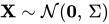
{\displaystyle \mathbf {X} \sim {\mathcal {N}}(\mathbf {0} ,\,\Sigma )}
follows the multivariate normal distribution with covariance
Σ
{\displaystyle \Sigma }
and the threshold is of the form
x
=
γ
Σ
l
∗
{\displaystyle \mathbf {x} =\gamma \Sigma \mathbf {l} ^{*}}
for some positive vector
l
∗
>
0
{\displaystyle \mathbf {l} ^{*}>\mathbf {0} }
and positive constant
γ
>
0
{\displaystyle \gamma >0}
. As in the one dimensional case, there is no simple analytical formula for the Q-function. Nevertheless, the Q-function can be approximated arbitrarily well as
γ
{\displaystyle \gamma }
becomes larger and larger.[18][19]
Behnad, Aydin (2020). "A Novel Extension to Craig's Q-Function Formula and Its Application in Dual-Branch EGC Performance Analysis". IEEE Transactions on Communications. 68 (7): 4117–4125. doi:10.1109/TCOMM.2020.2986209. S2CID216500014.
Gordon, R.D. (1941). "Values of Mills' ratio of area to bounding ordinate and of the normal probability integral for large values of the argument". Ann. Math. Stat. 12 (3): 364–366. doi:10.1214/aoms/1177731721.
Borjesson, P.; Sundberg, C.-E. (1979). "Simple Approximations of the Error Function Q(x) for Communications Applications". IEEE Transactions on Communications. 27 (3): 639–643. doi:10.1109/TCOM.1979.1094433.
Tanash, I.M.; Riihonen, T. (2020). "Global minimax approximations and bounds for the Gaussian Q-function by sums of exponentials". IEEE Transactions on Communications. 68 (10): 6514–6524. arXiv:2007.06939. doi:10.1109/TCOMM.2020.3006902. S2CID220514754.
Tanash, I.M.; Riihonen, T. (2021). "Improved coefficients for the Karagiannidis–Lioumpas approximations and bounds to the Gaussian Q-function". IEEE Communications Letters. 25 (5): 1468–1471. arXiv:2101.07631. doi:10.1109/LCOMM.2021.3052257. S2CID231639206.
Abreu, Giuseppe (2012). "Very Simple Tight Bounds on the Q-Function". IEEE Transactions on Communications. 60 (9): 2415–2420. doi:10.1109/TCOMM.2012.080612.110075.
Botev, Z. I.; Mackinlay, D.; Chen, Y.-L. (2017). "Logarithmically efficient estimation of the tail of the multivariate normal distribution". 2017 Winter Simulation Conference (WSC). IEEE. pp.1903–191. doi:10.1109/WSC.2017.8247926. ISBN978-1-5386-3428-8. S2CID4626481.












is the density function of the standard normal distribution, and the bounds become increasingly tight for large x.

and the quotient rule,

, the best upper bound is given by a = 0.344 {\displaystyle a=0.344}
and b = 5.334 {\displaystyle b=5.334}
with maximum absolute relative error of 0.44%. Likewise, the best approximation is given by a = 0.339 {\displaystyle a=0.339}
and b = 5.510 {\displaystyle b=5.510}
with maximum absolute relative error of 0.27%. Finally, the best lower bound is given by a = 1 / π {\displaystyle a=1/\pi }
and b = 2 π {\displaystyle b=2\pi }
with maximum absolute relative error of 1.17%.



that yield a minimax approximation or bound: Q ( x ) ≈ Q ~ ( x ) {\displaystyle Q(x)\approx {\tilde {Q}}(x)}
, Q ( x ) ≤ Q ~ ( x ) {\displaystyle Q(x)\leq {\tilde {Q}}(x)}
, or Q ( x ) ≥ Q ~ ( x ) {\displaystyle Q(x)\geq {\tilde {Q}}(x)}
for x ≥ 0 {\displaystyle x\geq 0}
, the relative and absolute approximation errors are less than 2.831 ⋅ 10 − 6 {\displaystyle 2.831\cdot 10^{-6}}
and 1.416 ⋅ 10 − 6 {\displaystyle 1.416\cdot 10^{-6}}
, respectively. The coefficients { ( a n , b n ) } n = 1 N {\displaystyle \{(a_{n},b_{n})\}_{n=1}^{N}}
have been released to open access as a comprehensive dataset.[12]
is given by Karagiannidis & Lioumpas (2007)[13] who showed for the appropriate choice of parameters { A , B } {\displaystyle \{A,B\}}
that

and erfc ( x ) {\displaystyle \operatorname {erfc} (x)}
over the range [ 0 , R ] {\displaystyle [0,R]}
is minimized by evaluating

and numerically integrating, they found the minimum error occurred when { A , B } = { 1.98 , 1.135 } , {\displaystyle \{A,B\}=\{1.98,1.135\},}
which gave a good approximation for ∀ x ≥ 0. {\displaystyle \forall x\geq 0.}


can be optimized over any desired range of arguments in order to minimize the sum of square errors ( a = 0.3842 {\displaystyle a=0.3842}
, b = 0.7640 {\displaystyle b=0.7640}
, c = 0.6964 {\displaystyle c=0.6964}
for x ∈ [ 0 , 20 ] {\displaystyle x\in [0,20]}
) or minimize the maximum absolute error ( a = 0.4920 {\displaystyle a=0.4920}
, b = 0.2887 {\displaystyle b=0.2887}
, c = 1.1893 {\displaystyle c=1.1893}
for x ∈ [ 0 , 20 ] {\displaystyle x\in [0,20]}