The quantum rotor model is a mathematical model for a quantum system. It can be visualized as an array of rotating electrons which behave as rigid rotors that interact through short-range dipole-dipole magnetic forces originating from their magnetic dipole moments (neglecting Coulomb forces). The model differs from similar spin-models such as the Ising model and the Heisenberg model in that it includes a term analogous to kinetic energy.
Although elementary quantum rotors do not exist in nature, the model can describe effective degrees of freedom for a system of sufficiently small number of closely coupled electrons in low-energy states.[1]
Formulation
Suppose the n-dimensional position (orientation) vector of the model at a given site
i
{\displaystyle i}


[
n
α
,
p
β
]
=
i
δ
α
β
{\displaystyle [n_{\alpha },p_{\beta }]=i\delta _{\alpha \beta }}
![{\displaystyle [n_{\alpha },p_{\beta }]=i\delta _{\alpha \beta }}](https://wikimedia.org/api/rest_v1/media/math/render/svg/363695a6731276ca363729d46fa91c614de29415)
However, it is found convenient[1] to use rotor angular momentum operators
L
{\displaystyle \mathbf {L} }


Then, the magnetic interactions between the quantum rotors, and thus their energy states, can be described by the following Hamiltonian:
-
H
R
=
J
g
¯
2
∑
i
L
i
2
−
J
∑
⟨
i
j
⟩
n
i
⋅
n
j
{\displaystyle H_{R}={\frac {J{\bar {g}}}{2}}\sum _{i}\mathbf {L} _{i}^{2}-J\sum _{\langle ij\rangle }\mathbf {n} _{i}\cdot \mathbf {n} _{j}}
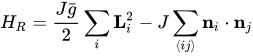
where
J
,
g
¯
{\displaystyle J,{\bar {g}}}


The interactions between the quantum rotors can be described by another (equivalent) Hamiltonian, which treats the rotors not as magnetic moments but as local electric currents.[2]
In higher dimensions, the Hamiltonian can be defined as
-
H
R
=
J
g
¯
2
∑
i
Δ
i
−
J
∑
⟨
i
j
⟩
n
i
⋅
n
j
{\displaystyle H_{R}={\frac {J{\bar {g}}}{2}}\sum _{i}\Delta _{i}-J\sum _{\langle ij\rangle }\mathbf {n} _{i}\cdot \mathbf {n} _{j}}

where
Δ
i
{\displaystyle \Delta _{i}}


Properties
One of the important features of the rotor model is the continuous O(N) symmetry, and hence the corresponding continuous symmetry breaking in the magnetically ordered state. In a system with two layers of Heisenberg spins
S
1
i
{\displaystyle \mathbf {S} _{1i}}


-
H
d
=
K
∑
i
S
1
i
⋅
S
2
i
+
J
∑
⟨
i
j
⟩
(
S
1
i
⋅
S
1
j
+
S
2
i
⋅
S
2
j
)
{\displaystyle H_{d}=K\sum _{i}\mathbf {S} _{1i}\cdot \mathbf {S} _{2i}+J\sum _{\langle ij\rangle }\left(\mathbf {S} _{1i}\cdot \mathbf {S} _{1j}+\mathbf {S} _{2i}\cdot \mathbf {S} _{2j}\right)}

using the correspondence
L
i
=
S
1
i
+
S
2
i
{\displaystyle \mathbf {L} _{i}=\mathbf {S} _{1i}+\mathbf {S} _{2i}}

Applications
The particular case of the quantum rotor model which has O(2) symmetry can be used to describe a superconducting array of Josephson junctions or the behavior of bosons in optical lattices.[4] Another specific case of O(3) symmetry is equivalent to a system of two layers (bilayer) of a quantum Heisenberg antiferromagnet; it can also describe double-layer quantum Hall ferromagnets.[4] It can also be shown that the phase transition for the two dimensional rotor model has the same universality class as that of antiferromagnetic Heisenberg spin models.[5]
See also
References
- Sachdev, Subir (1999). Quantum Phase Transitions. Cambridge University Press. ISBN 978-0-521-00454-1. Retrieved 10 July 2010.
- Alet, Fabien; Erik S. Sørensen (2003). "Cluster Monte Carlo algorithm for the quantum rotor model". Phys. Rev. E. 67 (1) 015701. arXiv:cond-mat/0211262. Bibcode:2003PhRvE..67a5701A. doi:10.1103/PhysRevE.67.015701. PMID 12636557. S2CID 25176793.
- Zinn-Justin, Jean (23 October 1998). "Vector models in the large $N$ limit: a few applications". arXiv.org.
- Vojta, Thomas; Sknepnek, Rastko (2006). "Quantum phase transitions of the diluted O(3) rotor model". Physical Review B. 74 (9) 094415. arXiv:cond-mat/0606154. Bibcode:2006PhRvB..74i4415V. doi:10.1103/PhysRevB.74.094415. S2CID 119348100.
- Sachdev, Subir (1995). "Quantum phase transitions in spins systems and the high temperature limit of continuum quantum field theories". arXiv:cond-mat/9508080.