In mathematics, a quasi-polynomial (sometimes called pseudo-polynomial) is a generalization of polynomials. While the coefficients of a polynomial come from a ring, the coefficients of quasi-polynomials are instead periodic functions with integral period. Quasi-polynomials appear throughout much of combinatorics as the enumerators for various objects.
Definition
A quasi-polynomial is a function
q
{\displaystyle q}


Equivalently, a function
q
{\displaystyle q}


Generating functions
A function
q
{\displaystyle q}


-
Q
(
x
)
:=
∑
n
≥
0
q
(
n
)
x
n
{\displaystyle Q(x):=\sum _{n\geq 0}q(n)x^{n}}
-
Q
(
x
)
:=
∑
n
≥
0
q
(
n
)
x
n
{\displaystyle Q(x):=\sum _{n\geq 0}q(n)x^{n}}

evaluates to a rational function of the form
Q
(
x
)
=
h
(
x
)
(
1
−
x
r
)
d
+
1
{\displaystyle Q(x)={\frac {h(x)}{(1-x^{r})^{d+1}}}}


Examples
- Given a
d
{\displaystyle d}
with rational vertices v 1 , … , v n {\displaystyle v_{1},\dots ,v_{n}}
, define t P {\displaystyle tP}
to be the convex hull of t v 1 , … , t v n {\displaystyle tv_{1},\dots ,tv_{n}}
. The function L ( P , t ) = # ( t P ∩ Z d ) {\displaystyle L(P,t)=\#(tP\cap \mathbb {Z} ^{d})}
is a quasi-polynomial in t {\displaystyle t}
(viewed as a positive integer variable) of degree d {\displaystyle d}
has integer vertices is a period of L ( P , t ) {\displaystyle L(P,t)}
. This is known as the Ehrhart quasi-polynomial, named after Eugène Ehrhart.
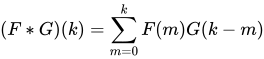
- Given two quasi-polynomials
F
{\displaystyle F}
and G {\displaystyle G}
, the convolution of F {\displaystyle F}
-
(
F
∗
G
)
(
k
)
=
∑
m
=
0
k
F
(
m
)
G
(
k
−
m
)
{\displaystyle (F*G)(k)=\sum _{m=0}^{k}F(m)G(k-m)}
-
(
F
∗
G
)
(
k
)
=
∑
m
=
0
k
F
(
m
)
G
(
k
−
m
)
{\displaystyle (F*G)(k)=\sum _{m=0}^{k}F(m)G(k-m)}
- which is a quasi-polynomial with degree
≤
deg
F
+
deg
G
+
1.
{\displaystyle \leq \deg F+\deg G+1.}

References
- Stanley, Richard P. (1997). "Section 4.4: Quasipolynomials". Enumerative Combinatorics, Volume 1. Cambridge University Press. ISBN 0-521-56069-1.
- Beck, Matthias; Sanyal, Raman (2018), "Section 4.5: Quasipolynomials", Combinatorial Reciprocity Theorems: An Invitation to Enumerative Geometric Combinatorics, Graduate Studies in Mathematics, American Mathematical Society, ISBN 978-1-4704-2200-4