In algebraic geometry, the Quot scheme is a scheme parametrizing sheaves on a projective scheme. More specifically, if X is a projective scheme over a Noetherian scheme S and if F is a coherent sheaf on X, then there is a scheme
Quot
F
(
X
)
{\displaystyle \operatorname {Quot} _{F}(X)}



It is typically used to construct another scheme parametrizing geometric objects that are of interest such as a Hilbert scheme. (In fact, taking F to be the structure sheaf
O
X
{\displaystyle {\mathcal {O}}_{X}}

Definition
For a scheme of finite type
X
→
S
{\displaystyle X\to S}


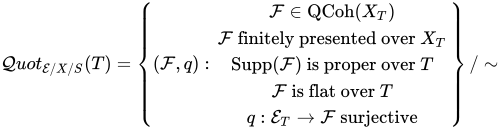
Q u o t E / X / S : ( S c h / S ) o p → Sets {\displaystyle {\mathcal {Quot}}_{{\mathcal {E}}/X/S}:(Sch/S)^{op}\to {\text{Sets}}}

sending
T
→
S
{\displaystyle T\to S}

Q u o t E / X / S ( T ) = { ( F , q ) : F ∈ QCoh ( X T ) F finitely presented over X T Supp ( F ) is proper over T F is flat over T q : E T → F surjective } / ∼ {\displaystyle {\mathcal {Quot}}_{{\mathcal {E}}/X/S}(T)=\left\{({\mathcal {F}},q):{\begin{matrix}{\mathcal {F}}\in {\text{QCoh}}(X_{T})\\{\mathcal {F}}\ {\text{finitely presented over}}\ X_{T}\\{\text{Supp}}({\mathcal {F}}){\text{ is proper over }}T\\{\mathcal {F}}{\text{ is flat over }}T\\q:{\mathcal {E}}_{T}\to {\mathcal {F}}{\text{ surjective}}\end{matrix}}\right\}/\sim }
where
X
T
=
X
×
S
T
{\displaystyle X_{T}=X\times _{S}T}






E T → q F ↓ ↓ E T → q ′ F ′ {\displaystyle {\begin{matrix}{\mathcal {E}}_{T}&{\xrightarrow {q}}&{\mathcal {F}}\\\downarrow {}&&\downarrow \\{\mathcal {E}}_{T}&{\xrightarrow {q'}}&{\mathcal {F}}'\end{matrix}}}
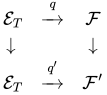
is a commutative diagram for
E
T
→
i
d
E
T
{\displaystyle {\mathcal {E}}_{T}{\xrightarrow {id}}{\mathcal {E}}_{T}}



Hilbert polynomial
For a relatively very ample line bundle
L
∈
Pic
(
X
)
{\displaystyle {\mathcal {L}}\in {\text{Pic}}(X)}


m
↦
χ
(
F
s
(
m
)
)
=
∑
i
=
0
n
(
−
1
)
i
dim
κ
(
s
)
H
i
(
X
,
F
s
⊗
L
s
⊗
m
)
{\displaystyle m\mapsto \chi ({\mathcal {F}}_{s}(m))=\sum _{i=0}^{n}(-1)^{i}{\text{dim}}_{\kappa (s)}H^{i}(X,{\mathcal {F}}_{s}\otimes {\mathcal {L}}_{s}^{\otimes m})}

which is a polynomial for
m
>>
0
{\displaystyle m>>0}


Q u o t E / X / S = ∐ Φ ∈ Q [ t ] Q u o t E / X / S Φ , L {\displaystyle {\mathcal {Quot}}_{{\mathcal {E}}/X/S}=\coprod _{\Phi \in \mathbb {Q} [t]}{\mathcal {Quot}}_{{\mathcal {E}}/X/S}^{\Phi ,{\mathcal {L}}}}
![{\displaystyle {\mathcal {Quot}}_{{\mathcal {E}}/X/S}=\coprod _{\Phi \in \mathbb {Q} [t]}{\mathcal {Quot}}_{{\mathcal {E}}/X/S}^{\Phi ,{\mathcal {L}}}}](https://wikimedia.org/api/rest_v1/media/math/render/svg/f890abd582faea3b13b26c15096e25304eb3b203)
where
Q u o t E / X / S Φ , L ( T ) = { ( F , q ) ∈ Q u o t E / X / S ( T ) : Φ F = Φ } {\displaystyle {\mathcal {Quot}}_{{\mathcal {E}}/X/S}^{\Phi ,{\mathcal {L}}}(T)=\left\{({\mathcal {F}},q)\in {\mathcal {Quot}}_{{\mathcal {E}}/X/S}(T):\Phi _{\mathcal {F}}=\Phi \right\}}

The Hilbert polynomial
Φ
F
{\displaystyle \Phi _{\mathcal {F}}}


Grothendieck's existence theorem
It is a theorem of Grothendieck's that the functors
Q
u
o
t
E
/
X
/
S
Φ
,
L
{\displaystyle {\mathcal {Quot}}_{{\mathcal {E}}/X/S}^{\Phi ,{\mathcal {L}}}}


Examples
Grassmannian
The Grassmannian
G
(
n
,
k
)
{\displaystyle G(n,k)}


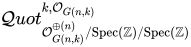
O G ( n , k ) ⊕ k → U {\displaystyle {\mathcal {O}}_{G(n,k)}^{\oplus k}\to {\mathcal {U}}}

where
U
x
{\displaystyle {\mathcal {U}}_{x}}


Q u o t O G ( n , k ) ⊕ ( n ) / Spec ( Z ) / Spec ( Z ) k , O G ( n , k ) {\displaystyle {\mathcal {Quot}}_{{\mathcal {O}}_{G(n,k)}^{\oplus (n)}/{\text{Spec}}(\mathbb {Z} )/{\text{Spec}}(\mathbb {Z} )}^{k,{\mathcal {O}}_{G(n,k)}}}
Projective space
As a special case, we can construct the projective bundle
P
(
E
)
{\displaystyle \mathbb {P} ({\mathcal {E}})}


Q u o t E / X / S 1 , O X {\displaystyle {\mathcal {Quot}}_{{\mathcal {E}}/X/S}^{1,{\mathcal {O}}_{X}}}

for a sheaf
E
{\displaystyle {\mathcal {E}}}

Hilbert scheme
The Hilbert scheme is a special example of the quot scheme. Notice a subscheme
Z
⊂
X
{\displaystyle Z\subset X}

O X → O Z {\displaystyle {\mathcal {O}}_{X}\to {\mathcal {O}}_{Z}}

and a flat family of such projections parametrized by a scheme
T
∈
S
c
h
/
S
{\displaystyle T\in Sch/S}

O X T → F {\displaystyle {\mathcal {O}}_{X_{T}}\to {\mathcal {F}}}

Since there is a hilbert polynomial associated to
Z
{\displaystyle Z}


Quot O X / X / S Φ Z ≅ Hilb X / S Φ Z {\displaystyle {\text{Quot}}_{{\mathcal {O}}_{X}/X/S}^{\Phi _{Z}}\cong {\text{Hilb}}_{X/S}^{\Phi _{Z}}}

Example of a parameterization
If
X
=
P
k
n
{\displaystyle X=\mathbb {P} _{k}^{n}}


Φ Z ( λ ) = ( n + λ n ) − ( n − d + λ n ) {\displaystyle \Phi _{Z}(\lambda )={\binom {n+\lambda }{n}}-{\binom {n-d+\lambda }{n}}}

Then, there is a surjection
O → O Z {\displaystyle {\mathcal {O}}\to {\mathcal {O}}_{Z}}
with kernel
O
(
−
d
)
{\displaystyle {\mathcal {O}}(-d)}




![{\displaystyle [s]\in Q}](https://wikimedia.org/api/rest_v1/media/math/render/svg/1cf2786e0f5d8b3c950b2678cabcd9d655d7e58e)

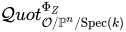
Q u o t O / P n / Spec ( k ) Φ Z {\displaystyle {\mathcal {Quot}}_{{\mathcal {O}}/\mathbb {P} ^{n}/{\text{Spec}}(k)}^{\Phi _{Z}}}
Quadrics in the projective plane
If
X
=
P
2
{\displaystyle X=\mathbb {P} ^{2}}


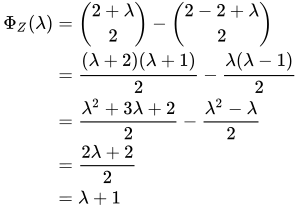
Φ Z ( λ ) = ( 2 + λ 2 ) − ( 2 − 2 + λ 2 ) = ( λ + 2 ) ( λ + 1 ) 2 − λ ( λ − 1 ) 2 = λ 2 + 3 λ + 2 2 − λ 2 − λ 2 = 2 λ + 2 2 = λ + 1 {\displaystyle {\begin{aligned}\Phi _{Z}(\lambda )&={\binom {2+\lambda }{2}}-{\binom {2-2+\lambda }{2}}\\&={\frac {(\lambda +2)(\lambda +1)}{2}}-{\frac {\lambda (\lambda -1)}{2}}\\&={\frac {\lambda ^{2}+3\lambda +2}{2}}-{\frac {\lambda ^{2}-\lambda }{2}}\\&={\frac {2\lambda +2}{2}}\\&=\lambda +1\end{aligned}}}
and
Quot O / P 2 / Spec ( k ) λ + 1 ≅ P ( Γ ( O ( 2 ) ) ) ≅ P 5 {\displaystyle {\text{Quot}}_{{\mathcal {O}}/\mathbb {P} ^{2}/{\text{Spec}}(k)}^{\lambda +1}\cong \mathbb {P} (\Gamma ({\mathcal {O}}(2)))\cong \mathbb {P} ^{5}}

The universal quotient over
P
5
×
P
2
{\displaystyle \mathbb {P} ^{5}\times \mathbb {P} ^{2}}

O → U {\displaystyle {\mathcal {O}}\to {\mathcal {U}}}

where the fiber over a point
[
Z
]
∈
Quot
O
/
P
2
/
Spec
(
k
)
λ
+
1
{\displaystyle [Z]\in {\text{Quot}}_{{\mathcal {O}}/\mathbb {P} ^{2}/{\text{Spec}}(k)}^{\lambda +1}}
![{\displaystyle [Z]\in {\text{Quot}}_{{\mathcal {O}}/\mathbb {P} ^{2}/{\text{Spec}}(k)}^{\lambda +1}}](https://wikimedia.org/api/rest_v1/media/math/render/svg/619ebb2770e2fb2e4775cef50709a87c612630c0)
O → O Z {\displaystyle {\mathcal {O}}\to {\mathcal {O}}_{Z}}
For example, if
[
Z
]
=
[
a
0
:
a
1
:
a
2
:
a
3
:
a
4
:
a
5
]
{\displaystyle [Z]=[a_{0}:a_{1}:a_{2}:a_{3}:a_{4}:a_{5}]}
![{\displaystyle [Z]=[a_{0}:a_{1}:a_{2}:a_{3}:a_{4}:a_{5}]}](https://wikimedia.org/api/rest_v1/media/math/render/svg/fd234c33c5c4c4fe1cc483b4f24e2f894b182640)
f = a 0 x 2 + a 1 x y + a 2 x z + a 3 y 2 + a 4 y z + a 5 z 2 {\displaystyle f=a_{0}x^{2}+a_{1}xy+a_{2}xz+a_{3}y^{2}+a_{4}yz+a_{5}z^{2}}

then the universal quotient over
[
Z
]
{\displaystyle [Z]}
![{\displaystyle [Z]}](https://wikimedia.org/api/rest_v1/media/math/render/svg/dba10cc2996611bf99b91bbb1c8c22aa504cdfe7)
0 → O ( − 2 ) → f O → O Z → 0 {\displaystyle 0\to {\mathcal {O}}(-2){\xrightarrow {f}}{\mathcal {O}}\to {\mathcal {O}}_{Z}\to 0}

Semistable vector bundles on a curve
Semistable vector bundles on a curve
C
{\displaystyle C}


-
H
1
(
C
,
F
)
=
0
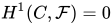
{\displaystyle H^{1}(C,{\mathcal {F}})=0}
-
F
{\displaystyle {\mathcal {F}}}
for
d
>
n
(
2
g
−
1
)
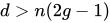
{\displaystyle d>n(2g-1)}
H 0 ( C , F ) ⊗ O C ≅ O C ⊕ N → F {\displaystyle H^{0}(C,{\mathcal {F}})\otimes {\mathcal {O}}_{C}\cong {\mathcal {O}}_{C}^{\oplus N}\to {\mathcal {F}}}

Then, the quot scheme
Q
u
o
t
O
C
⊕
N
/
C
/
Z
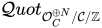
{\displaystyle {\mathcal {Quot}}_{{\mathcal {O}}_{C}^{\oplus N}/{\mathcal {C}}/\mathbb {Z} }}

χ ( F ) = d + n ( 1 − g ) {\displaystyle \chi ({\mathcal {F}})=d+n(1-g)}

For a fixed line bundle
L
{\displaystyle {\mathcal {L}}}



χ ( F ( m ) ) = m n + d + n ( 1 − g ) {\displaystyle \chi ({\mathcal {F}}(m))=mn+d+n(1-g)}
[5]
giving the Hilbert polynomial
Φ F ( λ ) = n λ + d + n ( 1 − g ) {\displaystyle \Phi _{\mathcal {F}}(\lambda )=n\lambda +d+n(1-g)}

Then, the locus of semi-stable vector bundles is contained in
Q u o t O C ⊕ N / C / Z Φ F , L {\displaystyle {\mathcal {Quot}}_{{\mathcal {O}}_{C}^{\oplus N}/{\mathcal {C}}/\mathbb {Z} }^{\Phi _{\mathcal {F}},{\mathcal {L}}}}
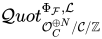
which can be used to construct the moduli space
M
C
(
n
,
d
)
{\displaystyle {\mathcal {M}}_{C}(n,d)}

See also
References
- Grothendieck, Alexander. Techniques de construction et théorèmes d'existence en géométrie algébrique IV : les schémas de Hilbert. Séminaire Bourbaki : années 1960/61, exposés 205-222, Séminaire Bourbaki, no. 6 (1961), Talk no. 221, p. 249-276
- Nitsure, Nitin (2005). "Construction of Hilbert and Quot Schemes". Fundamental algebraic geometry: Grothendieck’s FGA explained. Mathematical Surveys and Monographs. Vol. 123. American Mathematical Society. pp. 105–137. arXiv:math/0504590. ISBN 978-0-8218-4245-4.
- Altman, Allen B.; Kleiman, Steven L. (1980). "Compactifying the Picard scheme". Advances in Mathematics. 35 (1): 50–112. doi:10.1016/0001-8708(80)90043-2. ISSN 0001-8708.
- Meaning a basis
s
i
{\displaystyle s_{i}}
for the global sections Γ ( X , L ) {\displaystyle \Gamma (X,{\mathcal {L}})}
defines an embedding s : X → P S N {\displaystyle \mathbb {s} :X\to \mathbb {P} _{S}^{N}}
for N = dim ( Γ ( X , L ) ) {\displaystyle N={\text{dim}}(\Gamma (X,{\mathcal {L}}))}
- Hoskins, Victoria. "Moduli Problems and Geometric Invariant Theory" (PDF). pp. 68, 74–85. Archived (PDF) from the original on 1 March 2020.
