In mathematics, a subset
A
⊆
X
{\displaystyle A\subseteq X}


![{\displaystyle t\in [0,t_{x}],}](https://wikimedia.org/api/rest_v1/media/math/render/svg/16747de8b50f297e31f0faf306bcf29f99e1c6de)
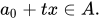


Every radial set is a star domain although not conversely.
Relation to the algebraic interior
The points at which a set is radial are called internal points.[2][3]
The set of all points at which
A
⊆
X
{\displaystyle A\subseteq X}
Relation to absorbing sets
Every absorbing subset is radial at the origin
a
0
=
0
,
{\displaystyle a_{0}=0,}

See also
- Absorbing set – Set that can be "inflated" to reach any point
- Algebraic interior – Generalization of topological interior
- Minkowski functional – Function made from a set
- Star domain – Property of point sets in Euclidean spaces
References
- Jaschke, Stefan; Küchler, Uwe (2000). "Coherent Risk Measures, Valuation Bounds, and (
μ
,
ρ
{\displaystyle \mu ,\rho }
)-Portfolio Optimization" (PDF). Humboldt University of Berlin.
- Aliprantis & Border 2006, p. 199–200.
- John Cook (May 21, 1988). "Separation of Convex Sets in Linear Topological Spaces" (PDF). Retrieved November 14, 2012.
- Nikolaĭ Kapitonovich Nikolʹskiĭ (1992). Functional analysis I: linear functional analysis. Springer. ISBN 978-3-540-50584-6.
- Schaefer & Wolff 1999, p. 11.
- Aliprantis, Charalambos D.; Border, Kim C. (2006). Infinite Dimensional Analysis: A Hitchhiker's Guide (Third ed.). Berlin: Springer Science & Business Media. ISBN 978-3-540-29587-7. OCLC 262692874.
- Schaefer, Helmut H.; Wolff, Manfred P. (1999). Topological Vector Spaces. GTM. Vol. 8 (Second ed.). New York, NY: Springer New York Imprint Springer. ISBN 978-1-4612-7155-0. OCLC 840278135.
- Schechter, Eric (1996). Handbook of Analysis and Its Foundations. San Diego, CA: Academic Press. ISBN 978-0-12-622760-4. OCLC 175294365.