Ramot Naftali
| |
|---|---|
 | |
| Etymology: Naftali Heights | |
  Ramot Naftali  Ramot Naftali | |
| Coordinates: 33°6′6″N 35°33′12″E / 33.10167°N 35.55333°E / 33.10167; 35.55333 | |
| Country |  Israel Israel |
| District | Northern |
| Council | Mevo'ot HaHermon |
| Affiliation | Moshavim Movement |
| Founded | 1945 |
| Founded by | Bnei Peled |
| Population (2024)[1] | 516 |
Ramot Naftali (Hebrew: רמות נפתלי, lit. 'Naftali Heights') is a moshav in northern Israel. Located in the Upper Galilee near the Lebanese border, it falls under the jurisdiction of Mevo'ot HaHermon Regional Council. In 2024 it had a population of 516.[1]
History
After the 1948 Arab–Israeli War, Ramot Naftali took over part of the land belonging to the newly depopulated Palestinian Arab villages of Qadas[2] and Al-Nabi Yusha'.[3]
 Ramot Naftali, 1945
 Ramot Naftali, 1945
 Ramot Naftali, 1945
 Ramot Naftali, 1946
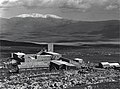 Ramot Naftali with Mount Hermon in distance, 1947
 Ramot Naftali, 1947
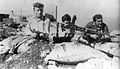 Members of the Yiftach Brigade at Ramot Naftali, 1948
 Israel Air Force plane above Ramot Naftali, 1948
 Ramot Naftali, 1970


Geography
Near Ramot Naftali are the following communities: kibbutz Malkia, kibbutz Yiftah, and moshav Dishon.
The community is located next to Metzudat Koach, a compound of the British Mandate, where 28 fighters were killed when it was captured during the War of Independence.
 Entrance to Ramot Naftali
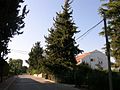 Street in Ramot Naftali
 House in Ramot Naftali
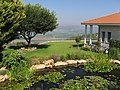 Garden in Ramot Naftali with the Hula Valley in the background
 View of the Mount Hermon from Ramot Naftali


References
- "Regional Statistics". Israel Central Bureau of Statistics. Retrieved 21 March 2026.
- Khalidi, Walid (1992). All That Remains: The Palestinian Villages Occupied and Depopulated by Israel in 1948. Washington D.C.: Institute for Palestine Studies. p. 485. ISBN 0-88728-224-5.
- Khalidi, Walid (1992). All That Remains: The Palestinian Villages Occupied and Depopulated by Israel in 1948. Washington D.C.: Institute for Palestine Studies. p. 481. ISBN 0-88728-224-5.
External links
- Ramot Naftali in Yigal Alon website