In mathematics, the rational sieve is a general algorithm for factoring integers into prime factors. It is a special case of the general number field sieve. While it is less efficient than the general algorithm, it is conceptually simpler. It serves as a helpful first step in understanding how the general number field sieve works.
Method
Suppose we are trying to factor the composite number n. We choose a bound B, and identify the factor base (which we will call P), the set of all primes less than or equal to B. Next, we search for positive integers z such that both z and z + n are B-smooth — i.e. all of their prime factors are in P. We can therefore write, for suitable exponents ai and bi,
z
=
∏
p
i
∈
P
p
i
a
i
and
z
+
n
=
∏
p
i
∈
P
p
i
b
i
.
{\displaystyle z=\prod _{p_{i}\in P}p_{i}^{a_{i}}\qquad {\text{and}}\qquad z+n=\prod _{p_{i}\in P}p_{i}^{b_{i}}.}

But z and
z
+
n
{\displaystyle z+n}

-
∏
p
i
∈
P
p
i
a
i
≡
∏
p
i
∈
P
p
i
b
i
(
mod
n
)
{\displaystyle \prod _{p_{i}\in P}p_{i}^{a_{i}}\equiv \prod _{p_{i}\in P}p_{i}^{b_{i}}{\pmod {n}}}
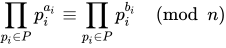
(where the ai and bi are nonnegative integers.)
When we have generated enough of these relations (it is generally sufficient that the number of relations be a few more than the size of P), we can use the methods of linear algebra to multiply together these various relations in such a way that the exponents of the primes are all even. This will give us a congruence of squares of the form a2 ≡ b2 (mod n), which can be turned into a factorization of n = gcd(a + b, n) × gcd(a − b, n). This factorization might turn out to be trivial (i.e. n = n × 1), in which case we have to try again with a different combination of relations, but with luck we will get a nontrivial pair of factors of n, and the algorithm will terminate.
Example
We will factor the integer n = 187 using the rational sieve. We will arbitrarily try the value B = 7, giving the factor base P = {2,3,5,7}. The first step is to test n for divisibility by each of the members of P; clearly if n is divisible by one of these primes, then we are finished already. However, 187 is not divisible by 2, 3, 5, or 7. Next, we search for suitable values of z; the first few are 2, 5, 9, and 56. These four suitable values of z give four multiplicative relations (mod 187):
2
1
3
0
5
0
7
0
=
2
≡
189
=
2
0
3
3
5
0
7
1
{\displaystyle 2^{1}3^{0}5^{0}7^{0}=2\equiv 189=2^{0}3^{3}5^{0}7^{1}}
 | 1 |
2
0
3
0
5
1
7
0
=
5
≡
192
=
2
6
3
1
5
0
7
0
{\displaystyle 2^{0}3^{0}5^{1}7^{0}=5\equiv 192=2^{6}3^{1}5^{0}7^{0}}
 | 2 |
2
0
3
2
5
0
7
0
=
9
≡
196
=
2
2
3
0
5
0
7
2
{\displaystyle 2^{0}3^{2}5^{0}7^{0}=9\equiv 196=2^{2}3^{0}5^{0}7^{2}}
 | 3 |
2
3
3
0
5
0
7
1
=
56
≡
243
=
2
0
3
5
5
0
7
0
{\displaystyle 2^{3}3^{0}5^{0}7^{1}=56\equiv 243=2^{0}3^{5}5^{0}7^{0}}
 | 4 |
There are now several essentially different ways to combine these and end up with even exponents. For example,
- (1)×(4): After multiplying these and canceling out the common factor of 7 (which we can do since 7, being a member of P, has already been determined to be coprime with n[1]), this reduces to 24 ≡ 38 (mod n). The resulting factorization is 187 = gcd(34 + 22, 187) × gcd(34 − 22, 187) = 11 × 17.
Alternatively, equation (3) is in the proper form already:
- (3): This says 32 ≡ 142 (mod n), which gives the factorization 187 = gcd(14 + 3, 187) × gcd(14 − 3, 187) = 11 × 17.
Limitations of the algorithm
Like the general number field sieve, the rational sieve cannot factor numbers of the form pm, where p is a prime and m is an integer. This is not a huge problem, though—such numbers are statistically rare, and moreover there is a simple and fast process to check whether a given number is of this form. Probably the most elegant method is to check whether ⌊n1/b⌋b = n holds for any 1 < b ≤ log2(n) using an integer version of Newton's method for the root extraction.[2]
The biggest problem is finding a sufficient number of z such that both z and z + n are B-smooth. For any given B, the proportion of numbers that are B-smooth decreases rapidly with the size of the number. So if n is large (say, a hundred digits), it will be difficult or impossible to find enough z for the algorithm to work. The advantage of the general number field sieve is that one only needs to search for smooth numbers of order exp(C (log(n))2/3 (log(log(n)))1/3) for some C > 0, rather than of order n as required here.[3]
References
- A. K. Lenstra, H. W. Lenstra, Jr., M. S. Manasse, and J. M. Pollard, The Factorization of the Ninth Fermat Number, Math. Comp. 61 (1993), 319-349. Available at .
- A. K. Lenstra, H. W. Lenstra, Jr. (eds.) The Development of the Number Field Sieve, Lecture Notes in Mathematics 1554, Springer-Verlag, New York, 1993.
Footnotes
- Note that common factors cannot in general be canceled in a congruence, but they can in this case, since the primes of the factor base are all required to be coprime to n, as mentioned above. See modular multiplicative inverse.
- R. Crandall and J. Papadopoulos, On the implementation of AKS-class primality tests, available at
- A. K. Lenstra, H. W. Lenstra, Jr., M. S. Manasse, and J. M. Pollard, The Factorization of the Ninth Fermat Number, Math. Comp. 61 (1993), p. 328