| Differential equations |
|---|
| Scope |
| Classification |
| Solution |
| People |
| Named equations |
Reduction of order (or d’Alembert reduction) is a technique in mathematics for solving second-order linear ordinary differential equations. It is employed when one solution
y
1
(
x
)
{\displaystyle y_{1}(x)}
is known and a second linearly independent solution
y
2
(
x
)
{\displaystyle y_{2}(x)}
is desired. The method also applies to n-th order equations. In this case the ansatz will yield an (n−1)-th order equation for
v
{\displaystyle v}
.
Second-order linear ordinary differential equations
An example
Consider the general, homogeneous, second-order linear constant coefficient ordinary differential equation. (ODE)
a
y
″
(
x
)
+
b
y
′
(
x
)
+
c
y
(
x
)
=
0
,
{\displaystyle ay''(x)+by'(x)+cy(x)=0,}

where
a
,
b
,
c
{\displaystyle a,b,c}
are real non-zero coefficients. Two linearly independent solutions for this ODE can be straightforwardly found using characteristic equations except for the case when the discriminant,
b
2
−
4
a
c
{\displaystyle b^{2}-4ac}
, vanishes. In this case,
a
y
″
(
x
)
+
b
y
′
(
x
)
+
b
2
4
a
y
(
x
)
=
0
,
{\displaystyle ay''(x)+by'(x)+{\frac {b^{2}}{4a}}y(x)=0,}
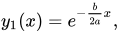
from which only one solution,
y
1
(
x
)
=
e
−
b
2
a
x
,
{\displaystyle y_{1}(x)=e^{-{\frac {b}{2a}}x},}
can be found using its characteristic equation.
The method of reduction of order is used to obtain a second linearly independent solution to this differential equation using our one known solution. To find a second solution we take as a guess
y
2
(
x
)
=
v
(
x
)
y
1
(
x
)
{\displaystyle y_{2}(x)=v(x)y_{1}(x)}

where
v
(
x
)
{\displaystyle v(x)}
is an unknown function to be determined. Since
y
2
(
x
)
{\displaystyle y_{2}(x)}
must satisfy the original ODE, we substitute it back in to get
a
(
v
″
y
1
+
2
v
′
y
1
′
+
v
y
1
″
)
+
b
(
v
′
y
1
+
v
y
1
′
)
+
b
2
4
a
v
y
1
=
0.
{\displaystyle a\left(v''y_{1}+2v'y_{1}'+vy_{1}''\right)+b\left(v'y_{1}+vy_{1}'\right)+{\frac {b^{2}}{4a}}vy_{1}=0.}
Rearranging this equation in terms of the derivatives of
v
(
x
)
{\displaystyle v(x)}
we get
(
a
y
1
)
v
″
+
(
2
a
y
1
′
+
b
y
1
)
v
′
+
(
a
y
1
″
+
b
y
1
′
+
b
2
4
a
y
1
)
v
=
0.
{\displaystyle \left(ay_{1}\right)v''+\left(2ay_{1}'+by_{1}\right)v'+\left(ay_{1}''+by_{1}'+{\frac {b^{2}}{4a}}y_{1}\right)v=0.}
Since we know that
y
1
(
x
)
{\displaystyle y_{1}(x)}

is a solution to the original problem, the coefficient of the last term is equal to zero. Furthermore, substituting
y
1
(
x
)
{\displaystyle y_{1}(x)}
into the second term's coefficient yields (for that coefficient)
2
a
(
−
b
2
a
e
−
b
2
a
x
)
+
b
e
−
b
2
a
x
=
(
−
b
+
b
)
e
−
b
2
a
x
=
0.
{\displaystyle 2a\left(-{\frac {b}{2a}}e^{-{\frac {b}{2a}}x}\right)+be^{-{\frac {b}{2a}}x}=\left(-b+b\right)e^{-{\frac {b}{2a}}x}=0.}
Therefore, we are left with
a
y
1
v
″
=
0.
{\displaystyle ay_{1}v''=0.}
Since
a
{\displaystyle a}
is assumed non-zero and
y
1
(
x
)
{\displaystyle y_{1}(x)}
is an exponential function (and thus always non-zero), we have
v
″
=
0.
{\displaystyle v''=0.}
This can be integrated twice to yield
v
(
x
)
=
c
1
x
+
c
2
{\displaystyle v(x)=c_{1}x+c_{2}}

where
c
1
,
c
2
{\displaystyle c_{1},c_{2}}
are constants of integration. We now can write our second solution as
y
2
(
x
)
=
(
c
1
x
+
c
2
)
y
1
(
x
)
=
c
1
x
y
1
(
x
)
+
c
2
y
1
(
x
)
.
{\displaystyle y_{2}(x)=(c_{1}x+c_{2})y_{1}(x)=c_{1}xy_{1}(x)+c_{2}y_{1}(x).}
Since the second term in
y
2
(
x
)
{\displaystyle y_{2}(x)}

is a scalar multiple of the first solution (and thus linearly dependent) we can drop that term, yielding a final solution of
y
2
(
x
)
=
x
y
1
(
x
)
=
x
e
−
b
2
a
x
.
{\displaystyle y_{2}(x)=xy_{1}(x)=xe^{-{\frac {b}{2a}}x}.}
Finally, we can prove that the second solution
y
2
(
x
)
{\displaystyle y_{2}(x)}

found via this method is linearly independent of the first solution by calculating the Wronskian
W
(
y
1
,
y
2
)
(
x
)
=
|
y
1
x
y
1
y
1
′
y
1
+
x
y
1
′
|
=
y
1
(
y
1
+
x
y
1
′
)
−
x
y
1
y
1
′
=
y
1
2
+
x
y
1
y
1
′
−
x
y
1
y
1
′
=
y
1
2
=
e
−
b
a
x
≠
0.
{\displaystyle W(y_{1},y_{2})(x)={\begin{vmatrix}y_{1}&xy_{1}\\y_{1}'&y_{1}+xy_{1}'\end{vmatrix}}=y_{1}(y_{1}+xy_{1}')-xy_{1}y_{1}'=y_{1}^{2}+xy_{1}y_{1}'-xy_{1}y_{1}'=y_{1}^{2}=e^{-{\frac {b}{a}}x}\neq 0.}
Thus
y
2
(
x
)
{\displaystyle y_{2}(x)}
is the second linearly independent solution we were looking for.
General method
Given the general non-homogeneous linear differential equation
y
″
+
p
(
t
)
y
′
+
q
(
t
)
y
=
r
(
t
)
{\displaystyle y''+p(t)y'+q(t)y=r(t)}

and a single solution
y
1
(
t
)
{\displaystyle y_{1}(t)}
of the homogeneous equation [
r
(
t
)
=
0
{\displaystyle r(t)=0}
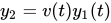
], let us try a solution of the full non-homogeneous equation in the form:
y
2
=
v
(
t
)
y
1
(
t
)
{\displaystyle y_{2}=v(t)y_{1}(t)}
where
v
(
t
)
{\displaystyle v(t)}
is an arbitrary function. Thus
y
2
′
=
v
′
(
t
)
y
1
(
t
)
+
v
(
t
)
y
1
′
(
t
)
{\displaystyle y_{2}'=v'(t)y_{1}(t)+v(t)y_{1}'(t)}
and
y
2
″
=
v
″
(
t
)
y
1
(
t
)
+
2
v
′
(
t
)
y
1
′
(
t
)
+
v
(
t
)
y
1
″
(
t
)
.
{\displaystyle y_{2}''=v''(t)y_{1}(t)+2v'(t)y_{1}'(t)+v(t)y_{1}''(t).}
If these are substituted for
y
{\displaystyle y}
,
y
′
{\displaystyle y'}
, and
y
″
{\displaystyle y''}
in the differential equation, then
y
1
(
t
)
v
″
+
(
2
y
1
′
(
t
)
+
p
(
t
)
y
1
(
t
)
)
v
′
+
(
y
1
″
(
t
)
+
p
(
t
)
y
1
′
(
t
)
+
q
(
t
)
y
1
(
t
)
)
v
=
r
(
t
)
.
{\displaystyle y_{1}(t)\,v''+(2y_{1}'(t)+p(t)y_{1}(t))\,v'+(y_{1}''(t)+p(t)y_{1}'(t)+q(t)y_{1}(t))\,v=r(t).}
Since
y
1
(
t
)
{\displaystyle y_{1}(t)}

is a solution of the original homogeneous differential equation,
y
1
″
(
t
)
+
p
(
t
)
y
1
′
(
t
)
+
q
(
t
)
y
1
(
t
)
=
0
{\displaystyle y_{1}''(t)+p(t)y_{1}'(t)+q(t)y_{1}(t)=0}
, so we can reduce to
y
1
(
t
)
v
″
+
(
2
y
1
′
(
t
)
+
p
(
t
)
y
1
(
t
)
)
v
′
=
r
(
t
)
{\displaystyle y_{1}(t)\,v''+(2y_{1}'(t)+p(t)y_{1}(t))\,v'=r(t)}
which is a first-order differential equation for
v
′
(
t
)
{\displaystyle v'(t)}
(reduction of order). Divide by
y
1
(
t
)
{\displaystyle y_{1}(t)}
, obtaining
v
″
+
(
2
y
1
′
(
t
)
y
1
(
t
)
+
p
(
t
)
)
v
′
=
r
(
t
)
y
1
(
t
)
.
{\displaystyle v''+\left({\frac {2y_{1}'(t)}{y_{1}(t)}}+p(t)\right)\,v'={\frac {r(t)}{y_{1}(t)}}.}
One integrating factor is given by
μ
(
t
)
=
e
∫
(
2
y
1
′
(
t
)
y
1
(
t
)
+
p
(
t
)
)
d
t
{\displaystyle \mu (t)=e^{\int ({\frac {2y_{1}'(t)}{y_{1}(t)}}+p(t))dt}}
, and because
-
∫
(
2
y
1
′
(
t
)
y
1
(
t
)
+
p
(
t
)
)
d
t
=
2
∫
y
1
′
(
t
)
y
1
(
t
)
d
t
+
∫
p
(
t
)
d
t
=
2
ln
(
y
1
(
t
)
)
+
∫
p
(
t
)
d
t
=
ln
(
y
1
2
(
t
)
)
+
∫
p
(
t
)
d
t
,
{\displaystyle \int \left({\frac {2y_{1}'(t)}{y_{1}(t)}}+p(t)\right)\,dt=2\int {\frac {y_{1}'(t)}{y_{1}(t)}}\,dt+\int p(t)\,dt=2\ln(y_{1}(t))+\int p(t)\,dt=\ln(y_{1}^{2}(t))+\int p(t)\,dt,}

this integrating factor can be more neatly expressed as
μ
(
t
)
=
e
ln
(
y
1
2
(
t
)
)
+
∫
p
(
t
)
d
t
=
y
1
2
(
t
)
e
∫
p
(
t
)
d
t
.
{\displaystyle \mu (t)=e^{\ln(y_{1}^{2}(t))+\int p(t)\,dt}=y_{1}^{2}(t)e^{\int p(t)dt}.}
Multiplying the differential equation by the integrating factor
μ
(
t
)
{\displaystyle \mu (t)}
, the equation for
v
(
t
)
{\displaystyle v(t)}
can be reduced to
d
d
t
(
v
′
(
t
)
y
1
2
(
t
)
e
∫
p
(
t
)
d
t
)
=
y
1
(
t
)
r
(
t
)
e
∫
p
(
t
)
d
t
.
{\displaystyle {\frac {d}{dt}}\left(v'(t)y_{1}^{2}(t)e^{\int p(t)dt}\right)=y_{1}(t)r(t)e^{\int p(t)dt}.}
After integrating the last equation,
v
′
(
t
)
{\displaystyle v'(t)}

is found, containing one constant of integration. Then, integrate
v
′
(
t
)
{\displaystyle v'(t)}
to find the full solution of the original non-homogeneous second-order equation, exhibiting two constants of integration as it should:
y
2
(
t
)
=
v
(
t
)
y
1
(
t
)
.
{\displaystyle y_{2}(t)=v(t)y_{1}(t).}
See also
References
- Boyce, William E.; DiPrima, Richard C. (2005). Elementary Differential Equations and Boundary Value Problems (8th ed.). Hoboken, NJ: John Wiley & Sons, Inc. ISBN 978-0-471-43338-5.
- Teschl, Gerald (2012). Ordinary Differential Equations and Dynamical Systems. Providence: American Mathematical Society. ISBN 978-0-8218-8328-0.
- Eric W. Weisstein, Second-Order Ordinary Differential Equation Second Solution, From MathWorld—A Wolfram Web Resource.