In mathematics, a regular element of a Lie algebra or Lie group is an element whose centralizer has dimension as small as possible.
For example, in a complex semisimple Lie algebra, an element
X
∈
g
{\displaystyle X\in {\mathfrak {g}}}
is regular if its centralizer in
g
{\displaystyle {\mathfrak {g}}}
has dimension equal to the rank of
g
{\displaystyle {\mathfrak {g}}}
, which in turn equals the dimension of some Cartan subalgebra
h
{\displaystyle {\mathfrak {h}}}
(note that in earlier papers, an element of a complex semisimple Lie algebra was termed regular if it is semisimple and the kernel of its adjoint representation is a Cartan subalgebra).
An element
g
∈
G
{\displaystyle g\in G}
a Lie group is regular if its centralizer has dimension equal to the rank of
G
{\displaystyle G}
.
Basic case
In the specific case of
g
l
n
(
k
)
{\displaystyle {\mathfrak {gl}}_{n}(\mathbb {k} )}
, the Lie algebra of
n
×
n
{\displaystyle n\times n}
matrices over an algebraically closed field
k
{\displaystyle \mathbb {k} }
(such as the complex numbers), a regular element
M
{\displaystyle M}
is an element whose Jordan normal form contains a single Jordan block for each eigenvalue (in other words, the geometric multiplicity of each eigenvalue is 1).
The centralizer of a regular element is the set of polynomials of degree less than
n
{\displaystyle n}
evaluated at the matrix
M
{\displaystyle M}
, and therefore the centralizer has dimension
n
{\displaystyle n}
(which equals the rank of
g
l
n
{\displaystyle {\mathfrak {gl}}_{n}}
, but is not necessarily an algebraic torus).
If the matrix
M
{\displaystyle M}
is diagonalisable, then it is regular if and only if there are
n
{\displaystyle n}
different eigenvalues. To see this, notice that
M
{\displaystyle M}
will commute with any matrix
P
{\displaystyle P}
that stabilises each of its eigenspaces. If there are
n
{\displaystyle n}
different eigenvalues, then this happens only if
P
{\displaystyle P}
is diagonalisable on the same basis as
M
{\displaystyle M}
; in fact
P
{\displaystyle P}
is a linear combination of the first
n
{\displaystyle n}
powers of
M
{\displaystyle M}
, and the centralizer is an algebraic torus of complex dimension
n
{\displaystyle n}
(real dimension
2
n
{\displaystyle 2n}
); since this is the smallest possible dimension of a centralizer, the matrix
M
{\displaystyle M}
is regular. However if there are equal eigenvalues, then the centralizer is the product of the general linear groups of the eigenspaces of
M
{\displaystyle M}
, and has strictly larger dimension, so that
M
{\displaystyle M}
is not regular.
For a connected compact Lie group
G
{\displaystyle G}
, the regular elements form an open dense subset, made up of
G
{\displaystyle G}
-conjugacy classes of the elements in a maximal torus
T
{\displaystyle T}
which are regular in
G
{\displaystyle G}
. The regular elements of
T
{\displaystyle T}
are themselves explicitly given as the complement of a set in
T
{\displaystyle T}
, a set of codimension-one subtori corresponding to the root system of
G
{\displaystyle G}
. Similarly, in the Lie algebra
g
{\displaystyle {\mathfrak {g}}}
of
G
{\displaystyle G}
, the regular elements form an open dense subset which can be described explicitly as adjoint
G
{\displaystyle G}
-orbits of regular elements of the Lie algebra of
T
{\displaystyle T}
, the elements outside the hyperplanes corresponding to the root system.[1]
Definition
Let
g
{\displaystyle {\mathfrak {g}}}
be a finite-dimensional Lie algebra over an infinite field.[2] For each
x
∈
g
{\displaystyle x\in {\mathfrak {g}}}
, let
-
p
x
(
t
)
=
det
(
t
−
ad
(
x
)
)
=
∑
i
=
0
dim
g
a
i
(
x
)
t
i
{\displaystyle p_{x}(t)=\det(t-\operatorname {ad} (x))=\sum _{i=0}^{\dim {\mathfrak {g}}}a_{i}(x)t^{i}}
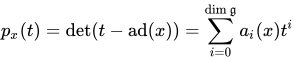
be the characteristic polynomial of the adjoint endomorphism
ad
(
x
)
:
y
↦
[
x
,
y
]
{\displaystyle \operatorname {ad} (x):y\mapsto [x,y]}
of
g
{\displaystyle {\mathfrak {g}}}
. Then, by definition, the rank of
g
{\displaystyle {\mathfrak {g}}}
is the least integer
r
{\displaystyle r}
such that
a
r
(
x
)
≠
0
{\displaystyle a_{r}(x)\neq 0}
for some
x
∈
g
{\displaystyle x\in {\mathfrak {g}}}
and is denoted by
rk
(
g
)
{\displaystyle \operatorname {rk} ({\mathfrak {g}})}
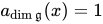
.[3] For example, since
a
dim
g
(
x
)
=
1
{\displaystyle a_{\dim {\mathfrak {g}}}(x)=1}
for every x,
g
{\displaystyle {\mathfrak {g}}}
is nilpotent (i.e., each
ad
(
x
)
{\displaystyle \operatorname {ad} (x)}
is nilpotent by Engel's theorem) if and only if
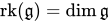
rk
(
g
)
=
dim
g
{\displaystyle \operatorname {rk} ({\mathfrak {g}})=\dim {\mathfrak {g}}}
. Note that over an algebraically closed field of characteristic zero and
h
{\displaystyle {\mathfrak {h}}}
is a Cartan subalgebra of
g
{\displaystyle {\mathfrak {g}}}
then
rk
(
g
)
=
dim
h
{\displaystyle \operatorname {rk} ({\mathfrak {g}})=\dim {\mathfrak {h}}}
; see the section below.
Let
g
reg
=
{
x
∈
g
|
a
rk
(
g
)
(
x
)
≠
0
}
{\displaystyle {\mathfrak {g}}_{\text{reg}}=\{x\in {\mathfrak {g}}|a_{\operatorname {rk} ({\mathfrak {g}})}(x)\neq 0\}}

. By definition, a regular element of
g
{\displaystyle {\mathfrak {g}}}
is an element of the set
g
reg
{\displaystyle {\mathfrak {g}}_{\text{reg}}}
.[3] Since
a
rk
(
g
)
{\displaystyle a_{\operatorname {rk} ({\mathfrak {g}})}}
is a polynomial function on
g
{\displaystyle {\mathfrak {g}}}
, with respect to the Zariski topology, the set
g
reg
{\displaystyle {\mathfrak {g}}_{\text{reg}}}
is an open subset of
g
{\displaystyle {\mathfrak {g}}}
.
Over
C
{\displaystyle \mathbb {C} }
,
g
reg
{\displaystyle {\mathfrak {g}}_{\text{reg}}}
is a connected set (with respect to the usual topology),[4] but over
R
{\displaystyle \mathbb {R} }
, it is only a finite union of connected open sets.[5]
A Cartan subalgebra and a regular element
Over an infinite field, a regular element can be used to construct a Cartan subalgebra, a self-normalizing nilpotent subalgebra. Over a field of characteristic zero, this approach constructs all the Cartan subalgebras.
Given an element
x
∈
g
{\displaystyle x\in {\mathfrak {g}}}
, let
-
g
0
(
x
)
=
∑
n
≥
0
ker
(
ad
(
x
)
n
:
g
→
g
)
{\displaystyle {\mathfrak {g}}^{0}(x)=\sum _{n\geq 0}\ker(\operatorname {ad} (x)^{n}:{\mathfrak {g}}\to {\mathfrak {g}})}

be the generalized eigenspace of
ad
(
x
)
{\displaystyle \operatorname {ad} (x)}
for eigenvalue zero. It is a subalgebra of
g
{\displaystyle {\mathfrak {g}}}
.[6] Note that
dim
g
0
(
x
)
{\displaystyle \dim {\mathfrak {g}}^{0}(x)}
is the same as the (algebraic) multiplicity[7] of zero as an eigenvalue of
ad
(
x
)
{\displaystyle \operatorname {ad} (x)}
; i.e., the least integer m such that
a
m
(
x
)
≠
0
{\displaystyle a_{m}(x)\neq 0}
in the notation in § Definition. Thus,
rk
(
g
)
≤
dim
g
0
(
x
)
{\displaystyle \operatorname {rk} ({\mathfrak {g}})\leq \dim {\mathfrak {g}}^{0}(x)}
and the equality holds if and only if
x
{\displaystyle x}
is a regular element.[3]
The statement is then that if
x
{\displaystyle x}
is a regular element, then
g
0
(
x
)
{\displaystyle {\mathfrak {g}}^{0}(x)}
is a Cartan subalgebra.[8] Thus,
rk
(
g
)
{\displaystyle \operatorname {rk} ({\mathfrak {g}})}
is the dimension of at least some Cartan subalgebra; in fact,
rk
(
g
)
{\displaystyle \operatorname {rk} ({\mathfrak {g}})}
is the minimum dimension of a Cartan subalgebra. More strongly, over a field of characteristic zero (e.g.,
R
{\displaystyle \mathbb {R} }
or
C
{\displaystyle \mathbb {C} }
),[9]
- every Cartan subalgebra of
g
{\displaystyle {\mathfrak {g}}}
has the same dimension; thus, rk ( g ) {\displaystyle \operatorname {rk} ({\mathfrak {g}})}
is the dimension of an arbitrary Cartan subalgebra,
- an element x of
g
{\displaystyle {\mathfrak {g}}}
is regular if and only if g 0 ( x ) {\displaystyle {\mathfrak {g}}^{0}(x)}
is a Cartan subalgebra, and
- every Cartan subalgebra is of the form
g
0
(
x
)
{\displaystyle {\mathfrak {g}}^{0}(x)}
for some regular element x ∈ g {\displaystyle x\in {\mathfrak {g}}}
.
A regular element in a Cartan subalgebra of a complex semisimple Lie algebra
For a Cartan subalgebra
h
{\displaystyle {\mathfrak {h}}}
of a complex semisimple Lie algebra
g
{\displaystyle {\mathfrak {g}}}
with the root system
Φ
{\displaystyle \Phi }
, an element of
h
{\displaystyle {\mathfrak {h}}}
is regular if and only if it is not in the union of hyperplanes
⋃
α
∈
Φ
{
h
∈
h
∣
α
(
h
)
=
0
}
{\textstyle \bigcup _{\alpha \in \Phi }\{h\in {\mathfrak {h}}\mid \alpha (h)=0\}}
.[10] This is because: for
r
=
dim
h
{\displaystyle r=\dim {\mathfrak {h}}}
,
- For each
h
∈
h
{\displaystyle h\in {\mathfrak {h}}}
, the characteristic polynomial of ad ( h ) {\displaystyle \operatorname {ad} (h)}
is t r ( t dim g − r − ∑ α ∈ Φ α ( h ) t dim g − r − 1 + ⋯ ± ∏ α ∈ Φ α ( h ) ) {\textstyle t^{r}\left(t^{\dim {\mathfrak {g}}-r}-\sum _{\alpha \in \Phi }\alpha (h)t^{\dim {\mathfrak {g}}-r-1}+\cdots \pm \prod _{\alpha \in \Phi }\alpha (h)\right)}
.
This characterization is sometimes taken as the definition of a regular element (especially when only regular elements in Cartan subalgebras are of interest).
Notes
- Sepanski, Mark R. (2006). Compact Lie Groups. Springer. p. 156. ISBN 978-0-387-30263-8.
- Editorial note: the definition of a regular element over a finite field is unclear.
- Bourbaki 1981, Ch. VII, § 2.2. Definition 2.
- Serre 2001, Ch. III, § 1. Proposition 1.
- Serre 2001, Ch. III, § 6.
- This is a consequence of the binomial-ish formula for ad.
- Recall that the geometric multiplicity of an eigenvalue of an endomorphism is the dimension of the eigenspace while the algebraic multiplicity of it is the dimension of the generalized eigenspace.
- Bourbaki 1981, Ch. VII, § 2.3. Theorem 1.
- Bourbaki 1981, Ch. VII, § 3.3. Theorem 2.
- Procesi 2007, Ch. 10, § 3.2.
References
- Bourbaki, N. (1981), Groupes et Algèbres de Lie, Éléments de Mathématique, Hermann
- Fulton, William; Harris, Joe (1991), Representation Theory, A First Course, Graduate Texts in Mathematics, vol. 129, Berlin, New York: Springer-Verlag, ISBN 978-0-387-97495-8, MR 1153249
- Procesi, Claudio (2007), Lie Groups: an approach through invariants and representation, Springer, ISBN 9780387260402
- Serre, Jean-Pierre (2001), Complex Semisimple Lie Algebras, Springer, ISBN 3-5406-7827-1