
In chromatography, resolution is a measure of the separation of two peaks of different retention time t in a chromatogram.[1][2][3][4]
Expression
Chromatographic peak resolution is given by
-
R
s
=
2
t
R
2
−
t
R
1
w
b
1
+
w
b
2
{\displaystyle R_{s}=2{\cfrac {t_{R2}-t_{R1}}{w_{b1}+w_{b2}}}}
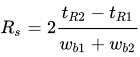
where tR is the retention time and wb is the peak width at baseline. The bigger the time-difference and/or the smaller the bandwidths, the better the resolution of the compounds. Here compound 1 elutes before compound 2.
If the peaks have the same width
-
R
s
=
t
R
2
−
t
R
1
w
b
{\displaystyle R_{s}={\cfrac {t_{R2}-t_{R1}}{w_{b}}}}
.
Plate number

The theoretical plate height is given by
-
H
=
L
N
{\displaystyle H={\frac {L}{N}}}

where L is the column length and N the number of theoretical plates.[5] The relation between plate number and peak width at the base is given by
-
N
=
16
⋅
(
t
R
W
b
)
2
{\displaystyle N=16\cdot \left({\frac {t_{R}}{W_{b}}}\right)^{2}\,}
.
See also
References
- IUPAC, Compendium of Chemical Terminology, 5th ed. (the "Gold Book") (2025). Online version: (2006–) "Peak Resolution Rs in chromatography". doi:10.1351/goldbook.P04465
- IUPAC, Compendium of Chemical Terminology, 5th ed. (the "Gold Book") (2025). Online version: (2006–) "Peak Resolution in gas chromatography". doi:10.1351/goldbook.R05317
- Maryutina, Tatiana A.; Savonina, Elena Yu.; Fedotov, Petr S.; Smith, Roger M.; Siren, Heli; Hibbert, D. Brynn (2018). "Terminology of separation methods (IUPAC Recommendations 2017)". Pure and Applied Chemistry. 90 (1): 181–231. doi:10.1515/pac-2017-0111. hdl:10138/233658. ISSN 0033-4545.
- Ettre, L. S. (1993). "Nomenclature for chromatography (IUPAC Recommendations 1993)". Pure and Applied Chemistry. 65 (4): 819–872. doi:10.1351/pac199365040819. ISSN 1365-3075.
- IUPAC, Compendium of Chemical Terminology, 5th ed. (the "Gold Book") (2025). Online version: (2006–) "plate number, N". doi:10.1351/goldbook.P04694