
|
Probability density function  | |||
|
Cumulative distribution function  | |||
| Notation |
R
i
c
e
(
ν
,
σ
)
{\displaystyle \mathrm {Rice} (\nu ,\sigma )}
 | ||
|---|---|---|---|
| Parameters |
ν
≥
0
{\displaystyle \nu \geq 0}
 , distance between the reference point and the center of the bivariate distribution, , distance between the reference point and the center of the bivariate distribution,σ ≥ 0 {\displaystyle \sigma \geq 0}  , scale , scale | ||
| Support |
x
∈
[
0
,
∞
)
{\displaystyle x\in [0,\infty )}
 | ||
x
σ
2
exp
(
−
(
x
2
+
ν
2
)
2
σ
2
)
I
0
(
x
ν
σ
2
)
{\displaystyle {\frac {x}{\sigma ^{2}}}\exp \left({\frac {-(x^{2}+\nu ^{2})}{2\sigma ^{2}}}\right)I_{0}\left({\frac {x\nu }{\sigma ^{2}}}\right)}
 | |||
| CDF |
1
−
Q
1
(
ν
σ
,
x
σ
)
{\displaystyle 1-Q_{1}\left({\frac {\nu }{\sigma }},{\frac {x}{\sigma }}\right)}
| ||
| Mean |
σ
π
/
2
L
1
/
2
(
−
ν
2
/
2
σ
2
)
{\displaystyle \sigma {\sqrt {\pi /2}}\,\,L_{1/2}(-\nu ^{2}/2\sigma ^{2})}
 | ||
| Variance |
2
σ
2
+
ν
2
−
π
σ
2
2
L
1
/
2
2
(
−
ν
2
2
σ
2
)
{\displaystyle 2\sigma ^{2}+\nu ^{2}-{\frac {\pi \sigma ^{2}}{2}}L_{1/2}^{2}\left({\frac {-\nu ^{2}}{2\sigma ^{2}}}\right)}
 | ||
| Skewness | (complicated) | ||
| Excess kurtosis | (complicated) | ||
In probability theory, the Rice distribution or Rician distribution (or, less commonly, Ricean distribution) is the probability distribution of the magnitude of a circularly symmetric bivariate normal random variable, possibly with non-zero mean (noncentral). It was named after Stephen O. Rice (1907–1986).
Characterization
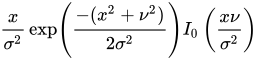
The probability density function is
-
f
(
x
∣
ν
,
σ
)
=
x
σ
2
exp
(
−
(
x
2
+
ν
2
)
2
σ
2
)
I
0
(
x
ν
σ
2
)
H
(
x
)
,
{\displaystyle f(x\mid \nu ,\sigma )={\frac {x}{\sigma ^{2}}}\exp \left({\frac {-(x^{2}+\nu ^{2})}{2\sigma ^{2}}}\right)I_{0}\left({\frac {x\nu }{\sigma ^{2}}}\right)H(x),}

where I0(z) is the modified Bessel function of the first kind with order zero, and H(x) is the Heaviside unit step.[1]
In the context of Rician fading, the distribution is often also rewritten using the shape parameter
K
=
ν
2
2
σ
2
{\displaystyle K={\frac {\nu ^{2}}{2\sigma ^{2}}}}

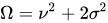
The characteristic function of the Rice distribution is given as:[3][4]
-
χ
X
(
t
∣
ν
,
σ
)
=
exp
(
−
ν
2
2
σ
2
)
[
Ψ
2
(
1
;
1
,
1
2
;
ν
2
2
σ
2
,
−
1
2
σ
2
t
2
)
+
i
2
σ
t
Ψ
2
(
3
2
;
1
,
3
2
;
ν
2
2
σ
2
,
−
1
2
σ
2
t
2
)
]
,
{\displaystyle {\begin{aligned}\chi _{X}(t\mid \nu ,\sigma )=\exp \left(-{\frac {\nu ^{2}}{2\sigma ^{2}}}\right)&\left[\Psi _{2}\left(1;1,{\frac {1}{2}};{\frac {\nu ^{2}}{2\sigma ^{2}}},-{\frac {1}{2}}\sigma ^{2}t^{2}\right)\right.\\[8pt]&\left.{}+i{\sqrt {2}}\sigma t\Psi _{2}\left({\frac {3}{2}};1,{\frac {3}{2}};{\frac {\nu ^{2}}{2\sigma ^{2}}},-{\frac {1}{2}}\sigma ^{2}t^{2}\right)\right],\end{aligned}}}
![{\displaystyle {\begin{aligned}\chi _{X}(t\mid \nu ,\sigma )=\exp \left(-{\frac {\nu ^{2}}{2\sigma ^{2}}}\right)&\left[\Psi _{2}\left(1;1,{\frac {1}{2}};{\frac {\nu ^{2}}{2\sigma ^{2}}},-{\frac {1}{2}}\sigma ^{2}t^{2}\right)\right.\\[8pt]&\left.{}+i{\sqrt {2}}\sigma t\Psi _{2}\left({\frac {3}{2}};1,{\frac {3}{2}};{\frac {\nu ^{2}}{2\sigma ^{2}}},-{\frac {1}{2}}\sigma ^{2}t^{2}\right)\right],\end{aligned}}}](https://wikimedia.org/api/rest_v1/media/math/render/svg/78e23ca2a48dd2b11c2e5ca46a8f017950308c55)
where
Ψ
2
(
α
;
γ
,
γ
′
;
x
,
y
)
{\displaystyle \Psi _{2}\left(\alpha ;\gamma ,\gamma ';x,y\right)}



-
Ψ
2
(
α
;
γ
,
γ
′
;
x
,
y
)
=
∑
n
=
0
∞
∑
m
=
0
∞
(
α
)
m
+
n
(
γ
)
m
(
γ
′
)
n
x
m
y
n
m
!
n
!
,
{\displaystyle \Psi _{2}\left(\alpha ;\gamma ,\gamma ';x,y\right)=\sum _{n=0}^{\infty }\sum _{m=0}^{\infty }{\frac {(\alpha )_{m+n}}{(\gamma )_{m}(\gamma ')_{n}}}{\frac {x^{m}y^{n}}{m!n!}},}

where
-
(
x
)
n
=
x
(
x
+
1
)
⋯
(
x
+
n
−
1
)
=
Γ
(
x
+
n
)
Γ
(
x
)
{\displaystyle (x)_{n}=x(x+1)\cdots (x+n-1)={\frac {\Gamma (x+n)}{\Gamma (x)}}}

is the rising factorial.
Properties
Moments
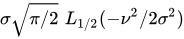
The first few raw moments are:
-
μ
1
′
=
σ
π
/
2
L
1
/
2
(
−
ν
2
/
2
σ
2
)
μ
2
′
=
2
σ
2
+
ν
2
μ
3
′
=
3
σ
3
π
/
2
L
3
/
2
(
−
ν
2
/
2
σ
2
)
μ
4
′
=
8
σ
4
+
8
σ
2
ν
2
+
ν
4
μ
5
′
=
15
σ
5
π
/
2
L
5
/
2
(
−
ν
2
/
2
σ
2
)
μ
6
′
=
48
σ
6
+
72
σ
4
ν
2
+
18
σ
2
ν
4
+
ν
6
{\displaystyle {\begin{aligned}\mu _{1}^{'}&=\sigma {\sqrt {\pi /2}}\,\,L_{1/2}(-\nu ^{2}/2\sigma ^{2})\\\mu _{2}^{'}&=2\sigma ^{2}+\nu ^{2}\,\\\mu _{3}^{'}&=3\sigma ^{3}{\sqrt {\pi /2}}\,\,L_{3/2}(-\nu ^{2}/2\sigma ^{2})\\\mu _{4}^{'}&=8\sigma ^{4}+8\sigma ^{2}\nu ^{2}+\nu ^{4}\,\\\mu _{5}^{'}&=15\sigma ^{5}{\sqrt {\pi /2}}\,\,L_{5/2}(-\nu ^{2}/2\sigma ^{2})\\\mu _{6}^{'}&=48\sigma ^{6}+72\sigma ^{4}\nu ^{2}+18\sigma ^{2}\nu ^{4}+\nu ^{6}\end{aligned}}}
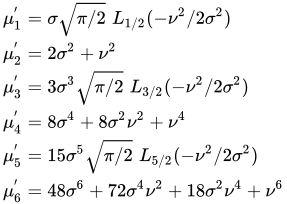
and, in general, the raw moments are given by
-
μ
k
′
=
σ
k
2
k
/
2
Γ
(
1
+
k
/
2
)
L
k
/
2
(
−
ν
2
/
2
σ
2
)
.
{\displaystyle \mu _{k}^{'}=\sigma ^{k}2^{k/2}\,\Gamma (1\!+\!k/2)\,L_{k/2}(-\nu ^{2}/2\sigma ^{2}).}

Here
L
q
(
x
)
{\displaystyle L_{q}(x)}

-
L
q
(
x
)
=
L
q
(
0
)
(
x
)
=
M
(
−
q
,
1
,
x
)
=
1
F
1
(
−
q
;
1
;
x
)
{\displaystyle L_{q}(x)=L_{q}^{(0)}(x)=M(-q,1,x)=\,_{1}F_{1}(-q;1;x)}

where
M
(
a
,
b
,
z
)
=
1
F
1
(
a
;
b
;
z
)
{\displaystyle M(a,b,z)=_{1}F_{1}(a;b;z)}



For the case
q
=
1
/
2
{\displaystyle q=1/2}

-
L
1
/
2
(
x
)
=
1
F
1
(
−
1
2
;
1
;
x
)
=
e
x
/
2
[
(
1
−
x
)
I
0
(
−
x
2
)
−
x
I
1
(
−
x
2
)
]
.
{\displaystyle {\begin{aligned}L_{1/2}(x)&=\,_{1}F_{1}\left(-{\frac {1}{2}};1;x\right)\\&=e^{x/2}\left[\left(1-x\right)I_{0}\left(-{\frac {x}{2}}\right)-xI_{1}\left(-{\frac {x}{2}}\right)\right].\end{aligned}}}
![{\displaystyle {\begin{aligned}L_{1/2}(x)&=\,_{1}F_{1}\left(-{\frac {1}{2}};1;x\right)\\&=e^{x/2}\left[\left(1-x\right)I_{0}\left(-{\frac {x}{2}}\right)-xI_{1}\left(-{\frac {x}{2}}\right)\right].\end{aligned}}}](https://wikimedia.org/api/rest_v1/media/math/render/svg/7baebb5240ced1a2464e31b42c0a0513eb18f296)
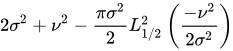
The second central moment, the variance, is
-
μ
2
=
2
σ
2
+
ν
2
−
(
π
σ
2
/
2
)
L
1
/
2
2
(
−
ν
2
/
2
σ
2
)
.
{\displaystyle \mu _{2}=2\sigma ^{2}+\nu ^{2}-(\pi \sigma ^{2}/2)\,L_{1/2}^{2}(-\nu ^{2}/2\sigma ^{2}).}

Note that
L
1
/
2
2
(
⋅
)
{\displaystyle L_{1/2}^{2}(\cdot )}


Related distributions
-
R
∼
R
i
c
e
(
|
ν
|
,
σ
)
{\displaystyle R\sim \mathrm {Rice} \left(|\nu |,\sigma \right)}
if R = X 2 + Y 2 {\displaystyle R={\sqrt {X^{2}+Y^{2}}}}
where X ∼ N ( ν cos θ , σ 2 ) {\displaystyle X\sim N\left(\nu \cos \theta ,\sigma ^{2}\right)}
and Y ∼ N ( ν sin θ , σ 2 ) {\displaystyle Y\sim N\left(\nu \sin \theta ,\sigma ^{2}\right)}
are statistically independent normal random variables and θ {\displaystyle \theta }
is any real number.
- Another case where
R
∼
R
i
c
e
(
ν
,
σ
)
{\displaystyle R\sim \mathrm {Rice} \left(\nu ,\sigma \right)}
comes from the following steps:
- Generate
P
{\displaystyle P}
having a Poisson distribution with parameter (also mean, for a Poisson) λ = ν 2 2 σ 2 {\displaystyle \textstyle \lambda ={\frac {\nu ^{2}}{2\sigma ^{2}}}}
.
- Generate
X
{\displaystyle X}
having a chi-squared distribution with 2 P + 2 {\displaystyle 2P+2}
degrees of freedom.
- Set
R
=
σ
X
.
{\displaystyle R=\sigma {\sqrt {X}}.}
- Generate
P
{\displaystyle P}
- If
R
∼
Rice
(
ν
,
1
)
{\displaystyle R\sim \operatorname {Rice} (\nu ,1)}
then R 2 {\displaystyle R^{2}}
has a noncentral chi-squared distribution with two degrees of freedom and noncentrality parameter ν 2 {\displaystyle \nu ^{2}}
.
- If
R
∼
Rice
(
ν
,
1
)
{\displaystyle R\sim \operatorname {Rice} (\nu ,1)}
has a noncentral chi distribution with two degrees of freedom and noncentrality parameter ν {\displaystyle \nu }
- If
R
∼
Rice
(
0
,
σ
)
{\displaystyle R\sim \operatorname {Rice} (0,\sigma )}
then R ∼ Rayleigh ( σ ) {\displaystyle R\sim \operatorname {Rayleigh} (\sigma )}
, i.e., for the special case of the Rice distribution given by ν = 0 {\displaystyle \nu =0}
, the distribution becomes the Rayleigh distribution, for which the variance is μ 2 = 4 − π 2 σ 2 {\displaystyle \textstyle \mu _{2}={\frac {4-\pi }{2}}\sigma ^{2}}
.
- If
R
∼
Rice
(
0
,
σ
)
{\displaystyle R\sim \operatorname {Rice} (0,\sigma )}
- If
R
∼
Rice
(
ν
,
σ
)
{\displaystyle R\sim \operatorname {Rice} \left(\nu ,\sigma \right)}
then 1 / R {\displaystyle 1/R}
has an Inverse Rician distribution.[8]
- The folded normal distribution is the univariate restriction of the Rice distribution.

Limiting cases
For large values of the argument, the Laguerre polynomial becomes[9]
-
lim
x
→
−
∞
L
ν
(
x
)
=
|
x
|
ν
Γ
(
1
+
ν
)
.
{\displaystyle \lim _{x\to -\infty }L_{\nu }(x)={\frac {|x|^{\nu }}{\Gamma (1+\nu )}}.}
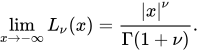
It is seen that as
ν
{\displaystyle \nu }

The transition to a Gaussian approximation proceeds as follows. From Bessel function theory we have
-
I
α
(
z
)
→
e
z
2
π
z
(
1
−
4
α
2
−
1
8
z
+
⋯
)
as
z
→
∞
{\displaystyle I_{\alpha }(z)\to {\frac {e^{z}}{\sqrt {2\pi z}}}\left(1-{\frac {4\alpha ^{2}-1}{8z}}+\cdots \right){\text{ as }}z\rightarrow \infty }

so, in the large
x
ν
/
σ
2
{\displaystyle x\nu /\sigma ^{2}}

-
f
(
x
,
ν
,
σ
)
=
x
σ
2
exp
(
−
(
x
2
+
ν
2
)
2
σ
2
)
I
0
(
x
ν
σ
2
)
is
x
σ
2
exp
(
−
(
x
2
+
ν
2
)
2
σ
2
)
σ
2
2
π
x
ν
exp
(
2
x
ν
2
σ
2
)
(
1
+
σ
2
8
x
ν
+
⋯
)
→
1
σ
2
π
exp
(
−
(
x
−
ν
)
2
2
σ
2
)
x
ν
,
as
x
ν
σ
2
→
∞
{\displaystyle {\begin{aligned}f(x,\nu ,\sigma )={}&{\frac {x}{\sigma ^{2}}}\exp \left({\frac {-(x^{2}+\nu ^{2})}{2\sigma ^{2}}}\right)I_{0}\left({\frac {x\nu }{\sigma ^{2}}}\right)\\{\text{ is }}\\&{\frac {x}{\sigma ^{2}}}\exp \left({\frac {-(x^{2}+\nu ^{2})}{2\sigma ^{2}}}\right){\sqrt {\frac {\sigma ^{2}}{2\pi x\nu }}}\exp \left({\frac {2x\nu }{2\sigma ^{2}}}\right)\left(1+{\frac {\sigma ^{2}}{8x\nu }}+\cdots \right)\\\rightarrow {}&{\frac {1}{\sigma {\sqrt {2\pi }}}}\exp \left(-{\frac {(x-\nu )^{2}}{2\sigma ^{2}}}\right){\sqrt {\frac {x}{\nu }}},\;\;\;{\text{ as }}{\frac {x\nu }{\sigma ^{2}}}\rightarrow \infty \end{aligned}}}
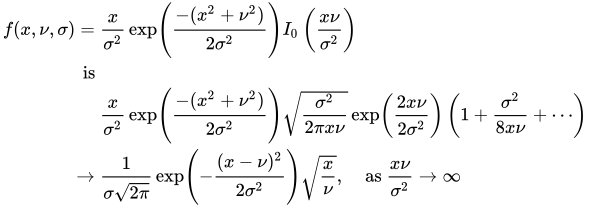
Moreover, when the density is concentrated around
ν
{\textstyle \nu }


-
f
(
x
,
ν
,
σ
)
≈
1
σ
2
π
exp
(
−
(
x
−
ν
)
2
2
σ
2
)
,
ν
σ
≫
1
{\displaystyle f(x,\nu ,\sigma )\approx {\frac {1}{\sigma {\sqrt {2\pi }}}}\exp \left(-{\frac {(x-\nu )^{2}}{2\sigma ^{2}}}\right),\;\;\;{\frac {\nu }{\sigma }}\gg 1}

The approximation becomes usable for
ν
/
σ
>
3
{\displaystyle {\nu }/{\sigma }>3}

Parameter estimation (Koay inversion technique)
There are three different methods for estimating the parameters of the Rice distribution, (1) method of moments,[10][11][12][13] (2) method of maximum likelihood,[10][11][12][14] and (3) method of least squares. In the first two methods the interest is in estimating the parameters of the distribution,
ν
{\displaystyle \nu }


The following is an efficient method, known as the "Koay inversion technique".[15] for solving the estimating equations, based on the sample mean and the sample standard deviation, simultaneously . This inversion technique is also known as the fixed point formula of SNR. Earlier works[10][16] on the method of moments usually use a root-finding method to solve the problem, which is not efficient.
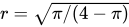
First, the ratio of the sample mean to the sample standard deviation is defined as
r
{\displaystyle r}


-
g
(
θ
)
=
ξ
(
θ
)
[
1
+
r
2
]
−
2
,
{\displaystyle g(\theta )={\sqrt {\xi {(\theta )}\left[1+r^{2}\right]-2}},}
![{\displaystyle g(\theta )={\sqrt {\xi {(\theta )}\left[1+r^{2}\right]-2}},}](https://wikimedia.org/api/rest_v1/media/math/render/svg/3475731daba192c855cd90f039f3a56a2bc26321)
where
θ
{\displaystyle \theta }


-
ξ
(
θ
)
=
2
+
θ
2
−
π
8
exp
(
−
θ
2
/
2
)
[
(
2
+
θ
2
)
I
0
(
θ
2
/
4
)
+
θ
2
I
1
(
θ
2
/
4
)
]
2
,
{\displaystyle \xi {\left(\theta \right)}=2+\theta ^{2}-{\frac {\pi }{8}}\exp {(-\theta ^{2}/2)}\left[(2+\theta ^{2})I_{0}(\theta ^{2}/4)+\theta ^{2}I_{1}(\theta ^{2}/4)\right]^{2},}
![{\displaystyle \xi {\left(\theta \right)}=2+\theta ^{2}-{\frac {\pi }{8}}\exp {(-\theta ^{2}/2)}\left[(2+\theta ^{2})I_{0}(\theta ^{2}/4)+\theta ^{2}I_{1}(\theta ^{2}/4)\right]^{2},}](https://wikimedia.org/api/rest_v1/media/math/render/svg/2c016f1732f8a5a3bc72b406e9c40d7023f1f621)
where
I
0
{\displaystyle I_{0}}


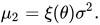
Note that
ξ
(
θ
)
{\displaystyle \xi {\left(\theta \right)}}

-
μ
2
=
ξ
(
θ
)
σ
2
.
{\displaystyle \mu _{2}=\xi {\left(\theta \right)}\sigma ^{2}.}
To find the fixed point,
θ
∗
{\displaystyle \theta ^{*}}



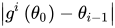


Once the fixed point is found, the estimates
ν
{\displaystyle \nu }
-
σ
=
μ
2
1
/
2
ξ
(
θ
∗
)
,
{\displaystyle \sigma ={\frac {\mu _{2}^{1/2}}{\sqrt {\xi \left(\theta ^{*}\right)}}},}

and
-
ν
=
(
μ
1
′
2
+
(
ξ
(
θ
∗
)
−
2
)
σ
2
)
.
{\displaystyle \nu ={\sqrt {\left(\mu _{1}^{'~2}+\left(\xi \left(\theta ^{*}\right)-2\right)\sigma ^{2}\right)}}.}

To speed up the iteration even more, one can use the Newton's method of root-finding.[15] This particular approach is highly efficient.
Applications
- The Euclidean norm of a bivariate circularly symmetric normally distributed random vector.
- Rician fading (for multipath interference))
- Effect of sighting error on target shooting.[17]
- Analysis of diversity receivers in radio communications.[18][19]
- Distribution of eccentricities for models of the inner Solar System after long-term numerical integration.[20]
- Distribution of noise in magnetic resonance imaging images is rician[21]
See also
References
- Johnson, Norman L., Samuel Kotz, and Narayanaswamy Balakrishnan. Continuous univariate distributions, volume 1. Vol. 1. John wiley & sons, 1994.
- Abdi, A. and Tepedelenlioglu, C. and Kaveh, M. and Giannakis, G., "On the estimation of the K parameter for the Rice fading distribution", IEEE Communications Letters, March 2001, p. 92–94
- Liu 2007 (in one of Horn's confluent hypergeometric functions with two variables).
- Annamalai 2000 (in a sum of infinite series).
- Erdelyi 1953.
- Srivastava 1985.
- Richards, M.A., Rice Distribution for RCS, Georgia Institute of Technology (Sep 2006)
- Jones, Jessica L., Joyce McLaughlin, and Daniel Renzi. "The noise distribution in a shear wave speed image computed using arrival times at fixed spatial positions.", Inverse Problems 33.5 (2017): 055012.
- Abramowitz and Stegun (1968) §13.5.1
- Talukdar et al. 1991
- Bonny et al. 1996
- Sijbers et al. 1998
- den Dekker and Sijbers 2014
- Varadarajan and Haldar 2015
- Koay et al. 2006 (known as the SNR fixed point formula).
- Abdi 2001
- "Ballistipedia". Retrieved 4 May 2014.
- Beaulieu, Norman C; Hemachandra, Kasun (September 2011). "Novel Representations for the Bivariate Rician Distribution". IEEE Transactions on Communications. 59 (11): 2951–2954. doi:10.1109/TCOMM.2011.092011.090171. S2CID 1221747.
- Dharmawansa, Prathapasinghe; Rajatheva, Nandana; Tellambura, Chinthananda (March 2009). "New Series Representation for the Trivariate Non-Central Chi-Squared Distribution" (PDF). IEEE Transactions on Communications. 57 (3): 665–675. CiteSeerX 10.1.1.582.533. doi:10.1109/TCOMM.2009.03.070083. S2CID 15706035.
- Laskar, J. (1 July 2008). "Chaotic diffusion in the Solar System". Icarus. 196 (1): 1–15. arXiv:0802.3371. Bibcode:2008Icar..196....1L. doi:10.1016/j.icarus.2008.02.017. ISSN 0019-1035. S2CID 11586168.
- Gudbjartsson, HáKon; Patz, Samuel (December 1995). "The rician distribution of noisy mri data". Magnetic Resonance in Medicine. 34 (6): 910–914. doi:10.1002/mrm.1910340618.
Further reading
- Abramowitz, M. and Stegun, I. A. (ed.), Handbook of Mathematical Functions, National Bureau of Standards, 1964; reprinted Dover Publications, 1965. ISBN 0-486-61272-4
- Rice, S. O., Mathematical Analysis of Random Noise. Bell System Technical Journal 24 (1945) 46–156.
- I. Soltani Bozchalooi; Ming Liang (20 November 2007). "A smoothness index-guided approach to wavelet parameter selection in signal de-noising and fault detection". Journal of Sound and Vibration. 308 (1–2): 253–254. Bibcode:2007JSV...308..246B. doi:10.1016/j.jsv.2007.07.038.
- Wang, Dong; Zhou, Qiang; Tsui, Kwok-Leung (2017). "On the distribution of the modulus of Gabor wavelet coefficients and the upper bound of the dimensionless smoothness index in the case of additive Gaussian noises: Revisited". Journal of Sound and Vibration. 395: 393–400. doi:10.1016/j.jsv.2017.02.013.
- Liu, X. and Hanzo, L., A Unified Exact BER Performance Analysis of Asynchronous DS-CDMA Systems Using BPSK Modulation over Fading Channels, IEEE Transactions on Wireless Communications, Volume 6, Issue 10, October 2007, pp. 3504–3509.
- Annamalai, A., Tellambura, C. and Bhargava, V. K., Equal-Gain Diversity Receiver Performance in Wireless Channels, IEEE Transactions on Communications, Volume 48, October 2000, pp. 1732–1745.
- Erdelyi, A., Magnus, W., Oberhettinger, F. and Tricomi, F. G., Higher Transcendental Functions, Volume 1. Archived 11 August 2011 at the Wayback Machine McGraw-Hill Book Company Inc., 1953.
- Srivastava, H. M. and Karlsson, P. W., Multiple Gaussian Hypergeometric Series. Ellis Horwood Ltd., 1985.
- Sijbers J., den Dekker A. J., Scheunders P. and Van Dyck D., "Maximum Likelihood estimation of Rician distribution parameters" Archived 19 October 2011 at the Wayback Machine, IEEE Transactions on Medical Imaging, Vol. 17, Nr. 3, pp. 357–361, (1998)
- Varadarajan D. and Haldar J. P., "A Majorize-Minimize Framework for Rician and Non-Central Chi MR Images", IEEE Transactions on Medical Imaging, Vol. 34, no. 10, pp. 2191–2202, (2015)
- den Dekker, A.J.; Sijbers, J (December 2014). "Data distributions in magnetic resonance images: a review". Physica Medica. 30 (7): 725–741. doi:10.1016/j.ejmp.2014.05.002. PMID 25059432.
- Koay, C.G. and Basser, P. J., Analytically exact correction scheme for signal extraction from noisy magnitude MR signals, Journal of Magnetic Resonance, Volume 179, Issue = 2, p. 317–322, (2006)
- Abdi, A., Tepedelenlioglu, C., Kaveh, M., and Giannakis, G. On the estimation of the K parameter for the Rice fading distribution, IEEE Communications Letters, Volume 5, Number 3, March 2001, pp. 92–94.
- Talukdar, K.K.; Lawing, William D. (March 1991). "Estimation of the parameters of the Rice distribution". Journal of the Acoustical Society of America. 89 (3): 1193–1197. Bibcode:1991ASAJ...89.1193T. doi:10.1121/1.400532.
- Bonny, J.M.; Renou, J.P.; Zanca, M. (November 1996). "Optimal Measurement of Magnitude and Phase from MR Data". Journal of Magnetic Resonance, Series B. 113 (2): 136–144. Bibcode:1996JMRB..113..136B. doi:10.1006/jmrb.1996.0166. PMID 8954899.
External links
- MATLAB code for Rice/Rician distribution (PDF, mean and variance, and generating random samples)