In number theory, a kth root of unity modulo n for positive integers k, n ≥ 2, is a root of unity in the ring of integers modulo n; that is, a solution x to the equation (or congruence)
x
k
≡
1
(
mod
n
)
{\displaystyle x^{k}\equiv 1{\pmod {n}}}

The roots of unity modulo n are exactly the integers that are coprime with n. In fact, these integers are roots of unity modulo n by Euler's theorem, and the other integers cannot be roots of unity modulo n, because they are zero divisors modulo n.
A primitive root modulo n, is a generator of the group of units of the ring of integers modulo n. There exist primitive roots modulo n if and only if
λ
(
n
)
=
φ
(
n
)
,
{\displaystyle \lambda (n)=\varphi (n),}
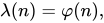


A root of unity modulo n is a primitive kth root of unity modulo n for some divisor k of
λ
(
n
)
,
{\displaystyle \lambda (n),}


Roots of unity
Properties
- If x is a kth root of unity modulo n, then x is a unit (invertible) whose inverse is
x
k
−
1
{\displaystyle x^{k-1}}
. That is, x and n are coprime.
- If x is a unit, then it is a (primitive) kth root of unity modulo n, where k is the multiplicative order of x modulo n.
- If x is a kth root of unity and
x
−
1
{\displaystyle x-1}
is not a zero divisor, then ∑ j = 0 k − 1 x j ≡ 0 ( mod n ) {\displaystyle \sum _{j=0}^{k-1}x^{j}\equiv 0{\pmod {n}}}
, because
-
(
x
−
1
)
⋅
∑
j
=
0
k
−
1
x
j
≡
x
k
−
1
≡
0
(
mod
n
)
.
{\displaystyle (x-1)\cdot \sum _{j=0}^{k-1}x^{j}\equiv x^{k}-1\equiv 0{\pmod {n}}.}
-
(
x
−
1
)
⋅
∑
j
=
0
k
−
1
x
j
≡
x
k
−
1
≡
0
(
mod
n
)
.
{\displaystyle (x-1)\cdot \sum _{j=0}^{k-1}x^{j}\equiv x^{k}-1\equiv 0{\pmod {n}}.}

Number of kth roots
For the lack of a widely accepted symbol, we denote the number of kth roots of unity modulo n by
f
(
n
,
k
)
{\displaystyle f(n,k)}

-
f
(
n
,
1
)
=
1
{\displaystyle f(n,1)=1}
for n ≥ 2 {\displaystyle n\geq 2}
-
f
(
n
,
λ
(
n
)
)
=
φ
(
n
)
{\displaystyle f(n,\lambda (n))=\varphi (n)}
where λ denotes the Carmichael function and φ {\displaystyle \varphi }
-
n
↦
f
(
n
,
k
)
{\displaystyle n\mapsto f(n,k)}
is a multiplicative function
-
k
∣
ℓ
⟹
f
(
n
,
k
)
∣
f
(
n
,
ℓ
)
{\displaystyle k\mid \ell \implies f(n,k)\mid f(n,\ell )}
where the bar denotes divisibility
-
f
(
n
,
lcm
(
a
,
b
)
)
=
lcm
(
f
(
n
,
a
)
,
f
(
n
,
b
)
)
{\displaystyle f(n,\operatorname {lcm} (a,b))=\operatorname {lcm} (f(n,a),f(n,b))}
where lcm {\displaystyle \operatorname {lcm} }
denotes the least common multiple
- For prime
p
{\displaystyle p}
, ∀ i ∈ N ∃ j ∈ N f ( n , p i ) = p j {\displaystyle \forall i\in \mathbb {N} \ \exists j\in \mathbb {N} \ f(n,p^{i})=p^{j}}
. The precise mapping from i {\displaystyle i}
to j {\displaystyle j}
is not known. If it were known, then together with the previous law it would yield a way to evaluate f {\displaystyle f}
quickly.

Examples
Let
n
=
7
{\displaystyle n=7}


Primitive roots of unity
Properties
- The maximum possible radix exponent for primitive roots modulo
n
{\displaystyle n}
is λ ( n ) {\displaystyle \lambda (n)}
, where λ denotes the Carmichael function.
- A radix exponent for a primitive root of unity is a divisor of
λ
(
n
)
{\displaystyle \lambda (n)}
- Every divisor
k
{\displaystyle k}
of λ ( n ) {\displaystyle \lambda (n)}
and compute the power x λ ( n ) / k {\displaystyle x^{\lambda (n)/k}}
.
- If x is a primitive kth root of unity and also a (not necessarily primitive) ℓth root of unity, then k is a divisor of ℓ. This is true, because Bézout's identity yields an integer linear combination of k and ℓ equal to
gcd
(
k
,
ℓ
)
{\displaystyle \gcd(k,\ell )}
. Since k is minimal, it must be k = gcd ( k , ℓ ) {\displaystyle k=\gcd(k,\ell )}
and gcd ( k , ℓ ) {\displaystyle \gcd(k,\ell )}
Number of primitive kth roots
For the lack of a widely accepted symbol, we denote the number of primitive kth roots of unity modulo n by
g
(
n
,
k
)
{\displaystyle g(n,k)}

-
g
(
n
,
k
)
=
{
>
0
if
k
∣
λ
(
n
)
,
0
otherwise
.
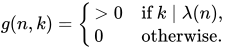
{\displaystyle g(n,k)={\begin{cases}>0&{\text{if }}k\mid \lambda (n),\\0&{\text{otherwise}}.\end{cases}}}
- Consequently the function
k
↦
g
(
n
,
k
)
{\displaystyle k\mapsto g(n,k)}
has d ( λ ( n ) ) {\displaystyle d(\lambda (n))}
values different from zero, where d {\displaystyle d}
computes the number of divisors.
-
g
(
n
,
1
)
=
1
{\displaystyle g(n,1)=1}
-
g
(
4
,
2
)
=
1
{\displaystyle g(4,2)=1}
-
g
(
2
n
,
2
)
=
3
{\displaystyle g(2^{n},2)=3}
for n ≥ 3 {\displaystyle n\geq 3}
, since -1 is always a square root of 1.
-
g
(
2
n
,
2
k
)
=
2
k
{\displaystyle g(2^{n},2^{k})=2^{k}}
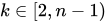
for k ∈ [ 2 , n − 1 ) {\displaystyle k\in [2,n-1)}
-
g
(
n
,
2
)
=
1
{\displaystyle g(n,2)=1}
for n ≥ 3 {\displaystyle n\geq 3}
-
∑
k
∈
N
g
(
n
,
k
)
=
f
(
n
,
λ
(
n
)
)
=
φ
(
n
)
{\displaystyle \sum _{k\in \mathbb {N} }g(n,k)=f(n,\lambda (n))=\varphi (n)}
with φ {\displaystyle \varphi }
- The connection between
f
{\displaystyle f}
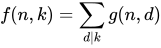
can be written in an elegant way using a Dirichlet convolution:


-
f
=
1
∗
g
{\displaystyle f=\mathbf {1} *g}
, i.e. f ( n , k ) = ∑ d ∣ k g ( n , d ) {\displaystyle f(n,k)=\sum _{d\mid k}g(n,d)}
-
f
=
1
∗
g
{\displaystyle f=\mathbf {1} *g}
- One can compute values of
g
{\displaystyle g}
Testing whether x is a primitive kth root of unity modulo n
By fast exponentiation, one can check that
x
k
≡
1
(
mod
n
)
{\displaystyle x^{k}\equiv 1{\pmod {n}}}

That is, x is a primitive kth root of unity modulo n if and only if
x
k
≡
1
(
mod
n
)
{\textstyle x^{k}\equiv 1{\pmod {n}}}


For example, if
n
=
17
,
{\displaystyle n=17,}


Finding a primitive kth root of unity modulo n
Among the primitive kth roots of unity, the primitive
λ
(
n
)
{\displaystyle \lambda (n)}
Finding multiple primitive kth roots modulo n
Once a primitive kth root of unity x is obtained, every power
x
ℓ
{\displaystyle x^{\ell }}





x
m
≡
(
x
m
)
a
k
+
b
ℓ
≡
(
x
k
)
m
a
(
(
x
ℓ
)
m
)
b
≡
1
(
mod
n
)
{\displaystyle x^{m}\equiv (x^{m})^{ak+b\ell }\equiv (x^{k})^{ma}((x^{\ell })^{m})^{b}\equiv 1{\pmod {n}}}

which means that
x
{\displaystyle x}
That is, by exponentiating x one can obtain
φ
(
k
)
{\displaystyle \varphi (k)}

Finding an n with a primitive kth root of unity modulo n
A motivating question is, in what integer residue class rings does a primitive kth root of unity exist? It can be used to compute a discrete Fourier transform (more precisely a number theoretic transform) of a
k
{\displaystyle k}

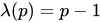
A simple way to find such an n is to check for primitive kth roots with respect to the moduli in the arithmetic progression
k
+
1
,
2
k
+
1
,
3
k
+
1
,
…
{\displaystyle k+1,2k+1,3k+1,\dots }



Finding an n with multiple primitive roots of unity modulo n
To find a modulus
n
{\displaystyle n}

- For given
n
{\displaystyle n}
roots of unity modulo n {\displaystyle n}
th root of unity modulo n.
- Proof
Backward direction:
If there is a primitive
lcm
(
k
1
,
…
,
k
m
)
{\displaystyle \operatorname {lcm} (k_{1},\ldots ,k_{m})}
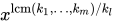

Forward direction:
If there are primitive
k
1
th
,
…
,
k
m
th
{\displaystyle k_{1}{\text{th}},\ldots ,k_{m}{\text{th}}}


References
- Finch, Stephen; Martin, Greg; Sebah, Pascal (2010). "Roots of unity and nullity modulo n" (PDF). Proceedings of the American Mathematical Society. 138 (8): 2729–2743. doi:10.1090/s0002-9939-10-10341-4. Retrieved 2011-02-20.