In algebraic topology, a simplicial homotopy is an analog of a homotopy between topological spaces for simplicial sets. Precisely,[1]pg 23 if
-
f
,
g
:
X
→
Y
{\displaystyle f,g:X\to Y}

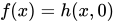
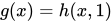
are maps between simplicial sets, a simplicial homotopy from f to g is a map
-
h
:
X
×
Δ
1
→
Y
{\displaystyle h:X\times \Delta ^{1}\to Y}

such that the restriction of
h
{\displaystyle h}


Using the adjunction
-
Hom
(
X
×
Δ
1
,
Y
)
=
Hom
(
Δ
1
×
X
,
Y
)
=
Hom
(
Δ
1
,
Hom
_
(
X
,
Y
)
)
{\displaystyle \operatorname {Hom} (X\times \Delta ^{1},Y)=\operatorname {Hom} (\Delta ^{1}\times X,Y)=\operatorname {Hom} (\Delta ^{1},{\underline {\operatorname {Hom} }}(X,Y))}
,
the simplicial homotopy
h
{\displaystyle h}

A simplicial homotopy is in general not an equivalence relation.[2] However, if
Hom
_
(
X
,
Y
)
{\displaystyle {\underline {\operatorname {Hom} }}(X,Y)}


Simplicial homotopy equivalence
If
X
{\displaystyle X}


-
[
X
,
K
]
=
Hom
(
X
,
K
)
/
∼
{\displaystyle [X,K]=\operatorname {Hom} (X,K)/\sim }
![{\displaystyle [X,K]=\operatorname {Hom} (X,K)/\sim }](https://wikimedia.org/api/rest_v1/media/math/render/svg/0f5924bcdb0a300a02dcd14842687484def68850)
where
f
∼
g
{\displaystyle f\sim g}


A map
K
→
L
{\displaystyle K\to L}

![{\displaystyle [f]}](https://wikimedia.org/api/rest_v1/media/math/render/svg/7414a730e8157655ff770265ec3a03ec9f09dd54)


An obvious pointed version of the above consideration also holds.
Simplicial homotopy group
Let
S
1
{\displaystyle S^{1}}


-
π
n
X
=
[
S
n
,
X
]
{\displaystyle \pi _{n}X=[S^{n},X]}
![{\displaystyle \pi _{n}X=[S^{n},X]}](https://wikimedia.org/api/rest_v1/media/math/render/svg/01933c254562233f07b4a64a076e6aa6337e066a)
for each pointed Kan complex X and an integer
n
≥
0
{\displaystyle n\geq 0}


If
X
{\displaystyle X}
-
Ω
X
=
Map
X
(
x
0
,
x
0
)
{\displaystyle \Omega X=\operatorname {Map} _{X}(x_{0},x_{0})}

from the base point to itself is also a Kan complex called the loop space of
X
{\displaystyle X}

-
Ω
n
X
=
Hom
_
(
S
n
,
X
)
{\displaystyle \Omega ^{n}X={\underline {\operatorname {Hom} }}(S^{n},X)}

as pointed Kan complexes. Thus,
-
π
n
X
=
π
0
Ω
n
X
.
{\displaystyle \pi _{n}X=\pi _{0}\Omega ^{n}X.}

Now, we have the identification
π
0
Map
C
(
x
,
y
)
=
Hom
τ
(
C
)
(
x
,
y
)
{\displaystyle \pi _{0}\operatorname {Map} _{C}(x,y)=\operatorname {Hom} _{\tau (C)}(x,y)}


An analog of Whitehead's theorem holds: a map
f
{\displaystyle f}

See also
- Kan complex
- Dold–Kan correspondence (under which a chain homotopy corresponds to a simplicial homotopy)
- Simplicial homology
- Homotopy category of an ∞-category
Notes
- Goerss, Paul G.; Jardin, John F. (2009). Simplicial Homotopy Theory. Birkhäuser Basel. ISBN 978-3-0346-0188-7. OCLC 837507571.
- Joyal & Tierney 2008, § 2.4.
- Joyal & Tierney 2008, § 3.2.
- Joyal & Tierney 2008, § 4.2.
- Cisinski 2023, Proposition 3.1.31.
- Cisinski 2023, (3.8.8.6)
- Joyal & Tierney 2008, Theorem 4.4.2.
References
- Joyal, André; Tierney, Myles (2008). "Notes on simplicial homotopy theory" (PDF).
- Quillen, Daniel G. (1967), Homotopical algebra, Lecture Notes in Mathematics, No. 43, vol. 43, Berlin, New York: Springer-Verlag, doi:10.1007/BFb0097438, ISBN 978-3-540-03914-3, MR 0223432
- Cisinski, Denis-Charles (2023). Higher Categories and Homotopical Algebra (PDF). Cambridge University Press. ISBN 978-1108473200.
External links