Stress majorization is an optimization strategy used in multidimensional scaling (MDS) where, for a set of
n
{\displaystyle n}


-
σ
(
X
)
=
∑
i
<
j
≤
n
w
i
j
(
d
i
j
(
X
)
−
δ
i
j
)
2
{\displaystyle \sigma (X)=\sum _{i<j\leq n}w_{ij}(d_{ij}(X)-\delta _{ij})^{2}}

where
w
i
j
≥
0
{\displaystyle w_{ij}\geq 0}


A configuration
X
{\displaystyle X}
There are many ways that
σ
(
X
)
{\displaystyle \sigma (X)}

The SMACOF algorithm
The stress function
σ
{\displaystyle \sigma }
-
σ
(
X
)
=
∑
i
<
j
≤
n
w
i
j
(
d
i
j
(
X
)
−
δ
i
j
)
2
=
∑
i
<
j
w
i
j
δ
i
j
2
+
∑
i
<
j
w
i
j
d
i
j
2
(
X
)
−
2
∑
i
<
j
w
i
j
δ
i
j
d
i
j
(
X
)
{\displaystyle \sigma (X)=\sum _{i<j\leq n}w_{ij}(d_{ij}(X)-\delta _{ij})^{2}=\sum _{i<j}w_{ij}\delta _{ij}^{2}+\sum _{i<j}w_{ij}d_{ij}^{2}(X)-2\sum _{i<j}w_{ij}\delta _{ij}d_{ij}(X)}

Note that the first term is a constant
C
{\displaystyle C}


-
∑
i
<
j
w
i
j
δ
i
j
d
i
j
(
X
)
=
tr
X
′
B
(
X
)
X
≥
tr
X
′
B
(
Z
)
Z
{\displaystyle \sum _{i<j}w_{ij}\delta _{ij}d_{ij}(X)=\,\operatorname {tr} \,X'B(X)X\geq \,\operatorname {tr} \,X'B(Z)Z}

where
B
(
Z
)
{\displaystyle B(Z)}

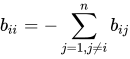
-
b
i
j
=
−
w
i
j
δ
i
j
d
i
j
(
Z
)
{\displaystyle b_{ij}=-{\frac {w_{ij}\delta _{ij}}{d_{ij}(Z)}}}
for d i j ( Z ) ≠ 0 , i ≠ j {\displaystyle d_{ij}(Z)\neq 0,i\neq j}

and
b
i
j
=
0
{\displaystyle b_{ij}=0}


and
b
i
i
=
−
∑
j
=
1
,
j
≠
i
n
b
i
j
{\displaystyle b_{ii}=-\sum _{j=1,j\neq i}^{n}b_{ij}}
Proof of this inequality is by the Cauchy-Schwarz inequality, see Borg[3] (pp. 152–153).
Thus, we have a simple quadratic function
τ
(
X
,
Z
)
{\displaystyle \tau (X,Z)}

-
σ
(
X
)
=
C
+
tr
X
′
V
X
−
2
tr
X
′
B
(
X
)
X
{\displaystyle \sigma (X)=C+\,\operatorname {tr} \,X'VX-2\,\operatorname {tr} \,X'B(X)X}
-
≤
C
+
tr
X
′
V
X
−
2
tr
X
′
B
(
Z
)
Z
=
τ
(
X
,
Z
)
{\displaystyle \leq C+\,\operatorname {tr} \,X'VX-2\,\operatorname {tr} \,X'B(Z)Z=\tau (X,Z)}


The iterative minimization procedure is then:
- at the
k
t
h
{\displaystyle k^{th}}
step we set Z ← X k − 1 {\displaystyle Z\leftarrow X^{k-1}}
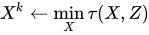
-
X
k
←
min
X
τ
(
X
,
Z
)
{\displaystyle X^{k}\leftarrow \min _{X}\tau (X,Z)}
- stop if
σ
(
X
k
−
1
)
−
σ
(
X
k
)
<
ϵ
{\displaystyle \sigma (X^{k-1})-\sigma (X^{k})<\epsilon }
otherwise repeat.

This algorithm has been shown to decrease stress monotonically (see de Leeuw[2]).
Use in graph drawing
Stress majorization and algorithms similar to SMACOF also have application in the field of graph drawing.[4][5] That is, one can find a reasonably aesthetically appealing layout for a network or graph by minimizing a stress function over the positions of the nodes in the graph. In this case, the
δ
i
j
{\displaystyle \delta _{ij}}


References
- Kruskal, J. B. (1964), "Multidimensional scaling by optimizing goodness of fit to a nonmetric hypothesis", Psychometrika, 29 (1): 1–27, doi:10.1007/BF02289565.
- de Leeuw, J. (1977), "Applications of convex analysis to multidimensional scaling", in Barra, J. R.; Brodeau, F.; Romie, G.; et al. (eds.), Recent developments in statistics, pp. 133–145.
- Borg, I.; Groenen, P. (1997), Modern Multidimensional Scaling: theory and applications, New York: Springer-Verlag.
- Michailidis, G.; de Leeuw, J. (2001), "Data visualization through graph drawing", Computation Stat., 16 (3): 435–450, CiteSeerX 10.1.1.28.9372, doi:10.1007/s001800100077.
- Gansner, E.; Koren, Y.; North, S. (2004), "Graph Drawing by Stress Majorization", Proceedings of 12th Int. Symp. Graph Drawing (GD'04), Lecture Notes in Computer Science, vol. 3383, Springer-Verlag, pp. 239–250.
- Cohen, J. (1997), "Drawing graphs to convey proximity: an incremental arrangement method", ACM Transactions on Computer-Human Interaction, 4 (3): 197–229, doi:10.1145/264645.264657.