 A supersilver rectangle contains two scaled copies of itself, ς = ((ς − 1)2 + 2(ς − 1) + 1) / ς | |
| Rationality | irrational algebraic |
|---|---|
| Symbol | ς |
| Representations | |
| Decimal | 2.20556943040059031170... |
| Algebraic form | real root of x3 = 2x2 + 1 |
| Continued fraction (linear) | [2;4,1,6,2,1,1,1,1,1,1,2,2,1,2,1,...] [1] not periodic infinite |
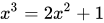
In mathematics, the supersilver ratio is a geometrical proportion, given by the unique real solution of the equation x3 = 2x2 + 1. Its decimal expansion begins with 2.2055694304005903... (sequence A356035 in the OEIS).
The name supersilver ratio is by analogy with the silver ratio, the positive solution of the equation x2 = 2x + 1, and the supergolden ratio.
Definition

Three quantities a > b > c > 0 are in the supersilver ratio if
2
a
+
c
a
=
a
b
=
b
c
.
{\displaystyle {\frac {2a+c}{a}}={\frac {a}{b}}={\frac {b}{c}}\,.}


Substituting
a
=
ς
b
=
ς
2
c
{\displaystyle a=\varsigma b=\varsigma ^{2}c}



The minimal polynomial for the reciprocal root is the depressed cubic
x
3
+
2
x
−
1
,
{\displaystyle x^{3}+2x-1,}

![{\displaystyle {\begin{aligned}w_{1,2}&=\left(1\pm {\frac {1}{3}}{\sqrt {\frac {59}{3}}}\right)/2\\1/\varsigma &={\sqrt[{3}]{w_{1}}}+{\sqrt[{3}]{w_{2}}}\end{aligned}}}](https://wikimedia.org/api/rest_v1/media/math/render/svg/d994bc772f2bdcb269889f33f420cdd0703338c9)

1
/
ς
{\displaystyle 1/\varsigma }


Rewrite the minimal polynomial as
(
x
2
+
1
)
2
=
1
+
x
{\displaystyle (x^{2}+1)^{2}=1+x}


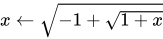

Dividing the defining trinomial
x
3
−
2
x
2
−
1
{\displaystyle x^{3}-2x^{2}-1}
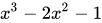





Properties

The growth rate of the average value of the n-th term of a random Fibonacci sequence is
ς
−
1
{\displaystyle \varsigma -1}

The defining equation can be written
1
=
1
ς
−
1
+
1
ς
2
+
1
=
1
ς
+
ς
−
1
ς
+
1
+
ς
−
2
ς
−
1
.
{\displaystyle {\begin{aligned}1&={\frac {1}{\varsigma -1}}+{\frac {1}{\varsigma ^{2}+1}}\\&={\frac {1}{\varsigma }}+{\frac {\varsigma -1}{\varsigma +1}}+{\frac {\varsigma -2}{\varsigma -1}}.\end{aligned}}}

The supersilver ratio can be expressed in terms of itself as fractions
ς
=
ς
ς
−
1
+
ς
−
1
ς
+
1
ς
2
=
1
ς
−
2
.
{\displaystyle {\begin{aligned}\varsigma &={\frac {\varsigma }{\varsigma -1}}+{\frac {\varsigma -1}{\varsigma +1}}\\\varsigma ^{2}&={\frac {1}{\varsigma -2}}.\end{aligned}}}
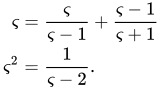
Similarly as the infinite geometric series
ς
=
2
∑
n
=
0
∞
ς
−
3
n
ς
2
=
−
1
+
∑
n
=
0
∞
(
ς
−
1
)
−
n
,
{\displaystyle {\begin{aligned}\varsigma &=2\sum _{n=0}^{\infty }\varsigma ^{-3n}\\\varsigma ^{2}&=-1+\sum _{n=0}^{\infty }(\varsigma -1)^{-n},\end{aligned}}}

in comparison to the silver ratio identities
σ
=
2
∑
n
=
0
∞
σ
−
2
n
σ
2
=
−
1
+
2
∑
n
=
0
∞
(
σ
−
1
)
−
n
.
{\displaystyle {\begin{aligned}\sigma &=2\sum _{n=0}^{\infty }\sigma ^{-2n}\\\sigma ^{2}&=-1+2\sum _{n=0}^{\infty }(\sigma -1)^{-n}.\end{aligned}}}
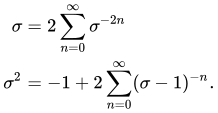
For every integer
n
{\displaystyle n}


Continued fraction pattern of a few low powers
ς
−
2
=
[
0
;
4
,
1
,
6
,
2
,
1
,
1
,
1
,
1
,
1
,
1
,
.
.
.
]
≈
0.2056
(
5
24
)
ς
−
1
=
[
0
;
2
,
4
,
1
,
6
,
2
,
1
,
1
,
1
,
1
,
1
,
.
.
.
]
≈
0.4534
(
5
11
)
ς
0
=
[
1
]
ς
1
=
[
2
;
4
,
1
,
6
,
2
,
1
,
1
,
1
,
1
,
1
,
1
,
.
.
.
]
≈
2.2056
(
53
24
)
ς
2
=
[
4
;
1
,
6
,
2
,
1
,
1
,
1
,
1
,
1
,
1
,
2
,
.
.
.
]
≈
4.8645
(
73
15
)
ς
3
=
[
10
;
1
,
2
,
1
,
2
,
4
,
4
,
2
,
2
,
6
,
2
,
.
.
.
]
≈
10.729
(
118
11
)
{\displaystyle {\begin{aligned}\varsigma ^{-2}&=[0;4,1,6,2,1,1,1,1,1,1,...]\approx 0.2056\;({\tfrac {5}{24}})\\\varsigma ^{-1}&=[0;2,4,1,6,2,1,1,1,1,1,...]\approx 0.4534\;({\tfrac {5}{11}})\\\varsigma ^{0}&=[1]\\\varsigma ^{1}&=[2;4,1,6,2,1,1,1,1,1,1,...]\approx 2.2056\;({\tfrac {53}{24}})\\\varsigma ^{2}&=[4;1,6,2,1,1,1,1,1,1,2,...]\approx 4.8645\;({\tfrac {73}{15}})\\\varsigma ^{3}&=[10;1,2,1,2,4,4,2,2,6,2,...]\approx 10.729\;({\tfrac {118}{11}})\end{aligned}}}
![{\displaystyle {\begin{aligned}\varsigma ^{-2}&=[0;4,1,6,2,1,1,1,1,1,1,...]\approx 0.2056\;({\tfrac {5}{24}})\\\varsigma ^{-1}&=[0;2,4,1,6,2,1,1,1,1,1,...]\approx 0.4534\;({\tfrac {5}{11}})\\\varsigma ^{0}&=[1]\\\varsigma ^{1}&=[2;4,1,6,2,1,1,1,1,1,1,...]\approx 2.2056\;({\tfrac {53}{24}})\\\varsigma ^{2}&=[4;1,6,2,1,1,1,1,1,1,2,...]\approx 4.8645\;({\tfrac {73}{15}})\\\varsigma ^{3}&=[10;1,2,1,2,4,4,2,2,6,2,...]\approx 10.729\;({\tfrac {118}{11}})\end{aligned}}}](https://wikimedia.org/api/rest_v1/media/math/render/svg/3a45365cee49cd383411ccc83a8759d690d2e28a)
As derived from its continued fraction expansion, the simplest rational approximations of
ς
{\displaystyle \varsigma }


The supersilver ratio is a Pisot number.[4] By definition of these numbers, the absolute value
1
/
ς
{\displaystyle 1/{\sqrt {\varsigma }}}



The minimal polynomial of the supersilver ratio
m
(
x
)
=
x
3
−
2
x
2
−
1
{\displaystyle m(x)=x^{3}-2x^{2}-1}



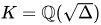




The Weber-Ramanujan class invariant is approximated with error < 3.5 ∙ 10−20 by
2
f
(
Δ
)
=
2
4
G
59
≈
(
e
π
−
Δ
+
24
)
1
/
24
,
{\displaystyle {\sqrt {2}}\,{\mathfrak {f}}({\sqrt {\Delta }})={\sqrt[{4}]{2}}\,G_{59}\approx (e^{\pi {\sqrt {-\Delta }}}+24)^{1/24},}
![{\displaystyle {\sqrt {2}}\,{\mathfrak {f}}({\sqrt {\Delta }})={\sqrt[{4}]{2}}\,G_{59}\approx (e^{\pi {\sqrt {-\Delta }}}+24)^{1/24},}](https://wikimedia.org/api/rest_v1/media/math/render/svg/fd8132fde5fa9086fa21ae8705c991382212ace3)

The elliptic integral singular value [9]
k
r
=
λ
∗
(
r
)
for
r
=
59
{\displaystyle k_{r}=\lambda ^{*}(r){\text{ for }}r=59}


Third-order Pell sequences


These numbers are related to the supersilver ratio as the Pell numbers and Pell-Lucas numbers are to the silver ratio.
The fundamental sequence is defined by the third-order recurrence relation
S
n
=
2
S
n
−
1
+
S
n
−
3
for
n
>
2
,
{\displaystyle S_{n}=2S_{n-1}+S_{n-3}{\text{ for }}n>2,}


The first few terms are 1, 2, 4, 9, 20, 44, 97, 214, 472, 1041, 2296, 5064,... (sequence A008998 in the OEIS).
The limit ratio between consecutive terms is the supersilver ratio:
lim
n
→
∞
S
n
+
1
/
S
n
=
ς
.
{\displaystyle \lim _{n\rightarrow \infty }S_{n+1}/S_{n}=\varsigma .}

The first 8 indices n for which
S
n
{\displaystyle S_{n}}

The sequence can be extended to negative indices using
S
n
=
S
n
+
3
−
2
S
n
+
2
.
{\displaystyle S_{n}=S_{n+3}-2S_{n+2}.}

Powers of the supersilver ratio can be written with third-order Pell numbers as quadratic coefficients
ς
n
=
ς
2
S
n
−
2
+
ς
S
n
−
4
+
S
n
−
3
,
{\displaystyle \varsigma ^{n}=\varsigma ^{2}S_{n-2}+\varsigma S_{n-4}+S_{n-3},}


The generating function of the sequence is given by [10]
1
1
−
2
x
−
x
3
=
∑
n
=
0
∞
S
n
x
n
for
x
<
1
ς
{\displaystyle {\frac {1}{1-2x-x^{3}}}=\sum _{n=0}^{\infty }S_{n}x^{n}{\text{ for }}x<{\tfrac {1}{\varsigma }}}

The third-order Pell numbers are related to sums of binomial coefficients by [11]
S
n
=
∑
k
=
0
⌊
n
/
3
⌋
(
n
−
2
k
k
)
⋅
2
n
−
3
k
{\displaystyle S_{n}=\sum _{k=0}^{\lfloor n/3\rfloor }{n-2k \choose k}\cdot 2^{n-3k}}

The characteristic equation of the recurrence is
x
3
−
2
x
2
−
1
=
0.
{\displaystyle x^{3}-2x^{2}-1=0.}







Since
|
b
β
n
+
c
γ
n
|
<
1
/
α
n
/
2
{\displaystyle \left\vert b\beta ^{n}+c\gamma ^{n}\right\vert <1/\alpha ^{n/2}}



Coefficients
a
=
b
=
c
=
1
{\displaystyle a=b=c=1}


The first few terms are 3, 2, 4, 11, 24, 52, 115, 254, 560, 1235, 2724, 6008,... (sequence A332647 in the OEIS).
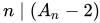
This third-order Pell-Lucas sequence has the Fermat property: if p is prime,
A
p
≡
A
1
mod
p
.
{\displaystyle A_{p}\equiv A_{1}{\bmod {p}}.}


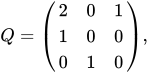
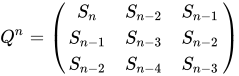
The third-order Pell numbers are obtained as integral powers n > 3 of a matrix with real eigenvalue
ς
{\displaystyle \varsigma }
Q
n
=
(
S
n
S
n
−
2
S
n
−
1
S
n
−
1
S
n
−
3
S
n
−
2
S
n
−
2
S
n
−
4
S
n
−
3
)
{\displaystyle Q^{n}={\begin{pmatrix}S_{n}&S_{n-2}&S_{n-1}\\S_{n-1}&S_{n-3}&S_{n-2}\\S_{n-2}&S_{n-4}&S_{n-3}\end{pmatrix}}}
The trace of
Q
n
{\displaystyle Q^{n}}


Alternatively,
Q
{\displaystyle Q}


Associated to this string rewriting process is a compact set composed of self-similar tiles called the Rauzy fractal, that visualizes the combinatorial information contained in a multiple-generation three-letter sequence.[14]
Supersilver rectangle

Given a rectangle of height 1, length
ς
{\displaystyle \varsigma }


On the right-hand side, cut off a square of side length 1 and mark the intersection with the falling diagonal. The remaining rectangle now has aspect ratio
1
+
1
/
ς
2
:
1
{\displaystyle 1+1/\varsigma ^{2}:1}


The parent supersilver rectangle and the two scaled copies along the diagonal have linear sizes in the ratios
ς
:
ς
−
1
:
1.
{\displaystyle \varsigma :\varsigma -1:1.}


If the diagram is further subdivided by perpendicular lines through the feet of the altitudes, the lengths of the diagonal and its seven distinct subsections are in ratios
ς
2
+
1
:
ς
2
:
ς
2
−
1
:
ς
+
1
:
{\displaystyle \varsigma ^{2}+1:\varsigma ^{2}:\varsigma ^{2}-1:\varsigma +1:}


Supersilver spiral

A supersilver spiral is a logarithmic spiral that gets wider by a factor of
ς
{\displaystyle \varsigma }


See also
Solutions of equations similar to
x
3
=
2
x
2
+
1
{\displaystyle x^{3}=2x^{2}+1}
- Silver ratio – the positive solution of the equation
x
2
=
2
x
+
1
{\displaystyle x^{2}=2x+1}
- Golden ratio – the positive solution of the equation
x
2
=
x
+
1
{\displaystyle x^{2}=x+1}
- Supergolden ratio – the real solution of the equation
x
3
=
x
2
+
1
{\displaystyle x^{3}=x^{2}+1}


References
- Sloane, N. J. A. (ed.). "Sequence A376121". The On-Line Encyclopedia of Integer Sequences. OEIS Foundation.
- Sloane, N. J. A. (ed.). "Sequence A272874". The On-Line Encyclopedia of Integer Sequences. OEIS Foundation.
- (sequence A137421 in the OEIS)
- Panju, Maysum (2011). "A systematic construction of almost integers" (PDF). The Waterloo Mathematics Review. 1 (2): 35–43.
- Sloane, N. J. A. (ed.). "Sequence A332647 (a(n) = 2*a(n-1) + a(n-3) with a(0) = 3, a(1) = 2, a(2) = 4)". The On-Line Encyclopedia of Integer Sequences. OEIS Foundation.
- "Hilbert class field of a quadratic field whose class number is 3". Mathematics stack exchange. 2012. Retrieved May 1, 2024.
- Berndt, Bruce C.; Chan, Heng Huat (1999). "Ramanujan and the modular j-invariant". Canadian Mathematical Bulletin. 42 (4): 427–440. doi:10.4153/CMB-1999-050-1.
- Johansson, Fredrik (2021). "Modular j-invariant". Fungrim. Retrieved April 30, 2024.
Table of Hilbert class polynomials
- Weisstein, Eric W. "Elliptic integral singular value". MathWorld.
- (sequence A008998 in the OEIS)
- Mahon, Br. J. M.; Horadam, A. F. (1990). "Third-order diagonal functions of Pell polynomials". The Fibonacci Quarterly. 28 (1): 3–10. doi:10.1080/00150517.1990.12429513.
- Only one of these is a 'restricted pseudoprime' as defined in: Adams, William; Shanks, Daniel (1982). "Strong primality tests that are not sufficient". Mathematics of Computation. 39 (159). American Mathematical Society: 255–300. doi:10.1090/S0025-5718-1982-0658231-9. JSTOR 2007637.
- for n ≥ 2 (sequence A193641 in the OEIS)
- Siegel, Anne; Thuswaldner, Jörg M. (2009). "Topological properties of Rauzy fractals". Mémoires de la Société Mathématique de France. 2. 118: 1–140. doi:10.24033/msmf.430.
- Analogue to the construction in: Crilly, Tony (1994). "A supergolden rectangle". The Mathematical Gazette. 78 (483): 320–325. doi:10.2307/3620208. JSTOR 3620208.