The Thirring–Wess model or Vector Meson model is an exactly solvable quantum field theory, describing the interaction of a Dirac field with a vector field in dimension two.
Definition
The Lagrangian density is made of three terms:
the free vector field
A
μ
{\displaystyle A^{\mu }}

-
(
F
μ
ν
)
2
4
+
μ
2
2
(
A
μ
)
2
{\displaystyle {(F^{\mu \nu })^{2} \over 4}+{\mu ^{2} \over 2}(A^{\mu })^{2}}
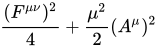
for
F
μ
ν
=
∂
μ
A
ν
−
∂
ν
A
μ
{\displaystyle F^{\mu \nu }=\partial ^{\mu }A^{\nu }-\partial ^{\nu }A^{\mu }}



-
ψ
¯
(
i
∂
/
−
m
)
ψ
{\displaystyle {\overline {\psi }}(i\partial \!\!\!/-m)\psi }

where the fermion mass
m
{\displaystyle m}

-
q
A
μ
(
ψ
¯
γ
μ
ψ
)
{\displaystyle qA^{\mu }({\bar {\psi }}\gamma ^{\mu }\psi )}

Although not required to define the massive vector field, there can be also a gauge-fixing term
-
α
2
(
∂
μ
A
μ
)
2
{\displaystyle {\alpha \over 2}(\partial ^{\mu }A^{\mu })^{2}}

for
α
≥
0
{\displaystyle \alpha \geq 0}
There is a remarkable difference between the case
α
>
0
{\displaystyle \alpha >0}


History
This model was introduced by Thirring and Wess as a version of the Schwinger model with a vector mass term in the Lagrangian .
When the fermion is massless (
m
=
0
{\displaystyle m=0}


References
- Thirring, WE; Wess, JE (1964). "Solution of a field theoretical model in one space one time dimensions". Annals of Physics. 27 (2): 331–337. Bibcode:1964AnPhy..27..331T. doi:10.1016/0003-4916(64)90234-9.
- Brown, LS (1963). "Gauge invariance and Mass in a Two-Dimensional Model". Il Nuovo Cimento. 29 (3): 617–643. Bibcode:1963NCim...29..617B. doi:10.1007/BF02827786. S2CID 122285105.
- Sommerfield, CM (1964). "On the definition of currents and the action principle in field theories of one spatial dimension". Annals of Physics. 26 (1): 1–43. Bibcode:1964AnPhy..26....1S. doi:10.1016/0003-4916(64)90273-8.
- Hagen, CR (1967). "Current definition and mass renormalization in a Model Field Theory". Il Nuovo Cimento A. 51 (4): 1033–1052. Bibcode:1967NCimA..51.1033H. doi:10.1007/BF02721770. S2CID 58940957.