

The Tobler hyperelliptical projection is a family of equal-area pseudocylindrical projections that may be used for world maps. Waldo R. Tobler introduced the construction in 1973 as the hyperelliptical projection, now usually known as the Tobler hyperelliptical projection.[1]
Overview
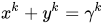
As with any pseudocylindrical projection, in the projection’s normal aspect,[2] the parallels of latitude are parallel, straight lines. Their spacing is calculated to provide the equal-area property. The projection blends the cylindrical equal-area projection, which has straight, vertical meridians, with meridians that follow a particular kind of curve known as superellipses[3] or Lamé curves or sometimes as hyperellipses. A hyperellipse is described by
x
k
+
y
k
=
γ
k
{\displaystyle x^{k}+y^{k}=\gamma ^{k}}


-
x
=
λ
[
α
+
(
1
−
α
)
(
γ
k
−
y
k
)
1
/
k
γ
]
α
y
=
sin
φ
+
α
−
1
γ
∫
0
y
(
γ
k
−
z
k
)
1
/
k
d
z
{\displaystyle {\begin{aligned}&x=\lambda [\alpha +(1-\alpha ){\frac {(\gamma ^{k}-y^{k})^{1/k}}{\gamma }}]\\\alpha &y=\sin \varphi +{\frac {\alpha -1}{\gamma }}\int _{0}^{y}(\gamma ^{k}-z^{k})^{1/k}dz\end{aligned}}}
![{\displaystyle {\begin{aligned}&x=\lambda [\alpha +(1-\alpha ){\frac {(\gamma ^{k}-y^{k})^{1/k}}{\gamma }}]\\\alpha &y=\sin \varphi +{\frac {\alpha -1}{\gamma }}\int _{0}^{y}(\gamma ^{k}-z^{k})^{1/k}dz\end{aligned}}}](https://wikimedia.org/api/rest_v1/media/math/render/svg/9941b7cbd504413e88bef988842478f223962aca)
where
λ
{\displaystyle \lambda }


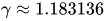
When
α
=
0
{\displaystyle \alpha =0}


See also
References
- Snyder, John P. (1993). Flattening the Earth: 2000 Years of Map Projections. Chicago: University of Chicago Press. p. 220.
- Mapthematics directory of map projections
- "Superellipse" in MathWorld encyclopedia
- Tobler, Waldo (1973). "The hyperelliptical and other new pseudocylindrical equal area map projections". Journal of Geophysical Research. 78 (11): 1753–1759. Bibcode:1973JGR....78.1753T. CiteSeerX 10.1.1.495.6424. doi:10.1029/JB078i011p01753.