In mathematics, the category of topological spaces, often denoted
T
o
p
{\displaystyle \mathbf {Top} }

N.B. Some authors use the name
T
o
p
{\displaystyle \mathbf {Top} }
As a concrete category
Like many categories, the category
T
o
p
{\displaystyle \mathbf {Top} }

to the category of sets which assigns to each topological space the underlying set and to each continuous map the underlying function.
The forgetful functor
U
{\displaystyle U}


which equips a given set with the discrete topology, and a right adjoint

which equips a given set with the indiscrete topology. Both of these functors are, in fact, right inverses to
U
{\displaystyle U}


T
o
p
{\displaystyle \mathbf {Top} }

T
o
p
{\displaystyle \mathbf {Top} }
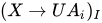

Limits and colimits
The category
T
o
p
{\displaystyle \mathbf {Top} }
Specifically, if
F
{\displaystyle F}


Unlike many algebraic categories, the forgetful functor
U
:
T
o
p
→
S
e
t
{\displaystyle U:\mathbf {Top} \to \mathbf {Set} }
Examples of limits and colimits in
T
o
p
{\displaystyle \mathbf {Top} }
- The empty set (considered as a topological space) is the initial object of
T
o
p
{\displaystyle \mathbf {Top} }
- The product in
T
o
p
{\displaystyle \mathbf {Top} }
- The equalizer of a pair of morphisms is given by placing the subspace topology on the set-theoretic equalizer. Dually, the coequalizer is given by placing the quotient topology on the set-theoretic coequalizer.
- Direct limits and inverse limits are the set-theoretic limits with the final topology and initial topology respectively.
- Adjunction spaces are an example of pushouts in
T
o
p
{\displaystyle \mathbf {Top} }
Other properties
- The monomorphisms in
T
o
p
{\displaystyle \mathbf {Top} }
- The extremal monomorphisms are (up to isomorphism) the subspace embeddings. In fact, in
T
o
p
{\displaystyle \mathbf {Top} }
- The extremal epimorphisms are (essentially) the quotient maps. Every extremal epimorphism is regular.
- The split monomorphisms are (essentially) the inclusions of retracts into their ambient space.
- The split epimorphisms are (up to isomorphism) the continuous surjective maps of a space onto one of its retracts.
- There are no zero morphisms in
T
o
p
{\displaystyle \mathbf {Top} }
-
T
o
p
{\displaystyle \mathbf {Top} }
or the category of compactly generated weak Hausdorff spaces. However, T o p {\displaystyle \mathbf {Top} }
Relationships to other categories
- The category of pointed topological spaces
T
o
p
{\displaystyle \mathbf {Top} }
- The homotopy category
h
T
o
p
{\displaystyle \mathbf {hTop} }
has topological spaces for objects and homotopy equivalence classes of continuous maps for morphisms. This is a quotient category of T o p {\displaystyle \mathbf {Top} }
-
T
o
p
{\displaystyle \mathbf {Top} }
of Hausdorff spaces as a full subcategory. The added structure of this subcategory allows for more epimorphisms: in fact, the epimorphisms in this subcategory are precisely those morphisms with dense images in their codomains, so that epimorphisms need not be surjective.
-
T
o
p
{\displaystyle \mathbf {Top} }
- The forgetful functor to
S
e
t
{\displaystyle \mathbf {Set} }
- There is a functor to the category of locales
L
o
c
{\displaystyle \mathbf {Loc} }
sending a topological space to its locale of open sets. This functor has a right adjoint that sends each locale to its topological space of points. This adjunction restricts to an equivalence between the category of sober spaces and spatial locales.
- The homotopy hypothesis relates
T
o
p
{\displaystyle \mathbf {Top} }
, the category of ∞-groupoids. The conjecture states that ∞-groupoids are equivalent to topological spaces modulo weak homotopy equivalence.
See also
- Category of groups – Category whose objects are groups and whose morphisms are group homomorphisms
- Category of metric spaces – Category whose objects are metric spaces and whose morphisms are metric maps
- Category of sets – Category whose objects are sets and whose morphisms are functions
- Category of topological spaces with base point – Topological space with a distinguished pointPages displaying short descriptions of redirect targets
- Category of topological vector spaces
- Category of measurable spaces
- Categorical topology
Citations
- Dolecki 2009, pp. 1–51
References
- Adámek, Jiří, Herrlich, Horst, & Strecker, George E.; (1990). Abstract and Concrete Categories Archived 2015-04-21 at the Wayback Machine (4.2MB PDF). Originally publ. John Wiley & Sons. ISBN 0-471-60922-6. (now free on-line edition).
- Dolecki, Szymon; Mynard, Frédéric (2016). Convergence Foundations Of Topology. New Jersey: World Scientific Publishing Company. ISBN 978-981-4571-52-4. OCLC 945169917.
- Dolecki, Szymon (2009). "An initiation into convergence theory" (PDF). In Mynard, Frédéric; Pearl, Elliott (eds.). Beyond Topology. Contemporary Mathematics. Vol. 486. pp. 115–162. doi:10.1090/conm/486/09509. ISBN 9780821842799. Retrieved 14 January 2021.
- Dolecki, Szymon; Mynard, Frédéric (2014). "A unified theory of function spaces and hyperspaces: local properties" (PDF). Houston J. Math. 40 (1): 285–318. Retrieved 14 January 2021.
- Herrlich, Horst: Topologische Reflexionen und Coreflexionen. Springer Lecture Notes in Mathematics 78 (1968).
- Herrlich, Horst: Categorical topology 1971–1981. In: General Topology and its Relations to Modern Analysis and Algebra 5, Heldermann Verlag 1983, pp. 279–383.
- Herrlich, Horst & Strecker, George E.: Categorical Topology – its origins, as exemplified by the unfolding of the theory of topological reflections and coreflections before 1971. In: Handbook of the History of General Topology (eds. C.E.Aull & R. Lowen), Kluwer Acad. Publ. vol 1 (1997) pp. 255–341.