Trace class operator

☆ Save On Wikipedia ↗

In mathematics, specifically functional analysis, a trace-class operator is a linear operator for which a trace may be defined, such that the trace is a finite number independent of the choice of basis used to compute the trace. This trace of trace-class operators generalizes the trace of matrices studied in linear algebra. All trace-class operators are compact operators.

In quantum mechanics, quantum states are described by density matrices, which are certain trace class operators.[1]

Trace-class operators are essentially the same as nuclear operators, though many authors reserve the term "trace-class operator" for the special case of nuclear operators on Hilbert spaces and use the term "nuclear operator" in more general topological vector spaces (such as Banach spaces).

Definition

Let H {\displaystyle H} {\displaystyle H} be a separable Hilbert space, { e k } k = 1 ∞ {\displaystyle \left\{e_{k}\right\}_{k=1}^{\infty }} {\displaystyle \left\{e_{k}\right\}_{k=1}^{\infty }} an orthonormal basis and A : H → H {\displaystyle A:H\to H} {\displaystyle A:H\to H} a positive bounded linear operator on H {\displaystyle H} {\displaystyle H}. The trace of A {\displaystyle A} {\displaystyle A} is denoted by Tr ⁡ ( A ) {\displaystyle \operatorname {Tr} (A)} {\displaystyle \operatorname {Tr} (A)} and defined as[2][3]

Tr ⁡ ( A ) = ∑ k = 1 ∞ ⟨ A e k , e k ⟩ , {\displaystyle \operatorname {Tr} (A)=\sum _{k=1}^{\infty }\left\langle Ae_{k},e_{k}\right\rangle ,} {\displaystyle \operatorname {Tr} (A)=\sum _{k=1}^{\infty }\left\langle Ae_{k},e_{k}\right\rangle ,}
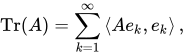
independent of the choice of orthonormal basis. A (not necessarily positive) bounded linear operator T : H → H {\displaystyle T:H\rightarrow H} {\displaystyle T:H\rightarrow H} is called trace class if and only if

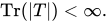
Tr ⁡ ( | T | ) < ∞ , {\displaystyle \operatorname {Tr} (|T|)<\infty ,} {\displaystyle \operatorname {Tr} (|T|)<\infty ,}
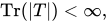
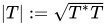
where | T | := T ∗ T {\displaystyle |T|:={\sqrt {T^{*}T}}} {\displaystyle |T|:={\sqrt {T^{*}T}}} denotes the positive-semidefinite Hermitian square root.[4]
The trace-norm of a trace class operator T is defined as ‖ T ‖ 1 := Tr ⁡ ( | T | ) . {\displaystyle \|T\|_{1}:=\operatorname {Tr} (|T|).} {\displaystyle \|T\|_{1}:=\operatorname {Tr} (|T|).} One can show that the trace-norm is a norm on the space of all trace class operators B 1 ( H ) {\displaystyle B_{1}(H)} {\displaystyle B_{1}(H)} and that B 1 ( H ) {\displaystyle B_{1}(H)} {\displaystyle B_{1}(H)}, with the trace-norm, becomes a Banach space.

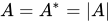
When H {\displaystyle H} {\displaystyle H} is finite-dimensional, every (positive) operator is trace class. For A {\displaystyle A} {\displaystyle A} this definition coincides with that of the trace of a matrix. If H {\displaystyle H} {\displaystyle H} is complex, then A {\displaystyle A} {\displaystyle A} is always self-adjoint (i.e. A = A ∗ = | A | {\displaystyle A=A^{*}=|A|} {\displaystyle A=A^{*}=|A|}) though the converse is not necessarily true.[5]

Equivalent formulations

Given a bounded linear operator T : H → H {\displaystyle T:H\to H} {\displaystyle T:H\to H}, each of the following statements is equivalent to T {\displaystyle T} {\displaystyle T} being in the trace class:

  • Tr ⁡ ( | T | ) = ∑ k ⟨ | T | e k , e k ⟩ {\textstyle \operatorname {Tr} (|T|)=\sum _{k}\left\langle |T|\,e_{k},e_{k}\right\rangle } {\textstyle \operatorname {Tr} (|T|)=\sum _{k}\left\langle |T|\,e_{k},e_{k}\right\rangle } is finite for every orthonormal basis ( e k ) k {\displaystyle \left(e_{k}\right)_{k}} {\displaystyle \left(e_{k}\right)_{k}} of H.[2]
  • T is a nuclear operator.[6][7]
    There exist two orthogonal sequences ( x i ) i = 1 ∞ {\displaystyle \left(x_{i}\right)_{i=1}^{\infty }} {\displaystyle \left(x_{i}\right)_{i=1}^{\infty }} and ( y i ) i = 1 ∞ {\displaystyle \left(y_{i}\right)_{i=1}^{\infty }} {\displaystyle \left(y_{i}\right)_{i=1}^{\infty }} in H {\displaystyle H} {\displaystyle H} and positive real numbers ( λ i ) i = 1 ∞ {\displaystyle \left(\lambda _{i}\right)_{i=1}^{\infty }} {\displaystyle \left(\lambda _{i}\right)_{i=1}^{\infty }} in ℓ 1 {\displaystyle \ell ^{1}} {\displaystyle \ell ^{1}} such that ∑ i = 1 ∞ λ i < ∞ {\textstyle \sum _{i=1}^{\infty }\lambda _{i}<\infty } {\textstyle \sum _{i=1}^{\infty }\lambda _{i}<\infty } and
    x ↦ T ( x ) = ∑ i = 1 ∞ λ i ⟨ x , x i ⟩ y i , ∀ x ∈ H , {\displaystyle x\mapsto T(x)=\sum _{i=1}^{\infty }\lambda _{i}\left\langle x,x_{i}\right\rangle y_{i},\quad \forall x\in H,} {\displaystyle x\mapsto T(x)=\sum _{i=1}^{\infty }\lambda _{i}\left\langle x,x_{i}\right\rangle y_{i},\quad \forall x\in H,}
    where ( λ i ) i = 1 ∞ {\displaystyle \left(\lambda _{i}\right)_{i=1}^{\infty }} {\displaystyle \left(\lambda _{i}\right)_{i=1}^{\infty }} are the singular values of T (or, equivalently, the eigenvalues of | T | {\displaystyle |T|} {\displaystyle |T|}), with each value repeated as often as its multiplicity.[8]
  • T is a compact operator with Tr ⁡ ( | T | ) < ∞ . {\displaystyle \operatorname {Tr} (|T|)<\infty .} {\displaystyle \operatorname {Tr} (|T|)<\infty .}
    If T is trace class then[9]
    ‖ T ‖ 1 = sup { | Tr ⁡ ( C T ) | : ‖ C ‖ ≤ 1  and  C : H → H  is a compact operator  } . {\displaystyle \|T\|_{1}=\sup \left\{|\operatorname {Tr} (CT)|:\|C\|\leq 1{\text{ and }}C:H\to H{\text{ is a compact operator }}\right\}.} {\displaystyle \|T\|_{1}=\sup \left\{|\operatorname {Tr} (CT)|:\|C\|\leq 1{\text{ and }}C:H\to H{\text{ is a compact operator }}\right\}.}
  • T is an integral operator.[10]
  • T is equal to the composition of two Hilbert-Schmidt operators.[11]
  • | T | {\textstyle {\sqrt {|T|}}} {\textstyle {\sqrt {|T|}}} is a Hilbert-Schmidt operator.[11]

Examples

Spectral theorem

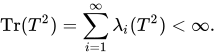
Let T {\displaystyle T} {\displaystyle T} be a bounded self-adjoint operator on a Hilbert space. Then T 2 {\displaystyle T^{2}} {\displaystyle T^{2}} is trace class if and only if T {\displaystyle T} {\displaystyle T} has a pure point spectrum with eigenvalues { λ i ( T ) } i = 1 ∞ {\displaystyle \left\{\lambda _{i}(T)\right\}_{i=1}^{\infty }} {\displaystyle \left\{\lambda _{i}(T)\right\}_{i=1}^{\infty }} such that[12]

Tr ⁡ ( T 2 ) = ∑ i = 1 ∞ λ i ( T 2 ) < ∞ . {\displaystyle \operatorname {Tr} (T^{2})=\sum _{i=1}^{\infty }\lambda _{i}(T^{2})<\infty .} {\displaystyle \operatorname {Tr} (T^{2})=\sum _{i=1}^{\infty }\lambda _{i}(T^{2})<\infty .}
Mercer's theorem

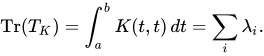
Mercer's theorem provides another example of a trace class operator. That is, suppose K {\displaystyle K} {\displaystyle K} is a continuous symmetric positive-definite kernel on L 2 ( [ a , b ] ) {\displaystyle L^{2}([a,b])} {\displaystyle L^{2}([a,b])}, defined as

K ( s , t ) = ∑ j = 1 ∞ λ j e j ( s ) e j ( t ) {\displaystyle K(s,t)=\sum _{j=1}^{\infty }\lambda _{j}\,e_{j}(s)\,e_{j}(t)} {\displaystyle K(s,t)=\sum _{j=1}^{\infty }\lambda _{j}\,e_{j}(s)\,e_{j}(t)}
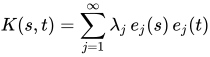
then the associated Hilbert–Schmidt integral operator T K {\displaystyle T_{K}} {\displaystyle T_{K}} is trace class, i.e.,

Tr ⁡ ( T K ) = ∫ a b K ( t , t ) d t = ∑ i λ i . {\displaystyle \operatorname {Tr} (T_{K})=\int _{a}^{b}K(t,t)\,dt=\sum _{i}\lambda _{i}.} {\displaystyle \operatorname {Tr} (T_{K})=\int _{a}^{b}K(t,t)\,dt=\sum _{i}\lambda _{i}.}
Finite-rank operators

Every finite-rank operator is a trace-class operator. Furthermore, the space of all finite-rank operators is a dense subspace of B 1 ( H ) {\displaystyle B_{1}(H)} {\displaystyle B_{1}(H)} (when endowed with the trace norm).[9]

Given any x , y ∈ H , {\displaystyle x,y\in H,} {\displaystyle x,y\in H,} define the operator x ⊗ y : H → H {\displaystyle x\otimes y:H\to H} {\displaystyle x\otimes y:H\to H} by ( x ⊗ y ) ( z ) := ⟨ z , y ⟩ x . {\displaystyle (x\otimes y)(z):=\langle z,y\rangle x.} {\displaystyle (x\otimes y)(z):=\langle z,y\rangle x.} Then x ⊗ y {\displaystyle x\otimes y} {\displaystyle x\otimes y} is a continuous linear operator of rank 1 and is thus trace class; moreover, for any bounded linear operator A on H (and into H), Tr ⁡ ( A ( x ⊗ y ) ) = ⟨ A x , y ⟩ . {\displaystyle \operatorname {Tr} (A(x\otimes y))=\langle Ax,y\rangle .} {\displaystyle \operatorname {Tr} (A(x\otimes y))=\langle Ax,y\rangle .}[9]

Properties

  1. If A : H → H {\displaystyle A:H\to H} {\displaystyle A:H\to H} is a non-negative self-adjoint operator, then A {\displaystyle A} {\displaystyle A} is trace-class if and only if Tr ⁡ A < ∞ . {\displaystyle \operatorname {Tr} A<\infty .} {\displaystyle \operatorname {Tr} A<\infty .} Therefore, a self-adjoint operator A {\displaystyle A} {\displaystyle A} is trace-class if and only if its positive part A + {\displaystyle A^{+}} {\displaystyle A^{+}} and negative part A − {\displaystyle A^{-}} {\displaystyle A^{-}} are both trace-class. (The positive and negative parts of a self-adjoint operator are obtained by the continuous functional calculus.)
  2. The trace is a linear functional over the space of trace-class operators, that is, Tr ⁡ ( a A + b B ) = a Tr ⁡ ( A ) + b Tr ⁡ ( B ) . {\displaystyle \operatorname {Tr} (aA+bB)=a\operatorname {Tr} (A)+b\operatorname {Tr} (B).} {\displaystyle \operatorname {Tr} (aA+bB)=a\operatorname {Tr} (A)+b\operatorname {Tr} (B).} The bilinear map ⟨ A , B ⟩ = Tr ⁡ ( A ∗ B ) {\displaystyle \langle A,B\rangle =\operatorname {Tr} (A^{*}B)} {\displaystyle \langle A,B\rangle =\operatorname {Tr} (A^{*}B)} is an inner product on the trace class; the corresponding norm is called the Hilbert–Schmidt norm. The completion of the trace-class operators in the Hilbert–Schmidt norm are called the Hilbert–Schmidt operators.
  3. Tr : B 1 ( H ) → C {\displaystyle \operatorname {Tr} :B_{1}(H)\to \mathbb {C} } {\displaystyle \operatorname {Tr} :B_{1}(H)\to \mathbb {C} } is a positive linear functional such that if T {\displaystyle T} {\displaystyle T} is a trace class operator satisfying T ≥ 0  and  Tr ⁡ T = 0 , {\displaystyle T\geq 0{\text{ and }}\operatorname {Tr} T=0,} {\displaystyle T\geq 0{\text{ and }}\operatorname {Tr} T=0,} then T = 0. {\displaystyle T=0.} {\displaystyle T=0.}[11]
  4. If T : H → H {\displaystyle T:H\to H} {\displaystyle T:H\to H} is trace-class then so is T ∗ {\displaystyle T^{*}} {\displaystyle T^{*}} and ‖ T ‖ 1 = ‖ T ∗ ‖ 1 . {\displaystyle \|T\|_{1}=\left\|T^{*}\right\|_{1}.} {\displaystyle \|T\|_{1}=\left\|T^{*}\right\|_{1}.}[11]
  5. If A : H → H {\displaystyle A:H\to H} {\displaystyle A:H\to H} is bounded, and T : H → H {\displaystyle T:H\to H} {\displaystyle T:H\to H} is trace-class, then A T {\displaystyle AT} {\displaystyle AT} and T A {\displaystyle TA} {\displaystyle TA} are also trace-class (i.e. the space of trace-class operators on H is a two-sided ideal in the algebra of bounded linear operators on H), and[11][13] ‖ A T ‖ 1 = Tr ⁡ ( | A T | ) ≤ ‖ A ‖ ‖ T ‖ 1 , ‖ T A ‖ 1 = Tr ⁡ ( | T A | ) ≤ ‖ A ‖ ‖ T ‖ 1 . {\displaystyle \|AT\|_{1}=\operatorname {Tr} (|AT|)\leq \|A\|\|T\|_{1},\quad \|TA\|_{1}=\operatorname {Tr} (|TA|)\leq \|A\|\|T\|_{1}.} {\displaystyle \|AT\|_{1}=\operatorname {Tr} (|AT|)\leq \|A\|\|T\|_{1},\quad \|TA\|_{1}=\operatorname {Tr} (|TA|)\leq \|A\|\|T\|_{1}.} Furthermore, under the same hypothesis,[11] Tr ⁡ ( A T ) = Tr ⁡ ( T A ) {\displaystyle \operatorname {Tr} (AT)=\operatorname {Tr} (TA)} {\displaystyle \operatorname {Tr} (AT)=\operatorname {Tr} (TA)} and | Tr ⁡ ( A T ) | ≤ ‖ A ‖ ‖ T ‖ . {\displaystyle |\operatorname {Tr} (AT)|\leq \|A\|\|T\|.} {\displaystyle |\operatorname {Tr} (AT)|\leq \|A\|\|T\|.} The last assertion also holds under the weaker hypothesis that A and T are Hilbert–Schmidt.
  6. If ( e k ) k {\displaystyle \left(e_{k}\right)_{k}} {\displaystyle \left(e_{k}\right)_{k}} and ( f k ) k {\displaystyle \left(f_{k}\right)_{k}} {\displaystyle \left(f_{k}\right)_{k}} are two orthonormal bases of H and if T is trace class then ∑ k | ⟨ T e k , f k ⟩ | ≤ ‖ T ‖ 1 . {\textstyle \sum _{k}\left|\left\langle Te_{k},f_{k}\right\rangle \right|\leq \|T\|_{1}.} {\textstyle \sum _{k}\left|\left\langle Te_{k},f_{k}\right\rangle \right|\leq \|T\|_{1}.}[9]
  7. If A is trace-class, then one can define the Fredholm determinant of I + A {\displaystyle I+A} {\displaystyle I+A}: det ( I + A ) := ∏ n ≥ 1 [ 1 + λ n ( A ) ] , {\displaystyle \det(I+A):=\prod _{n\geq 1}[1+\lambda _{n}(A)],} {\displaystyle \det(I+A):=\prod _{n\geq 1}[1+\lambda _{n}(A)],} where { λ n ( A ) } n {\displaystyle \{\lambda _{n}(A)\}_{n}} {\displaystyle \{\lambda _{n}(A)\}_{n}} is the spectrum of A . {\displaystyle A.} {\displaystyle A.} The trace class condition on A {\displaystyle A} {\displaystyle A} guarantees that the infinite product is finite: indeed, det ( I + A ) ≤ e ‖ A ‖ 1 . {\displaystyle \det(I+A)\leq e^{\|A\|_{1}}.} {\displaystyle \det(I+A)\leq e^{\|A\|_{1}}.} It also implies that det ( I + A ) ≠ 0 {\displaystyle \det(I+A)\neq 0} {\displaystyle \det(I+A)\neq 0} if and only if ( I + A ) {\displaystyle (I+A)} {\displaystyle (I+A)} is invertible.
  8. If A : H → H {\displaystyle A:H\to H} {\displaystyle A:H\to H} is trace class then for any orthonormal basis ( e k ) k {\displaystyle \left(e_{k}\right)_{k}} {\displaystyle \left(e_{k}\right)_{k}} of H , {\displaystyle H,} {\displaystyle H,} the sum of positive terms ∑ k | ⟨ A e k , e k ⟩ | {\textstyle \sum _{k}\left|\left\langle A\,e_{k},e_{k}\right\rangle \right|} {\textstyle \sum _{k}\left|\left\langle A\,e_{k},e_{k}\right\rangle \right|} is finite.[11]
  9. If A = B ∗ C {\displaystyle A=B^{*}C} {\displaystyle A=B^{*}C} for some Hilbert-Schmidt operators B {\displaystyle B} {\displaystyle B} and C {\displaystyle C} {\displaystyle C} then for any normal vector e ∈ H , {\displaystyle e\in H,} {\displaystyle e\in H,} | ⟨ A e , e ⟩ | ≤ 1 2 ( ‖ B e ‖ 2 + ‖ C e ‖ 2 ) {\textstyle |\langle Ae,e\rangle |\leq {\frac {1}{2}}\left(\|Be\|^{2}+\|Ce\|^{2}\right)} {\textstyle |\langle Ae,e\rangle |\leq {\frac {1}{2}}\left(\|Be\|^{2}+\|Ce\|^{2}\right)} holds.[11]

Lidskii's theorem

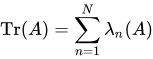
Let A {\displaystyle A} {\displaystyle A} be a trace-class operator in a separable Hilbert space H , {\displaystyle H,} {\displaystyle H,} and let { λ n ( A ) } n = 1 N ≤ ∞ {\displaystyle \{\lambda _{n}(A)\}_{n=1}^{N\leq \infty }} {\displaystyle \{\lambda _{n}(A)\}_{n=1}^{N\leq \infty }} be the eigenvalues of A . {\displaystyle A.} {\displaystyle A.} Let us assume that λ n ( A ) {\displaystyle \lambda _{n}(A)} {\displaystyle \lambda _{n}(A)} are enumerated with algebraic multiplicities taken into account (that is, if the algebraic multiplicity of λ {\displaystyle \lambda } {\displaystyle \lambda } is k , {\displaystyle k,} {\displaystyle k,} then λ {\displaystyle \lambda } {\displaystyle \lambda } is repeated k {\displaystyle k} {\displaystyle k} times in the list λ 1 ( A ) , λ 2 ( A ) , … {\displaystyle \lambda _{1}(A),\lambda _{2}(A),\dots } {\displaystyle \lambda _{1}(A),\lambda _{2}(A),\dots }). Lidskii's theorem (named after Victor Borisovich Lidskii) states that Tr ⁡ ( A ) = ∑ n = 1 N λ n ( A ) {\displaystyle \operatorname {Tr} (A)=\sum _{n=1}^{N}\lambda _{n}(A)} {\displaystyle \operatorname {Tr} (A)=\sum _{n=1}^{N}\lambda _{n}(A)}
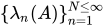
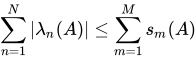
Note that the series on the right converges absolutely due to Weyl's inequality ∑ n = 1 N | λ n ( A ) | ≤ ∑ m = 1 M s m ( A ) {\displaystyle \sum _{n=1}^{N}\left|\lambda _{n}(A)\right|\leq \sum _{m=1}^{M}s_{m}(A)} {\displaystyle \sum _{n=1}^{N}\left|\lambda _{n}(A)\right|\leq \sum _{m=1}^{M}s_{m}(A)} between the eigenvalues { λ n ( A ) } n = 1 N {\displaystyle \{\lambda _{n}(A)\}_{n=1}^{N}} {\displaystyle \{\lambda _{n}(A)\}_{n=1}^{N}} and the singular values { s m ( A ) } m = 1 M {\displaystyle \{s_{m}(A)\}_{m=1}^{M}} {\displaystyle \{s_{m}(A)\}_{m=1}^{M}} of the compact operator A . {\displaystyle A.} {\displaystyle A.}[14] See also Grothendieck trace theorem.
Relationship between common classes of operators

One can view certain classes of bounded operators as noncommutative analogue of classical sequence spaces, with trace-class operators as the noncommutative analogue of the sequence space ℓ 1 ( N ) . {\displaystyle \ell ^{1}(\mathbb {N} ).} {\displaystyle \ell ^{1}(\mathbb {N} ).}

Indeed, it is possible to apply the spectral theorem to show that every normal trace-class operator on a separable Hilbert space can be realized in a certain way as an ℓ 1 {\displaystyle \ell ^{1}} {\displaystyle \ell ^{1}} sequence with respect to some choice of a pair of Hilbert bases. In the same vein, the bounded operators are noncommutative versions of ℓ ∞ ( N ) , {\displaystyle \ell ^{\infty }(\mathbb {N} ),} {\displaystyle \ell ^{\infty }(\mathbb {N} ),} the compact operators that of c 0 {\displaystyle c_{0}} {\displaystyle c_{0}} (the sequences convergent to 0), Hilbert–Schmidt operators correspond to ℓ 2 ( N ) , {\displaystyle \ell ^{2}(\mathbb {N} ),} {\displaystyle \ell ^{2}(\mathbb {N} ),} and finite-rank operators to c 00 {\displaystyle c_{00}} {\displaystyle c_{00}} (the sequences that have only finitely many non-zero terms). To some extent, the relationships between these classes of operators are similar to the relationships between their commutative counterparts.

Recall that every compact operator T {\displaystyle T} {\displaystyle T} on a Hilbert space takes the following canonical form: there exist orthonormal bases ( u i ) i {\displaystyle (u_{i})_{i}} {\displaystyle (u_{i})_{i}} and ( v i ) i {\displaystyle (v_{i})_{i}} {\displaystyle (v_{i})_{i}} and a sequence ( α i ) i {\displaystyle \left(\alpha _{i}\right)_{i}} {\displaystyle \left(\alpha _{i}\right)_{i}} of non-negative numbers with α i → 0 {\displaystyle \alpha _{i}\to 0} {\displaystyle \alpha _{i}\to 0} such that T x = ∑ i α i ⟨ x , v i ⟩ u i  for all  x ∈ H . {\displaystyle Tx=\sum _{i}\alpha _{i}\langle x,v_{i}\rangle u_{i}\quad {\text{ for all }}x\in H.} {\displaystyle Tx=\sum _{i}\alpha _{i}\langle x,v_{i}\rangle u_{i}\quad {\text{ for all }}x\in H.} Making the above heuristic comments more precise, we have that T {\displaystyle T} {\displaystyle T} is trace-class iff the series ∑ i α i {\textstyle \sum _{i}\alpha _{i}} {\textstyle \sum _{i}\alpha _{i}} is convergent, T {\displaystyle T} {\displaystyle T} is Hilbert–Schmidt iff ∑ i α i 2 {\textstyle \sum _{i}\alpha _{i}^{2}} {\textstyle \sum _{i}\alpha _{i}^{2}} is convergent, and T {\displaystyle T} {\displaystyle T} is finite-rank iff the sequence ( α i ) i {\displaystyle \left(\alpha _{i}\right)_{i}} {\displaystyle \left(\alpha _{i}\right)_{i}} has only finitely many nonzero terms. This allows to relate these classes of operators. The following inclusions hold and are all proper when H {\displaystyle H} {\displaystyle H} is infinite-dimensional: {  finite rank  } ⊆ {  trace class  } ⊆ {  Hilbert--Schmidt  } ⊆ {  compact  } . {\displaystyle \{{\text{ finite rank }}\}\subseteq \{{\text{ trace class }}\}\subseteq \{{\text{ Hilbert--Schmidt }}\}\subseteq \{{\text{ compact }}\}.} {\displaystyle \{{\text{ finite rank }}\}\subseteq \{{\text{ trace class }}\}\subseteq \{{\text{ Hilbert--Schmidt }}\}\subseteq \{{\text{ compact }}\}.}

The trace-class operators are given the trace norm ‖ T ‖ 1 = Tr ⁡ [ ( T ∗ T ) 1 / 2 ] = ∑ i α i . {\textstyle \|T\|_{1}=\operatorname {Tr} \left[\left(T^{*}T\right)^{1/2}\right]=\sum _{i}\alpha _{i}.} {\textstyle \|T\|_{1}=\operatorname {Tr} \left[\left(T^{*}T\right)^{1/2}\right]=\sum _{i}\alpha _{i}.} The norm corresponding to the Hilbert–Schmidt inner product is ‖ T ‖ 2 = [ Tr ⁡ ( T ∗ T ) ] 1 / 2 = ( ∑ i α i 2 ) 1 / 2 . {\displaystyle \|T\|_{2}=\left[\operatorname {Tr} \left(T^{*}T\right)\right]^{1/2}=\left(\sum _{i}\alpha _{i}^{2}\right)^{1/2}.} {\displaystyle \|T\|_{2}=\left[\operatorname {Tr} \left(T^{*}T\right)\right]^{1/2}=\left(\sum _{i}\alpha _{i}^{2}\right)^{1/2}.} Also, the usual operator norm is ‖ T ‖ = sup i ( α i ) . {\textstyle \|T\|=\sup _{i}\left(\alpha _{i}\right).} {\textstyle \|T\|=\sup _{i}\left(\alpha _{i}\right).} By classical inequalities regarding sequences, ‖ T ‖ ≤ ‖ T ‖ 2 ≤ ‖ T ‖ 1 {\displaystyle \|T\|\leq \|T\|_{2}\leq \|T\|_{1}} {\displaystyle \|T\|\leq \|T\|_{2}\leq \|T\|_{1}} for appropriate T . {\displaystyle T.} {\displaystyle T.}

It is also clear that finite-rank operators are dense in both trace-class and Hilbert–Schmidt in their respective norms.

Trace class as the dual of compact operators

The dual space of c 0 {\displaystyle c_{0}} {\displaystyle c_{0}} is ℓ 1 ( N ) . {\displaystyle \ell ^{1}(\mathbb {N} ).} {\displaystyle \ell ^{1}(\mathbb {N} ).} Similarly, we have that the dual of compact operators, denoted by K ( H ) ∗ , {\displaystyle K(H)^{*},} {\displaystyle K(H)^{*},} is the trace-class operators, denoted by B 1 . {\displaystyle B_{1}.} {\displaystyle B_{1}.} The argument, which we now sketch, is reminiscent of that for the corresponding sequence spaces. Let f ∈ K ( H ) ∗ , {\displaystyle f\in K(H)^{*},} {\displaystyle f\in K(H)^{*},} we identify f {\displaystyle f} {\displaystyle f} with the operator T f {\displaystyle T_{f}} {\displaystyle T_{f}} defined by ⟨ T f x , y ⟩ = f ( S x , y ) , {\displaystyle \langle T_{f}x,y\rangle =f\left(S_{x,y}\right),} {\displaystyle \langle T_{f}x,y\rangle =f\left(S_{x,y}\right),} where S x , y {\displaystyle S_{x,y}} {\displaystyle S_{x,y}} is the rank-one operator given by S x , y ( h ) = ⟨ h , y ⟩ x . {\displaystyle S_{x,y}(h)=\langle h,y\rangle x.} {\displaystyle S_{x,y}(h)=\langle h,y\rangle x.}

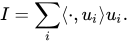
This identification works because the finite-rank operators are norm-dense in K ( H ) . {\displaystyle K(H).} {\displaystyle K(H).} In the event that T f {\displaystyle T_{f}} {\displaystyle T_{f}} is a positive operator, for any orthonormal basis u i , {\displaystyle u_{i},} {\displaystyle u_{i},} one has ∑ i ⟨ T f u i , u i ⟩ = f ( I ) ≤ ‖ f ‖ , {\displaystyle \sum _{i}\langle T_{f}u_{i},u_{i}\rangle =f(I)\leq \|f\|,} {\displaystyle \sum _{i}\langle T_{f}u_{i},u_{i}\rangle =f(I)\leq \|f\|,} where I {\displaystyle I} {\displaystyle I} is the identity operator: I = ∑ i ⟨ ⋅ , u i ⟩ u i . {\displaystyle I=\sum _{i}\langle \cdot ,u_{i}\rangle u_{i}.} {\displaystyle I=\sum _{i}\langle \cdot ,u_{i}\rangle u_{i}.}

But this means that T f {\displaystyle T_{f}} {\displaystyle T_{f}} is trace-class. An appeal to polar decomposition extend this to the general case, where T f {\displaystyle T_{f}} {\displaystyle T_{f}} need not be positive.

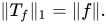
A limiting argument using finite-rank operators shows that ‖ T f ‖ 1 = ‖ f ‖ . {\displaystyle \|T_{f}\|_{1}=\|f\|.} {\displaystyle \|T_{f}\|_{1}=\|f\|.} Thus K ( H ) ∗ {\displaystyle K(H)^{*}} {\displaystyle K(H)^{*}} is isometrically isomorphic to B 1 . {\displaystyle B_{1}.} {\displaystyle B_{1}.}
As the predual of bounded operators

Recall that the dual of ℓ 1 ( N ) {\displaystyle \ell ^{1}(\mathbb {N} )} {\displaystyle \ell ^{1}(\mathbb {N} )} is ℓ ∞ ( N ) . {\displaystyle \ell ^{\infty }(\mathbb {N} ).} {\displaystyle \ell ^{\infty }(\mathbb {N} ).} In the present context, the dual of trace-class operators B 1 {\displaystyle B_{1}} {\displaystyle B_{1}} is the bounded operators B ( H ) . {\displaystyle B(H).} {\displaystyle B(H).} More precisely, the set B 1 {\displaystyle B_{1}} {\displaystyle B_{1}} is a two-sided ideal in B ( H ) . {\displaystyle B(H).} {\displaystyle B(H).} So given any operator T ∈ B ( H ) , {\displaystyle T\in B(H),} {\displaystyle T\in B(H),} we may define a continuous linear functional φ T {\displaystyle \varphi _{T}} {\displaystyle \varphi _{T}} on B 1 {\displaystyle B_{1}} {\displaystyle B_{1}} by φ T ( A ) = Tr ⁡ ( A T ) . {\displaystyle \varphi _{T}(A)=\operatorname {Tr} (AT).} {\displaystyle \varphi _{T}(A)=\operatorname {Tr} (AT).} This correspondence between bounded linear operators and elements φ T {\displaystyle \varphi _{T}} {\displaystyle \varphi _{T}} of the dual space of B 1 {\displaystyle B_{1}} {\displaystyle B_{1}} is an isometric isomorphism. It follows that B ( H ) {\displaystyle B(H)} {\displaystyle B(H)} is the dual space of B 1 . {\displaystyle B_{1}.} {\displaystyle B_{1}.} This can be used to define the weak-* topology on B ( H ) . {\displaystyle B(H).} {\displaystyle B(H).}

See also

References

  1. Mittelstaedt 2009, pp. 389–390.
  2. Conway 2000, p. 86.
  3. Reed & Simon 1980, p. 206.
  4. Reed & Simon 1980, p. 196.
  5. Reed & Simon 1980, p. 195.
  6. Trèves 2006, p. 494.
  7. Conway 2000, p. 89.
  8. Reed & Simon 1980, pp. 203–204, 209.
  9. Conway 1990, p. 268.
  10. Trèves 2006, pp. 502–508.
  11. Conway 1990, p. 267.
  12. Simon 2010, p. 21.
  13. Reed & Simon 1980, p. 218.
  14. Simon, B. (2005) Trace ideals and their applications, Second Edition, American Mathematical Society.

Bibliography