The White River Fauna are fossil animals found in the White River Group of South Dakota, North Dakota, Wyoming, Colorado and Nebraska in the United States. In southwest South Dakota and northwest Nebraska, these fossils are characteristic of the White River Badlands (including Badlands National Park), though they can be found far beyond the limits of the White River watershed.[1]
In Wyoming, the White River Group is undifferentiated, and is more commonly known as the White River Formation. Further east in Nebraska and South Dakota, the group is divided into the Chadron Formation (lower part) and Brule Formation (upper part). Exposures are less well-investigated in northeast Colorado and scattered sites across western North Dakota. The White River Group is overlain by the Sharps Formation in Badlands National Park and the Arikaree Group in northwest Nebraska.
Animals from the White River Group date from the Eocene and Oligocene epochs.[2] The fauna is representative of four North American Land Mammal Ages (NALMAs):
Only the uppermost layers of the White River Group extend into the Arikareean (specifically, the informal "brown siltstone member" of the Brule Formation).[2] All NALMA and Epoch information in this list refers solely to each species' distribution through the White River Group, as some species survive into later time intervals outside of the White River area.
Birds
| Genus |
Species |
NALMA |
Epoch |
Notes |
Image |
|---|
| †Archaealectrornis |
†A. sibleyi |
|
"early Oligocene"[3] |
A potential pheasant or guan-like bird |
|
| †Badistornis |
†B. aramus |
Orellan |
early Oligocene |
An aramid (limpkin relative) known from both leg fossils and possible egg fossils. |
|
| †Bathornis |
†B. celeripes |
Chadronian - Orellan |
late Eocene - early Oligocene |
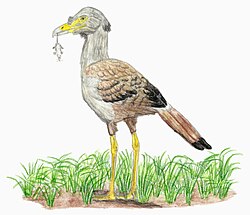
The type genus of Bathornithidae, an extinct family of large predatory birds related to seriemas.[4][5] |
 |
| †B. cursor |
Chadronian |
late Eocene |
| †B. geographicus |
Whitneyan |
"mid" Oligocene |
| †B. veredus (type) |
Chadronian - Orellan |
late Eocene - early Oligocene |
| Buteo |
†B. grangeri |
Orellan |
early Oligocene |
A hawk in the living genus Buteo |
|
| "Gavia" |
†"G." pusilla |
Orellan |
early Oligocene |
A potential loon |
|
| †Gnotornis |
†G. aramielus |
Whitneyan |
"mid" Oligocene |
A heron |
|
| †Palaeogyps |
†P. prodromus |
Chadronian |
late Eocene |
A potential cathartid (New World vulture) |
|
| †Palaeonossax |
†P. senectus |
Whitneyan |
"mid" Oligocene |
A potential cracid (guan or curassow relative) |
|
| †Palaeoplancus |
†P. sternbergi |
Whitneyan |
"mid" Oligocene |
An osprey-like accipitriform,[5] initially regarded as an eagle |
|
| †Paracrax |
†P. antiqua |
Orellan |
early Oligocene |
A bathornithid initially mistaken for a cormorant (Phalacrocorax mediterraneus) |
|
| †P. gigantea |
Whitneyan |
"mid" Oligocene |
A large bathornithid, closely related and similar to the conspecific Bathornis; however, it seems to have occupied more arid environments.[6] |
|
| †P. wetmorei |
Whitneyan |
"mid" Oligocene |
|
| †Phasmagyps |
†P. patritus |
Chadronian |
late Eocene |
A potential cathartid (New World vulture) |
|
| †Procrax |
†P. brevipes |
Chadronian |
late Eocene |
A potential cracid (guan or curassow relative) with short legs similar to piping guans (Pipile)[3] |
|
Mammals
†Apatemyids
| Genus |
Species |
NALMA |
Epoch |
Notes |
Image |
|---|
| †Apatemys |
†A. sp. |
Chadronian[7] |
late Eocene |
An apatemyid (part of an extinct group of aye-aye-like insectivores) |
|
| †Sinclairella |
†S. dakotensis |
Chadronian[7] - Whitneyan |
late Eocene - "mid" Oligocene |
An apatemyid |
|
Chiropterans
| Genus / Taxon |
Species |
NALMA |
Epoch |
Notes |
Image |
|---|
| †Chadronycteris |
†C. rabenae |
Chadronian 3 |
late Eocene |
A vespertilionoid bat |
|
| †Oligomyotis |
†O. casementi |
Orellan |
early Oligocene |
A vespertilionid (vesper bat) |
|
| Vespertilionidae |
|
Chadronian 3 |
late Eocene |
An indeterminate vespertilionid, larger than Chadronycteris[27] |
|
Eulipotyphlans
Modern ants often use tiny tooth fossils as grains when building their anthills, and teeth from eulipotyphlans (relatives of shrews, moles, and hedgehogs) are common at anthill sites close to the Chadronian-Orellan transition.[7][28] Both erinaceomorph (hedgehog-like) and "soricomorph" (shrew and mole-like) eulipotyphlans occur in the White River fauna, though erinaceomorphs would go extinct in North America later on in the Cenozoic, near the end of the Miocene.[29]
| Genus |
Species |
NALMA |
Epoch |
Notes |
Image |
|---|
| †Amphechinus |
†A. sp. |
Chadronian[7] |
late Eocene |
An erinaceid (early hedgehog) |
|
| †Ankylodon |
†A. annectens |
Orellan |
early Oligocene |
A late-surviving sespedectid (hedgehog relative) |
|
| †A. progressus |
Chadronian?[7] - Orellan |
late Eocene? - early Oligocene |
|
| †Apternodus |
†A. brevirostris |
Chadronian? |
late Eocene? |
An apternodontid (early mole-like mammal)[30] |
|
| †A. dasophylakas |
Chadronian |
late Eocene |
|
| †A. gregoryi |
Chadronian - Orellan |
late Eocene - early Oligocene |
|
| †A. iliffensis |
Chadronian |
late Eocene |
|
| †A. major |
Chadronian |
late Eocene |
|
| †A. mediaevus |
Chadronian |
late Eocene |
|
| †Centetodon |
†C. chadronensis |
Chadronian - Orellan[28] |
late Eocene - early Oligocene |
A geolabidid (shrew relative) |
|
| †C. magnus |
Chadronian - Orellan |
late Eocene - early Oligocene |
|
| †C. marginalis |
Chadronian - Orellan |
late Eocene - early Oligocene |
|
| †C. wolffi |
Chadronian - Whitneyan |
late Eocene - "mid" Oligocene |
|
| †Clinopternodus |
†C. gracilis |
Chadronian |
late Eocene |
A micropternodontid (early mole-like mammal) |
|
| †Domnina |
†D. gradata |
Chadronian - Whitneyan |
late Eocene - "mid" Oligocene |
A heterosoricine shrew |
|
| †D. thompsoni |
Chadronian |
late Eocene |
|
| †Micropternodus |
†M. borealis |
Chadronian - Orellan |
late Eocene - early Oligocene |
A micropternodontid |
|
| †M. montrosensis |
Chadronian - Orellan |
late Eocene - early Oligocene |
|
| †Noritrimylus |
†N. compressus[7] |
Chadronian - Orellan |
late Eocene - early Oligocene |
A heterosoricine shrew |
|
| †N. metaxy |
Whitneyan |
"mid" Oligocene |
|
| †Oligoryctes |
†O. altitalonidus |
Chadronian - Orellan |
late Eocene - early Oligocene |
An oligoryctid (shrew relative) |
|
| †O. cameronensis |
Chadronian |
late Eocene |
|
| cf. †O. cameronensis |
Chadronian |
late Eocene |
|
| †O. tenutalonidus[7] |
Chadronian |
late Eocene |
|
| †Oligoscalops |
†O. galbreathi |
Chadronian - Orellan |
late Eocene - early Oligocene |
A proscalopid (early mole-like mammal) |
|
| †Proscalops |
†P. sp. |
Chadronian[7] - Whitneyan |
late Eocene - "mid" Oligocene |
A proscalopid |
|
| †P. tertius |
Orellan - Whitneyan |
early - "mid" Oligocene |
|
| †Proterix |
†P. bicuspis |
Whitneyan |
"mid" Oligocene |
An galericine (gymnure-like) erinaceid |
|
| †P. loomisi |
Whitneyan |
"mid" Oligocene |
|
| †P. minimus |
Chadronian[7] - Orellan |
late Eocene - early Oligocene |
|
†Leptictids
Leptictids are an extinct group of mammals with an insectivorous diet, a flexible snout, and hopping adaptations.
| Genus |
Species |
NALMA |
Epoch |
Notes |
Image |
|---|
| †Blacktops |
†B. sp. |
Chadronian[7] - Orellan |
late Eocene - early Oligocene |
A leptictid |
|
| †Leptictis |
†L. dakotensis |
Chadronian[7] - Whitneyan |
late Eocene - "mid" Oligocene |
A leptictid |
|
| †Megaleptictis |
†M. altidens |
Chadronian?[31] - Orellan[32] |
late Eocene? - early Oligocene |
A large leptictid known from a complete skull with possible adaptations for herbivory.[31] |
|
| Genus |
Species |
NALMA |
Epoch |
Notes |
Image |
|---|
| †Copedelphys |
†C. stevensoni |
Chadronian[7] - Whitneyan |
late Eocene - "mid" Oligocene |
A herpetotheriid metatherian (opossum-like marsupial relative) |
|
| †Herpetotherium |
†H. fugax |
Chadronian - Whitneyan |
late Eocene - "mid" Oligocene |
A herpetotheriid. The most abundant non-rodent species found in ant mounds.[7][28] |
|
| †H. valens |
Chadronian - Orellan |
late Eocene - early Oligocene |
A herpetotheriid.[7] |
|
| †Nanodelphys |
†N. hunti |
Chadronian[7] - Whitneyan |
late Eocene - "mid" Oligocene |
A peradectid. |
|
†Palaeanodonta
| Genus |
Species |
NALMA |
Epoch |
Notes |
Image |
|---|
| †Epoicotherium |
†E. unicum |
Chadronian |
late Eocene |
An epoicotheriid (mole-like mammals potentially related to pangolins). |
|
| †Xenocranium |
†X. pileorivale |
Chadronian |
late Eocene |
An epoicotheriid |
 |
†Pantolestans
| Genus |
Species |
NALMA |
Epoch |
Notes |
Image |
|---|
| †Chadronia |
†C. margaretae |
Chadronian |
late Eocene |
A pantolestid (part of an extinct group of otter-like mammals) |
|
| †Cymaprimadon |
†C. kenni |
Chadronian |
late Eocene |
A pantolestid |
|
Perissodactyls
Equids
| Genus |
Species |
NALMA |
Epoch |
Notes |
Image |
|---|
| †Mesohippus |
|
|
|
A rather small three-toed equid (horse) with browsing habits |
 |
| †Miohippus |
|
|
|
A three-toed equid (horse), around the size of a sheep |
 |
Primates
| Taxon |
Species |
NALMA |
Epoch |
Notes |
Image |
|---|
| †Chumashius |
†C. sp. |
Chadronian |
late Eocene |
An omomyid (tarsier relative) |
|
| †Omomyidae |
indet. |
Chadronian |
late Eocene |
An indeterminate omomyid, similar to Chumashius but larger.[7] |
|
Rodents
Modern ants often use tiny tooth fossils as grains when building their anthills, and rodent teeth are common at anthill sites close to the Chadronian-Orellan transition.[7][28]
Reptiles
Crocodilians
| Genus |
Species |
NALMA |
Epoch |
Notes |
Image |
|---|
| Alligator |
†A. prenasalis |
Chadronian |
late Eocene |
The earliest known species of alligator. |
 |
Snakes
| Genus |
Species |
NALMA |
Epoch |
Notes |
Image |
|---|
| †Boavus |
†B. cf. occidentalis |
Chadronian - Orellan |
late Eocene - early Oligocene |
A boine boid (true boa).[34] |
|
| †Calamagras |
†C. angulatus |
Orellan - Arikareean |
Oligocene |
An erycine boid (sand boa).[34][37] |
|
| †C. murivorus |
Orellan |
early Oligocene |
|
| †Coprophis |
†C. dakotaensis |
Orellan |
early Oligocene |
A rare booid based on eroded fossils found within a mammal coprolite.[34] |
|
| †Geringophis |
†G. vetus |
Orellan |
early Oligocene |
An erycine boid (sand boa).[34][37] |
|
| †Helagras |
†H. orellanensis |
Orellan |
early Oligocene |
An erycine boid (sand boa).[34] |
|
| †Hibernophis[38] |
†H. breithaupti |
Orellan |
early Oligocene |
A booid based on complete skeletons.[38] |
|
| †Texasophis |
†T. galbreathi |
Orellan |
early Oligocene |
A colubrid.[34] |
|
Turtles
Indeterminate fossils of an anosteirine carettochelyid and a ptychogastrin geoemydid are also known from the White River Group.[39]
| Genus |
Species |
NALMA |
Epoch |
Notes |
Image |
|---|
| Apalone |
†A. leucopotamica |
Chadronian - Orellan |
late Eocene - early Oligocene |
A trionychid (softshell turtle).[39] |
|
| Chrysemys |
†C. antiqua |
Chadronian - Whitneyan |
late Eocene - "mid" Oligocene |
An emydid (pond turtle), sometimes known as "Trachemys" antiqua. A potential relative of modern painted turtles (Chrysemys).[39] |
|
| cf. †Echmatemys |
cf. †E. sp. |
Chadronian |
late Eocene |
A "batagurid" (geoemydid) similar to Echmatemys.[39] |
|
| Gopherus |
†G. laticuneus |
Chadronian - Whitneyan |
late Eocene - "mid" Oligocene |
A gopher tortoise in the subgenus Oligopherus. Gopherus fossils are also known from the Whitneyan.[39] |
|
| †Hesperotestudo |
†H. brontops |
Chadronian |
late Eocene |
A testudinid (tortoise). Hesperotestudo-like fossils are also known from the Whitneyan.[39] |
|
| †Pseudograptemys[39] |
†P. inornata |
Chadronian |
late Eocene |
An emydid (pond turtle) closely related to Graptemys (map turtles).[39] |
|
| †Stylemys |
†S. amphithorax |
Chadronian |
late Eocene |
A common testudinid (tortoise) related to gopher tortoises (Gopherus). Probably survived into the Whitneyan in the White River area.[39] |
 |
| †S. nebrascensis |
Chadronian - Orellan |
late Eocene - early Oligocene |
|
| †Xenochelys |
†X. formosa |
Chadronian |
late Eocene |
A kinosternid (mud turtle).[39] |
|
Further reading
- Rachel Benton, Dennis O. Terry Jr., Emmett Evanoff, & H. Gregory McDonald, The White River Badlands: Geology and Paleontology, Indiana University Press 2015
- Donald R. Prothero & Robert J. Emry (ed.), The Terrestrial Eocene-Oligocene Transition in North America, Cambridge University Press, 1996
- William Berryman Scott, A history of land mammals in the western hemisphere, MacMillan Publishing Company, 1913
References
- Scott, William Berryman; Jepsen, Glenn Lowell (1940). "The Mammalian Fauna of the White River Oligocene: Part IV. Artiodactyla". Transactions of the American Philosophical Society. 28 (4): 363–746. doi:10.2307/1005504. ISSN 0065-9746. JSTOR 1005504.
- Prothero, Donald R.; Emry, Robert J. (2004). "5. The Chadronian, Orellan, and Whitneyan North American Land Mammal Ages". In Woodburne, Michael O. (ed.). Late Cretaceous and Cenozoic Mammals of North America: Biostratigraphy and Geochronology. Columbia University Press. pp. 156–168. doi:10.7312/wood13040-007. ISBN 978-0-231-13040-0. JSTOR 10.7312/wood13040.11.
- Mayr, Gerald (2022), "Pelagornithidae, Gastornithidae, and Crown Group Galloanseres", in Mayr, Gerald (ed.), Paleogene Fossil Birds, Fascinating Life Sciences, Cham: Springer International Publishing, pp. 43–72, doi:10.1007/978-3-030-87645-6_4, ISBN 978-3-030-87645-6, retrieved 2026-06-09
- Wetmore, A. (1927). "Fossil Birds from the Oligocene of Colorado" (PDF). Proceedings of the Colorado Museum of Natural History. 7 (2): 1–14.
- Mayr, Gerald (2022), "Accipitriformes (New World Vultures, Hawks, and Allies), Falconiformes (Falcons), and Cariamiformes (Seriemas and Allies)", in Mayr, Gerald (ed.), Paleogene Fossil Birds, Fascinating Life Sciences, Cham: Springer International Publishing, pp. 153–176, doi:10.1007/978-3-030-87645-6_8, ISBN 978-3-030-87645-6, retrieved 2026-06-09
- Wetmore, A. (1927). "Fossil Birds from the Oligocene of Colorado" (PDF). Proceedings of the Colorado Museum of Natural History. 7 (2): 1–14.
- William W. Korth, Clint A. Boyd, Jeff J. Person, and Deborah K. Anderson (2022). "Special Issue: Fossil mammals from ant mounds situated on exposures of the Big Cottonwood Creek Member of the Chadron Formation (latest Eocene-early Oligocene), Sioux County, Nebraska." Paludicola 13 (4).
- Edwards, Paul (1976). "The subfamily Leptochoerinae (Artiodactyla, Dichobunidae) of North America (Oligocene)". Rocky Mountain Geology. 14 (2): 99–113.
- Stevens, Margaret Skeels; Stevens, James Bowie (1996-06-13), "Merycoidodontinae and Miniochoerinae", in Prothero, Donald R.; Emry, Robert J. (eds.), The Terrestrial Eocene-Oligocene Transition in North America (1 ed.), Cambridge University Press, pp. 498–573, doi:10.1017/cbo9780511665431.026, ISBN 978-0-521-43387-7, retrieved 2026-06-11
- Stevens, Margaret Skeels; Stevens, James Bowie (2007). "12. Family Merycoidodontidae". In Prothero, Donald R.; Foss, Scott E. (eds.). The Evolution of Artiodactyls. Baltimore: The Johns Hopkins University Press. pp. 157–168. doi:10.56021/9780801887352. ISBN 9780801887352.
- Lloyd, K. J.; Eberle, J. J. (2012-09-01). "A late Eocene (Chadronian) mammalian fauna from the White River Formation in Kings Canyon, northern Colorado". Rocky Mountain Geology. 47 (2): 113–132. doi:10.2113/gsrocky.47.2.113. ISSN 1555-7332.
- Watmore, Kristin I.; Stevens, Margaret Skeels; Prothero, Donald R.; Marriott, Katherine (2024). "Systematics of the late Eocene 'oreonetine' oreodonts (Merycoidodontidae: Artiodactyla)". Historical Biology. 36 (9): 1834–1853. doi:10.1080/08912963.2023.2234390. ISSN 0891-2963.
- Prothero, Donald; Ludtke, Joshua A. (2007). "13. Family Protoceratidae". In Prothero, Donald; Foss, Scott (eds.). The Evolution of Artiodactyls. Johns Hopkins University Press. doi:10.56021/9780801887352. ISBN 978-0-8018-8735-2.
- Emry, Robert J. (1973). "Stratigraphy and Preliminary Biostratigraphy of the Flagstaff Rim Area, Natrona County, Wyoming". Smithsonian Contributions to Paleobiology (18): 1–43. doi:10.5479/si.00810266.18.1. ISSN 0081-0266.
- Heaton, Timothy H.; Emry, Robert J. (1996-06-13), "Leptomerycidae", in Prothero, Donald R.; Emry, Robert J. (eds.), The Terrestrial Eocene-Oligocene Transition in North America (1 ed.), Cambridge University Press, pp. 581–608, doi:10.1017/cbo9780511665431.028, ISBN 978-0-521-43387-7, retrieved 2026-06-09
- Emry, Robert J. (1978). "A New Hypertragulid (Mammalia, Ruminantia) from the Early Chadronian of Wyoming and Texas". Journal of Paleontology. 52 (5): 1004–1014. ISSN 0022-3360. JSTOR 1303846.
- Shreero, Mattison; Welsh, Ed; Marriott, Katherine; Prothero, Donald R. (2023). "A tiny deer with big implications: a new genus (Santuccimeryx) from Badlands National Park helps bridge the gap between Oligocene and Miocene Leptomerycidae (Mammalia, Artiodactyla)". Proceedings of the South Dakota Academy of Science. 102: 59–81.
- Prothero, Donald R. (2009). "THE EARLY EVOLUTION OF THE NORTH AMERICAN PECCARIES" (PDF). Museum of Northern Arizona Bulletin. 65: 509–542. Archived from the original (PDF) on 20 November 2023.
- Prothero, Donald R. (2021). "The systematics of North American peccaries (Mammalia: Artiodactyla: Tayassuidae)". New Mexico Museum of Natural History and Science Bulletin. 85: 6–8.
- Hunt, Robert M. (1996-06-13), "Amphicyonidae", in Prothero, Donald R.; Emry, Robert J. (eds.), The Terrestrial Eocene-Oligocene Transition in North America (1 ed.), Cambridge University Press, pp. 476–485, doi:10.1017/cbo9780511665431.024, ISBN 978-0-521-43387-7, retrieved 2026-06-08
- Baskin, Jon A.; Tedford, Richard H. (1996-06-13), "Small Arctoid and Feliform Camivorans", in Prothero, Donald R.; Emry, Robert J. (eds.), The Terrestrial Eocene-Oligocene Transition in North America (1 ed.), Cambridge University Press, pp. 486–497, doi:10.1017/cbo9780511665431.025, ISBN 978-0-521-43387-7, retrieved 2026-06-08
- Wang, Xiaoming; Emry, Robert J.; Boyd, Clint A.; Person, Jeff J.; White, Stuart C.; Tedford, Richard H. (2022-06-29). "An exquisitely preserved skeleton of Eoarctos vorax (nov. gen. et sp.) from Fitterer Ranch, North Dakota (early Oligocene) and systematics and phylogeny of North American early arctoids (Carnivora, Caniformia)". Journal of Vertebrate Paleontology. 42 (sup1): 1–123. Bibcode:2022JVPal..42S...1W. doi:10.1080/02724634.2022.2145900. ISSN 0272-4634.
- Wang, Xiaoming; Tedford, Richard; Taylor, Beryl (1999-11-17). "Phylogenetic systematics of the Borophaginae (Carnivora, Canidae)". Bulletin of the American Museum of Natural History. 243. hdl:2246/1588.
- Wang, Xiaofeng; Tedford, Richard H. (1996-06-13), "Canidae", in Prothero, Donald R.; Emry, Robert J. (eds.), The Terrestrial Eocene-Oligocene Transition in North America (1 ed.), Cambridge University Press, pp. 433–452, doi:10.1017/cbo9780511665431.022, ISBN 978-0-521-43387-7, retrieved 2026-06-08
- Bryant, Harold N. (1996-06-13), "Nimravidae", in Prothero, Donald R.; Emry, Robert J. (eds.), The Terrestrial Eocene-Oligocene Transition in North America (1 ed.), Cambridge University Press, pp. 453–475, doi:10.1017/cbo9780511665431.023, ISBN 978-0-521-43387-7, retrieved 2026-06-09
- Barrett, Paul Z. (2016-02-09). "Taxonomic and systematic revisions to the North American Nimravidae (Mammalia, Carnivora)". PeerJ. 4 e1658. doi:10.7717/peerj.1658. ISSN 2167-8359. PMC 4756750. PMID 26893959.
- Czaplewski, Nicholas J.; Morgan, Gary S.; LaGarry, Hannan E. (2023). "LATE EOCENE (CHADRONIAN) BATS (CHIROPTERA) FROM THE WHITE RIVER GROUP OF NORTHWESTERN NEBRASKA" (PDF). Paludicola. 14 (2): 75–86.
- William W. Korth, Clint A. Boyd (2025). "FOSSIL MAMMALS FROM ANT MOUNDS ON THE ORELLA MEMBER, BRULE FORMATION IN SIOUX COUNTY, NEBRASKA." Paludicola 15 (3).
- Gunnell, Gregg F.; Bown, Thomas M.; Hutchison, J. Howard; Bloch, Jonathan I. (2008-06-12), "Lipotyphla", in Janis, Christine M.; Gunnell, Gregg F.; Uhen, Mark D. (eds.), Evolution of Tertiary Mammals of North America (1 ed.), Cambridge University Press, pp. 89–126, doi:10.1017/cbo9780511541438.008, ISBN 978-0-521-78117-6, retrieved 2026-06-23
- Asher, Robert J.; McKENNA, Malcolm C.; Emry, Robert J.; Tabrum, Alan R.; Kron, Donald G. (2002). "MORPHOLOGY AND RELATIONSHIPS OF APTERNODUS AND OTHER EXTINCT, ZALAMBDODONT, PLACENTAL MAMMALS". Bulletin of the American Museum of Natural History. 273 (1): 1. doi:10.1206/0003-0090(2002)273<0001:MAROAA>2.0.CO;2. ISSN 0003-0090.
- Meehan, TJ; Martin, Larry D. (2011). "New large leptictid insectivore from the Late Paleogene of South Dakota, USA" (PDF). Acta Palaeontologica Polonica. 57 (3): 509–518. doi:10.4202/app.2011.0035. S2CID 129358395.
- Clint A. Boyd, Ed Welsh (2025). "Description of an Earliest Orellan Fauna from Badlands National Park, Interior, South Dakota and Implications for the Stratigraphic Position of the Bloom Basin Limestone Bed" Dakoterra 6:124-147.
- Smith, Krister T. (2006). "A diverse new assemblage of Late Eocene squamates (Reptilia) from the Chadron Formation of North Dakota, USA" (PDF). Palaeontologia Electronica. 9 (2): 5A.
- Sullivan, Robert M.; Holman, J. Alan (1996-06-13), "Squamata", in Prothero, Donald R.; Emry, Robert J. (eds.), The Terrestrial Eocene-Oligocene Transition in North America (1 ed.), Cambridge University Press, pp. 354–372, doi:10.1017/cbo9780511665431.018, ISBN 978-0-521-43387-7, retrieved 2024-11-02
- Scarpetta, Simon G. (2024). "A Palaeogene stem crotaphytid ( Aciprion formosum ) and the phylogenetic affinities of early fossil pleurodontan iguanians". Royal Society Open Science. 11 (1) 221139. Bibcode:2024RSOS...1121139S. doi:10.1098/rsos.221139. ISSN 2054-5703. PMC 10776235. PMID 38204790.
- Bhullar, Bhart-Anjan S. (2010-07-26). "Cranial osteology of Exostinus serratus (Squamata: Anguimorpha), fossil sister taxon to the enigmatic clade Xenosaurus". Zoological Journal of the Linnean Society. 159 (4): 921–953. doi:10.1111/j.1096-3642.2009.00573.x.
- Maddox, Dennis; Wall, William P. (1998). "A Systematic Review of the Fossil Lizards and Snakes (Squamata) from the White River Group of Badlands National Park" (PDF). National Park Service Paleontological Research Technical Report NPS/NRGRD/GRDTR-98/01: 4–7.
- Croghan, Jasmine A; Palci, Alessandro; Onary, Silvio; Lee, Michael S Y; Caldwell, Michael W (2024-06-19). "Morphology and systematics of a new fossil snake from the early Rupelian (Oligocene) White River Formation, Wyoming". Zoological Journal of the Linnean Society. 203 (3) zlae073. doi:10.1093/zoolinnean/zlae073. ISSN 0024-4082.
- Hutchison, J. Howard (1996-06-13), "Testudines", in Prothero, Donald R.; Emry, Robert J. (eds.), The Terrestrial Eocene-Oligocene Transition in North America (1 ed.), Cambridge University Press, pp. 337–353, doi:10.1017/cbo9780511665431.017, ISBN 978-0-521-43387-7, retrieved 2024-11-02
- Roček, Zbyněk; Wuttke, Michael; Gardner, James D.; Bhullar, Bhart-Anjan Singh (2014). "The Euro-American genus Eopelobates, and a re-definition of the family Pelobatidae (Amphibia, Anura)". Palaeobiodiversity and Palaeoenvironments. 94 (4): 529–567. Bibcode:2014PdPe...94..529R. doi:10.1007/s12549-014-0169-5. ISSN 1867-1594.


_(17811643683).jpg)


.jpg)


_-20120521-RM-224539.jpg)


