
 , the only possible zero-divisor graph that is a tree but not a star
In mathematics, and more specifically in combinatorial commutative algebra, a zero-divisor graph is an undirected graph representing the zero divisors of a commutative ring. It has elements of the ring as its vertices, and pairs of elements whose product is zero as its edges.[1]
Definition
There are two variations of the zero-divisor graph commonly used. In the original definition of Beck (1988), the vertices represent all elements of the ring.[2] In a later variant studied by Anderson & Livingston (1999), the vertices represent only the zero divisors of the given ring.[3]
Examples
If
n
{\displaystyle n}


It is a complete bipartite graph
K
p
−
1
,
q
−
1
{\displaystyle K_{p-1,q-1}}


The only cycle graphs that can be realized as zero-product graphs (with zero divisors as vertices) are the cycles of length 3 or 4.[3]
The only trees that may be realized as zero-divisor graphs are the stars (complete bipartite graphs that are trees) and the five-vertex tree formed as the zero-divisor graph of
Z
2
×
Z
4
{\displaystyle \mathbb {Z} _{2}\times \mathbb {Z} _{4}}
Properties
In the version of the graph that includes all elements, 0 is a universal vertex, and the zero divisors can be identified as the vertices that have a neighbor other than 0. Because it has a universal vertex, the graph of all ring elements is always connected and has diameter at most two. The graph of all zero divisors is non-empty for every ring that is not an integral domain. It remains connected, has diameter at most three,[3] and (if it contains a cycle) has girth at most four.[4][5]
The zero-divisor graph of a ring that is not an integral domain is finite if and only if the ring is finite.[3] More concretely, if the graph has maximum degree
d
{\displaystyle d}

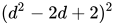
Beck (1988) conjectured that (like the perfect graphs) zero-divisor graphs always have equal clique number and chromatic number. However, this is not true; a counterexample was discovered by Anderson & Naseer (1993).[6]
References
- Anderson, David F.; Axtell, Michael C.; Stickles, Joe A. Jr. (2011), "Zero-divisor graphs in commutative rings", Commutative algebra—Noetherian and non-Noetherian perspectives, Springer, New York, pp. 23–45, doi:10.1007/978-1-4419-6990-3_2, ISBN 978-1-4419-6989-7, MR 2762487
- Beck, István (1988), "Coloring of commutative rings", Journal of Algebra, 116 (1): 208–226, doi:10.1016/0021-8693(88)90202-5, MR 0944156
- Anderson, David F.; Livingston, Philip S. (1999), "The zero-divisor graph of a commutative ring", Journal of Algebra, 217 (2): 434–447, doi:10.1006/jabr.1998.7840, MR 1700509
- Mulay, S. B. (2002), "Cycles and symmetries of zero-divisors", Communications in Algebra, 30 (7): 3533–3558, doi:10.1081/AGB-120004502, MR 1915011
- DeMeyer, Frank; Schneider, Kim (2002), "Automorphisms and zero divisor graphs of commutative rings", Commutative rings, Hauppauge, NY: Nova Science, pp. 25–37, MR 2037656
- Anderson, D. D.; Naseer, M. (1993), "Beck's coloring of a commutative ring", Journal of Algebra, 159 (2): 500–514, doi:10.1006/jabr.1993.1171, MR 1231228