In functional analysis and related areas of mathematics, a barrelled space (also written barreled space) is a topological vector space (TVS) for which every barrelled set in the space is a neighbourhood for the zero vector. A barrelled set or a barrel in a topological vector space is a set that is convex, balanced, absorbing, and closed. Barrelled spaces are studied because a form of the Banach–Steinhaus theorem still holds for them. Barrelled spaces were introduced by Bourbaki (1950).
Barrels
A convex and balanced subset of a real or complex vector space is called a disk and it is said to be disked, absolutely convex, or convex balanced.
A barrel or a barrelled set in a topological vector space (TVS) is a subset that is a closed absorbing disk; that is, a barrel is a convex, balanced, closed, and absorbing subset.
Every barrel must contain the origin. If
dim
X
≥
2
{\displaystyle \dim X\geq 2}


If
X
{\displaystyle X}
Examples of barrels and non-barrels
The closure of any convex, balanced, and absorbing subset is a barrel. This is because the closure of any convex (respectively, any balanced, any absorbing) subset has this same property.
A family of examples: Suppose that
X
{\displaystyle X}


![{\displaystyle R:[0,2\pi )\to (0,\infty ]}](https://wikimedia.org/api/rest_v1/media/math/render/svg/e45b0db59ec2241ebe7b14d47aa5de8ffa461eb8)


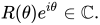
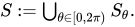



![{\displaystyle (0,\infty ].}](https://wikimedia.org/api/rest_v1/media/math/render/svg/853a49556870b53448d42fda7b8086ac5e35f603)



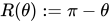





Properties of barrels
- In any topological vector space (TVS)
X
,
{\displaystyle X,}
- In any locally convex Hausdorff TVS
X
,
{\displaystyle X,}
- If
X
{\displaystyle X}
of X ′ {\displaystyle X^{\prime }}
is σ ( X ′ , X ) {\displaystyle \sigma \left(X^{\prime },X\right)}
-bounded if and only if there exists a barrel B {\displaystyle B}
in X {\displaystyle X}
[1]
- Let
(
X
,
Y
,
b
)
{\displaystyle (X,Y,b)}
be a pairing and let ν {\displaystyle \nu }
be a locally convex topology on X {\displaystyle X}
if and only if B {\displaystyle B}
-bounded subset of Y . {\displaystyle Y.}
[1]
- Suppose
M
{\displaystyle M}
is a vector subspace of finite codimension in a locally convex space X {\displaystyle X}
If B {\displaystyle B}
in X {\displaystyle X}
[2]
Characterizations of barreled spaces
Denote by
L
(
X
;
Y
)
{\displaystyle L(X;Y)}

If
(
X
,
τ
)
{\displaystyle (X,\tau )}

-
X
{\displaystyle X}
- Definition: Every barrel in
X
{\displaystyle X}
- This definition is similar to a characterization of Baire TVSs proved by Saxon [1974], who proved that a TVS
Y
{\displaystyle Y}
- This definition is similar to a characterization of Baire TVSs proved by Saxon [1974], who proved that a TVS
Y
{\displaystyle Y}
- For any Hausdorff TVS
Y
{\displaystyle Y}
- For any F-space
Y
{\displaystyle Y}
- An F-space is a complete metrizable TVS.
- Every closed linear operator from
X
{\displaystyle X}
- A linear map
F
:
X
→
Y
{\displaystyle F:X\to Y}
is called closed if its graph is a closed subset of X × Y . {\displaystyle X\times Y.}
- A linear map
F
:
X
→
Y
{\displaystyle F:X\to Y}
- Every Hausdorff TVS topology
ν
{\displaystyle \nu }
-closed set is coarser than τ . {\displaystyle \tau .}
[5]

If
(
X
,
τ
)
{\displaystyle (X,\tau )}
- There exists a TVS
Y
{\displaystyle Y}
) such that every pointwise bounded subset of L ( X ; Y ) {\displaystyle L(X;Y)}
- For any locally convex TVS
Y
,
{\displaystyle Y,}
every pointwise bounded subset of L ( X ; Y ) {\displaystyle L(X;Y)}
- It follows from the above two characterizations that in the class of locally convex TVS, barrelled spaces are exactly those for which the uniform boundedness principle holds.
- Every
σ
(
X
′
,
X
)
{\displaystyle \sigma \left(X^{\prime },X\right)}
-
X
{\displaystyle X}
[2]
- Every lower semicontinuous seminorm on
X
{\displaystyle X}
- Every linear map
F
:
X
→
Y
{\displaystyle F:X\to Y}
- A linear map
F
:
X
→
Y
{\displaystyle F:X\to Y}
of the origin in Y , {\displaystyle Y,}
is a neighborhood of the origin in X . {\displaystyle X.}
- A linear map
F
:
X
→
Y
{\displaystyle F:X\to Y}
- Every surjective linear map
F
:
Y
→
X
{\displaystyle F:Y\to X}
from a locally convex space Y {\displaystyle Y}
- This means that for every neighborhood
V
{\displaystyle V}
is a neighborhood of 0 in X . {\displaystyle X.}
- This means that for every neighborhood
V
{\displaystyle V}
- If
ω
{\displaystyle \omega }
is a locally convex topology on X {\displaystyle X}
has a neighborhood basis at the origin consisting of τ {\displaystyle \tau }
If
X
{\displaystyle X}
- Closed graph theorem: Every closed linear operator
F
:
X
→
Y
{\displaystyle F:X\to Y}
- The linear operator is called closed if its graph is a closed subset of
X
×
Y
.
{\displaystyle X\times Y.}
- The linear operator is called closed if its graph is a closed subset of
X
×
Y
.
{\displaystyle X\times Y.}
- For every subset
A
{\displaystyle A}
of the continuous dual space of X , {\displaystyle X,}
- equicontinuous;
- relatively weakly compact;
- strongly bounded;
- weakly bounded.
- The 0-neighborhood bases in
X
{\displaystyle X}
correspond to each other by polarity.[6]
If
X
{\displaystyle X}
- For any complete metrizable TVS
Y
{\displaystyle Y}
If
X
{\displaystyle X}
- (Property S): The weak* topology on
X
′
{\displaystyle X^{\prime }}
- (Property C): Every weak* bounded subset of
X
′
{\displaystyle X^{\prime }}
- (𝜎-barrelled): Every countable weak* bounded subset of
X
′
{\displaystyle X^{\prime }}
- (Baire-like):
X
{\displaystyle X}
Examples and sufficient conditions
Each of the following topological vector spaces is barreled:
- TVSs that are Baire space.
- Consequently, every topological vector space that is of the second category in itself is barrelled.
- F-spaces, Fréchet spaces, Banach spaces, and Hilbert spaces.
- However, there exist normed vector spaces that are not barrelled. For example, if the
L
p
{\displaystyle L^{p}}
-space L 2 ( [ 0 , 1 ] ) {\displaystyle L^{2}([0,1])}
is topologized as a subspace of L 1 ( [ 0 , 1 ] ) , {\displaystyle L^{1}([0,1]),}
then it is not barrelled.
- However, there exist normed vector spaces that are not barrelled. For example, if the
L
p
{\displaystyle L^{p}}
- Complete pseudometrizable TVSs.[9]
- Consequently, every finite-dimensional TVS is barrelled.
- Montel spaces.
- Strong dual spaces of Montel spaces (since they are necessarily Montel spaces).
- A locally convex quasi-barrelled space that is also a σ-barrelled space.[10]
- A sequentially complete quasibarrelled space.
- A quasi-complete Hausdorff locally convex infrabarrelled space.[2]
- A TVS is called quasi-complete if every closed and bounded subset is complete.
- A TVS with a dense barrelled vector subspace.[2]
- Thus the completion of a barreled space is barrelled.
- A Hausdorff locally convex TVS with a dense infrabarrelled vector subspace.[2]
- Thus the completion of an infrabarrelled Hausdorff locally convex space is barrelled.[2]
- A vector subspace of a barrelled space that has countable codimensional.[2]
- In particular, a finite codimensional vector subspace of a barrelled space is barreled.
- A locally convex ultrabarelled TVS.[11]
- A Hausdorff locally convex TVS
X
{\displaystyle X}
- A locally convex TVS
X
{\displaystyle X}
a closed linear map of X {\displaystyle X}
- A product of a family of barreled spaces.[14]
- A locally convex direct sum and the inductive limit of a family of barrelled spaces.[15]
- A quotient of a barrelled space.[16][15]
- A Hausdorff sequentially complete quasibarrelled boundedly summing TVS.[17]
- A locally convex Hausdorff reflexive space is barrelled.
Counterexamples
- A barrelled space need not be Montel, complete, metrizable, unordered Baire-like, nor the inductive limit of Banach spaces.
- Not all normed spaces are barrelled. However, they are all infrabarrelled.[2]
- A closed subspace of a barreled space is not necessarily countably quasi-barreled (and thus not necessarily barrelled).[18]
- There exists a dense vector subspace of the Fréchet barrelled space
R
N
{\displaystyle \mathbb {R} ^{\mathbb {N} }}
that is not barrelled.[2]
- There exist complete locally convex TVSs that are not barrelled.[2]
- The finest locally convex topology on an infinite-dimensional vector space is a Hausdorff barrelled space that is a meagre subset of itself (and thus not a Baire space).[2]
Properties of barreled spaces
Banach–Steinhaus generalization
The importance of barrelled spaces is due mainly to the following results.
Theorem[19]—Let
X
{\displaystyle X}
-
H
{\displaystyle H}
-
H
{\displaystyle H}
-
H
{\displaystyle H}
The Banach-Steinhaus theorem is a corollary of the above result.[20] When the vector space
Y
{\displaystyle Y}
Theorem[21]—If
X
{\displaystyle X}
-
H
{\displaystyle H}
-
H
{\displaystyle H}
-
H
{\displaystyle H}
-
H
{\displaystyle H}
Recall that a linear map
F
:
X
→
Y
{\displaystyle F:X\to Y}
Closed Graph Theorem[22]—Every closed linear operator from a Hausdorff barrelled TVS into a complete metrizable TVS is continuous.
Other properties
- Every Hausdorff barrelled space is quasi-barrelled.[23]
- A linear map from a barrelled space into a locally convex space is almost continuous.
- A linear map from a locally convex space onto a barrelled space is almost open.
- A separately continuous bilinear map from a product of barrelled spaces into a locally convex space is hypocontinuous.[24]
- A linear map with a closed graph from a barreled TVS into a
B
r
{\displaystyle B_{r}}
-complete TVS is necessarily continuous.[13]
See also
- Barrelled set
- Countably barrelled space
- Distinguished space – TVS whose strong dual is barralled
- Quasibarrelled space
- Ultrabarrelled space
- Uniform boundedness principle#Generalisations – Theorem stating that pointwise boundedness implies uniform boundedness
- Ursescu theorem – Generalization of closed graph, open mapping, and uniform boundedness theorem
- Webbed space – Space where open mapping and closed graph theorems hold
References
- Narici & Beckenstein 2011, pp. 225–273.
- Narici & Beckenstein 2011, pp. 371–423.
- Adasch, Ernst & Keim 1978, p. 39.
- Adasch, Ernst & Keim 1978, p. 43.
- Adasch, Ernst & Keim 1978, p. 32.
- Schaefer & Wolff 1999, pp. 127, 141Trèves 2006, p. 350.
- Narici & Beckenstein 2011, p. 477.
- Narici & Beckenstein 2011, p. 399.
- Narici & Beckenstein 2011, p. 383.
- Khaleelulla 1982, pp. 28–63.
- Narici & Beckenstein 2011, pp. 418–419.
- Trèves 2006, p. 350.
- Schaefer & Wolff 1999, p. 166.
- Schaefer & Wolff 1999, p. 138.
- Schaefer & Wolff 1999, p. 61.
- Trèves 2006, p. 346.
- Adasch, Ernst & Keim 1978, p. 77.
- Schaefer & Wolff 1999, pp. 103–110.
- Trèves 2006, p. 347.
- Trèves 2006, p. 348.
- Trèves 2006, p. 349.
- Adasch, Ernst & Keim 1978, p. 41.
- Adasch, Ernst & Keim 1978, pp. 70–73.
- Trèves 2006, p. 424.
Bibliography
- Adasch, Norbert; Ernst, Bruno; Keim, Dieter (1978). Topological Vector Spaces: The Theory Without Convexity Conditions. Lecture Notes in Mathematics. Vol. 639. Berlin New York: Springer-Verlag. ISBN 978-3-540-08662-8. OCLC 297140003.
- Berberian, Sterling K. (1974). Lectures in Functional Analysis and Operator Theory. Graduate Texts in Mathematics. Vol. 15. New York: Springer. ISBN 978-0-387-90081-0. OCLC 878109401.
- Bourbaki, Nicolas (1950). "Sur certains espaces vectoriels topologiques". Annales de l'Institut Fourier (in French). 2: 5–16 (1951). doi:10.5802/aif.16. MR 0042609.
- Bourbaki, Nicolas (1987) [1981]. Topological Vector Spaces: Chapters 1–5. Éléments de mathématique. Translated by Eggleston, H.G.; Madan, S. Berlin New York: Springer-Verlag. ISBN 3-540-13627-4. OCLC 17499190.
- Conway, John B. (1990). A Course in Functional Analysis. Graduate Texts in Mathematics. Vol. 96 (2nd ed.). New York: Springer-Verlag. ISBN 978-0-387-97245-9. OCLC 21195908.
- Edwards, Robert E. (1995). Functional Analysis: Theory and Applications. New York: Dover Publications. ISBN 978-0-486-68143-6. OCLC 30593138.
- Grothendieck, Alexander (1973). Topological Vector Spaces. Translated by Chaljub, Orlando. New York: Gordon and Breach Science Publishers. ISBN 978-0-677-30020-7. OCLC 886098.
- Husain, Taqdir; Khaleelulla, S. M. (1978). Barrelledness in Topological and Ordered Vector Spaces. Lecture Notes in Mathematics. Vol. 692. Berlin, New York, Heidelberg: Springer-Verlag. ISBN 978-3-540-09096-0. OCLC 4493665.
- Jarchow, Hans (1981). Locally convex spaces. Stuttgart: B.G. Teubner. ISBN 978-3-519-02224-4. OCLC 8210342.
- Khaleelulla, S. M. (1982). Counterexamples in Topological Vector Spaces. Lecture Notes in Mathematics. Vol. 936. Berlin, Heidelberg, New York: Springer-Verlag. ISBN 978-3-540-11565-6. OCLC 8588370.
- Köthe, Gottfried (1983) [1969]. Topological Vector Spaces I. Grundlehren der mathematischen Wissenschaften. Vol. 159. Translated by Garling, D.J.H. New York: Springer Science & Business Media. ISBN 978-3-642-64988-2. MR 0248498. OCLC 840293704.
- Narici, Lawrence; Beckenstein, Edward (2011). Topological Vector Spaces. Pure and applied mathematics (Second ed.). Boca Raton, FL: CRC Press. ISBN 978-1584888666. OCLC 144216834.
- Osborne, Mason Scott (2013). Locally Convex Spaces. Graduate Texts in Mathematics. Vol. 269. Cham Heidelberg New York Dordrecht London: Springer Science & Business Media. ISBN 978-3-319-02045-7. OCLC 865578438.
- Robertson, Alex P.; Robertson, Wendy J. (1980). Topological Vector Spaces. Cambridge Tracts in Mathematics. Vol. 53. Cambridge England: Cambridge University Press. ISBN 978-0-521-29882-7. OCLC 589250.
- Robertson, Alex P.; Robertson, Wendy J. (1964). Topological vector spaces. Cambridge Tracts in Mathematics. Vol. 53. Cambridge University Press. pp. 65–75.
- Schaefer, Helmut H.; Wolff, Manfred P. (1999). Topological Vector Spaces. GTM. Vol. 8 (Second ed.). New York, NY: Springer New York Imprint Springer. ISBN 978-1-4612-7155-0. OCLC 840278135.
- Schechter, Eric (1996). Handbook of Analysis and Its Foundations. San Diego, CA: Academic Press. ISBN 978-0-12-622760-4. OCLC 175294365.
- Swartz, Charles (1992). An introduction to Functional Analysis. New York: M. Dekker. ISBN 978-0-8247-8643-4. OCLC 24909067.
- Trèves, François (2006) [1967]. Topological Vector Spaces, Distributions and Kernels. Mineola, N.Y.: Dover Publications. ISBN 978-0-486-45352-1. OCLC 853623322.
- Voigt, Jürgen (2020). A Course on Topological Vector Spaces. Compact Textbooks in Mathematics. Cham: Birkhäuser Basel. ISBN 978-3-030-32945-7. OCLC 1145563701.
- Wilansky, Albert (2013). Modern Methods in Topological Vector Spaces. Mineola, New York: Dover Publications, Inc. ISBN 978-0-486-49353-4. OCLC 849801114.