Ursescu theorem

☆ Save On Wikipedia ↗

In mathematics, particularly in functional analysis and convex analysis, the Ursescu theorem is a theorem that generalizes the closed graph theorem, the open mapping theorem, and the uniform boundedness principle.

Ursescu theorem

The following notation and notions are used, where R : X ⇉ Y {\displaystyle {\mathcal {R}}:X\rightrightarrows Y} {\displaystyle {\mathcal {R}}:X\rightrightarrows Y} is a set-valued function and S {\displaystyle S} {\displaystyle S} is a non-empty subset of a topological vector space X {\displaystyle X} {\displaystyle X}:

  • the affine span of S {\displaystyle S} {\displaystyle S} is denoted by aff ⁡ S {\displaystyle \operatorname {aff} S} {\displaystyle \operatorname {aff} S} and the linear span is denoted by span ⁡ S . {\displaystyle \operatorname {span} S.} {\displaystyle \operatorname {span} S.}
  • S i := aint X ⁡ S {\displaystyle S^{i}:=\operatorname {aint} _{X}S} {\displaystyle S^{i}:=\operatorname {aint} _{X}S} denotes the algebraic interior of S {\displaystyle S} {\displaystyle S} in X . {\displaystyle X.} {\displaystyle X.}
  • i S := aint aff ⁡ ( S − S ) ⁡ S {\displaystyle {}^{i}S:=\operatorname {aint} _{\operatorname {aff} (S-S)}S} {\displaystyle {}^{i}S:=\operatorname {aint} _{\operatorname {aff} (S-S)}S} denotes the relative algebraic interior of S {\displaystyle S} {\displaystyle S} (i.e. the algebraic interior of S {\displaystyle S} {\displaystyle S} in aff ⁡ ( S − S ) {\displaystyle \operatorname {aff} (S-S)} {\displaystyle \operatorname {aff} (S-S)}).
  • i b S := i S {\displaystyle {}^{ib}S:={}^{i}S} {\displaystyle {}^{ib}S:={}^{i}S} if span ⁡ ( S − s 0 ) {\displaystyle \operatorname {span} \left(S-s_{0}\right)} {\displaystyle \operatorname {span} \left(S-s_{0}\right)} is barreled for some/every s 0 ∈ S {\displaystyle s_{0}\in S} {\displaystyle s_{0}\in S} while i b S := ∅ {\displaystyle {}^{ib}S:=\varnothing } {\displaystyle {}^{ib}S:=\varnothing } otherwise.
    • If S {\displaystyle S} {\displaystyle S} is convex then it can be shown that for any x ∈ X , {\displaystyle x\in X,} {\displaystyle x\in X,} x ∈ i b S {\displaystyle x\in {}^{ib}S} {\displaystyle x\in {}^{ib}S} if and only if the cone generated by S − x {\displaystyle S-x} {\displaystyle S-x} is a barreled linear subspace of X {\displaystyle X} {\displaystyle X} or equivalently, if and only if ∪ n ∈ N n ( S − x ) {\displaystyle \cup _{n\in \mathbb {N} }n(S-x)} {\displaystyle \cup _{n\in \mathbb {N} }n(S-x)} is a barreled linear subspace of X {\displaystyle X} {\displaystyle X}
  • The domain of R {\displaystyle {\mathcal {R}}} {\displaystyle {\mathcal {R}}} is Dom ⁡ R := { x ∈ X : R ( x ) ≠ ∅ } . {\displaystyle \operatorname {Dom} {\mathcal {R}}:=\{x\in X:{\mathcal {R}}(x)\neq \varnothing \}.} {\displaystyle \operatorname {Dom} {\mathcal {R}}:=\{x\in X:{\mathcal {R}}(x)\neq \varnothing \}.}
  • The image of R {\displaystyle {\mathcal {R}}} {\displaystyle {\mathcal {R}}} is Im ⁡ R := ∪ x ∈ X R ( x ) . {\displaystyle \operatorname {Im} {\mathcal {R}}:=\cup _{x\in X}{\mathcal {R}}(x).} {\displaystyle \operatorname {Im} {\mathcal {R}}:=\cup _{x\in X}{\mathcal {R}}(x).} For any subset A ⊆ X , {\displaystyle A\subseteq X,} {\displaystyle A\subseteq X,} R ( A ) := ∪ x ∈ A R ( x ) . {\displaystyle {\mathcal {R}}(A):=\cup _{x\in A}{\mathcal {R}}(x).} {\displaystyle {\mathcal {R}}(A):=\cup _{x\in A}{\mathcal {R}}(x).}
  • The graph of R {\displaystyle {\mathcal {R}}} {\displaystyle {\mathcal {R}}} is gr ⁡ R := { ( x , y ) ∈ X × Y : y ∈ R ( x ) } . {\displaystyle \operatorname {gr} {\mathcal {R}}:=\{(x,y)\in X\times Y:y\in {\mathcal {R}}(x)\}.} {\displaystyle \operatorname {gr} {\mathcal {R}}:=\{(x,y)\in X\times Y:y\in {\mathcal {R}}(x)\}.}
  • R {\displaystyle {\mathcal {R}}} {\displaystyle {\mathcal {R}}} is closed (respectively, convex) if the graph of R {\displaystyle {\mathcal {R}}} {\displaystyle {\mathcal {R}}} is closed (resp. convex) in X × Y . {\displaystyle X\times Y.} {\displaystyle X\times Y.}
    • Note that R {\displaystyle {\mathcal {R}}} {\displaystyle {\mathcal {R}}} is convex if and only if for all x 0 , x 1 ∈ X {\displaystyle x_{0},x_{1}\in X} {\displaystyle x_{0},x_{1}\in X} and all r ∈ [ 0 , 1 ] , {\displaystyle r\in [0,1],} {\displaystyle r\in [0,1],} r R ( x 0 ) + ( 1 − r ) R ( x 1 ) ⊆ R ( r x 0 + ( 1 − r ) x 1 ) . {\displaystyle r{\mathcal {R}}\left(x_{0}\right)+(1-r){\mathcal {R}}\left(x_{1}\right)\subseteq {\mathcal {R}}\left(rx_{0}+(1-r)x_{1}\right).} {\displaystyle r{\mathcal {R}}\left(x_{0}\right)+(1-r){\mathcal {R}}\left(x_{1}\right)\subseteq {\mathcal {R}}\left(rx_{0}+(1-r)x_{1}\right).}
  • The inverse of R {\displaystyle {\mathcal {R}}} {\displaystyle {\mathcal {R}}} is the set-valued function R − 1 : Y ⇉ X {\displaystyle {\mathcal {R}}^{-1}:Y\rightrightarrows X} {\displaystyle {\mathcal {R}}^{-1}:Y\rightrightarrows X} defined by R − 1 ( y ) := { x ∈ X : y ∈ R ( x ) } . {\displaystyle {\mathcal {R}}^{-1}(y):=\{x\in X:y\in {\mathcal {R}}(x)\}.} {\displaystyle {\mathcal {R}}^{-1}(y):=\{x\in X:y\in {\mathcal {R}}(x)\}.} For any subset B ⊆ Y , {\displaystyle B\subseteq Y,} {\displaystyle B\subseteq Y,} R − 1 ( B ) := ∪ y ∈ B R − 1 ( y ) . {\displaystyle {\mathcal {R}}^{-1}(B):=\cup _{y\in B}{\mathcal {R}}^{-1}(y).} {\displaystyle {\mathcal {R}}^{-1}(B):=\cup _{y\in B}{\mathcal {R}}^{-1}(y).}
    • If f : X → Y {\displaystyle f:X\to Y} {\displaystyle f:X\to Y} is a function, then its inverse is the set-valued function f − 1 : Y ⇉ X {\displaystyle f^{-1}:Y\rightrightarrows X} {\displaystyle f^{-1}:Y\rightrightarrows X} obtained from canonically identifying f {\displaystyle f} {\displaystyle f} with the set-valued function f : X ⇉ Y {\displaystyle f:X\rightrightarrows Y} {\displaystyle f:X\rightrightarrows Y} defined by x ↦ { f ( x ) } . {\displaystyle x\mapsto \{f(x)\}.} {\displaystyle x\mapsto \{f(x)\}.}
  • int T ⁡ S {\displaystyle \operatorname {int} _{T}S} {\displaystyle \operatorname {int} _{T}S} is the topological interior of S {\displaystyle S} {\displaystyle S} with respect to T , {\displaystyle T,} {\displaystyle T,} where S ⊆ T . {\displaystyle S\subseteq T.} {\displaystyle S\subseteq T.}
  • rint ⁡ S := int aff ⁡ S ⁡ S {\displaystyle \operatorname {rint} S:=\operatorname {int} _{\operatorname {aff} S}S} {\displaystyle \operatorname {rint} S:=\operatorname {int} _{\operatorname {aff} S}S} is the interior of S {\displaystyle S} {\displaystyle S} with respect to aff ⁡ S . {\displaystyle \operatorname {aff} S.} {\displaystyle \operatorname {aff} S.}

Statement

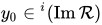
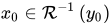
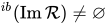
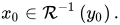
Theorem[1] (Ursescu)Let X {\displaystyle X} {\displaystyle X} be a complete semi-metrizable locally convex topological vector space and R : X ⇉ Y {\displaystyle {\mathcal {R}}:X\rightrightarrows Y} {\displaystyle {\mathcal {R}}:X\rightrightarrows Y} be a closed convex multifunction with non-empty domain. Assume that span ⁡ ( Im ⁡ R − y ) {\displaystyle \operatorname {span} (\operatorname {Im} {\mathcal {R}}-y)} {\displaystyle \operatorname {span} (\operatorname {Im} {\mathcal {R}}-y)} is a barrelled space for some/every y ∈ Im ⁡ R . {\displaystyle y\in \operatorname {Im} {\mathcal {R}}.} {\displaystyle y\in \operatorname {Im} {\mathcal {R}}.} Assume that y 0 ∈ i ( Im ⁡ R ) {\displaystyle y_{0}\in {}^{i}(\operatorname {Im} {\mathcal {R}})} {\displaystyle y_{0}\in {}^{i}(\operatorname {Im} {\mathcal {R}})} and let x 0 ∈ R − 1 ( y 0 ) {\displaystyle x_{0}\in {\mathcal {R}}^{-1}\left(y_{0}\right)} {\displaystyle x_{0}\in {\mathcal {R}}^{-1}\left(y_{0}\right)} (so that y 0 ∈ R ( x 0 ) {\displaystyle y_{0}\in {\mathcal {R}}\left(x_{0}\right)} {\displaystyle y_{0}\in {\mathcal {R}}\left(x_{0}\right)}). Then for every neighborhood U {\displaystyle U} {\displaystyle U} of x 0 {\displaystyle x_{0}} {\displaystyle x_{0}} in X , {\displaystyle X,} {\displaystyle X,} y 0 {\displaystyle y_{0}} {\displaystyle y_{0}} belongs to the relative interior of R ( U ) {\displaystyle {\mathcal {R}}(U)} {\displaystyle {\mathcal {R}}(U)} in aff ⁡ ( Im ⁡ R ) {\displaystyle \operatorname {aff} (\operatorname {Im} {\mathcal {R}})} {\displaystyle \operatorname {aff} (\operatorname {Im} {\mathcal {R}})} (that is, y 0 ∈ int aff ⁡ ( Im ⁡ R ) ⁡ R ( U ) {\displaystyle y_{0}\in \operatorname {int} _{\operatorname {aff} (\operatorname {Im} {\mathcal {R}})}{\mathcal {R}}(U)} {\displaystyle y_{0}\in \operatorname {int} _{\operatorname {aff} (\operatorname {Im} {\mathcal {R}})}{\mathcal {R}}(U)}). In particular, if i b ( Im ⁡ R ) ≠ ∅ {\displaystyle {}^{ib}(\operatorname {Im} {\mathcal {R}})\neq \varnothing } {\displaystyle {}^{ib}(\operatorname {Im} {\mathcal {R}})\neq \varnothing } then i b ( Im ⁡ R ) = i ( Im ⁡ R ) = rint ⁡ ( Im ⁡ R ) . {\displaystyle {}^{ib}(\operatorname {Im} {\mathcal {R}})={}^{i}(\operatorname {Im} {\mathcal {R}})=\operatorname {rint} (\operatorname {Im} {\mathcal {R}}).} {\displaystyle {}^{ib}(\operatorname {Im} {\mathcal {R}})={}^{i}(\operatorname {Im} {\mathcal {R}})=\operatorname {rint} (\operatorname {Im} {\mathcal {R}}).}

Corollaries

Closed graph theorem

Closed graph theoremLet X {\displaystyle X} {\displaystyle X} and Y {\displaystyle Y} {\displaystyle Y} be Fréchet spaces and T : X → Y {\displaystyle T:X\to Y} {\displaystyle T:X\to Y} be a linear map. Then T {\displaystyle T} {\displaystyle T} is continuous if and only if the graph of T {\displaystyle T} {\displaystyle T} is closed in X × Y . {\displaystyle X\times Y.} {\displaystyle X\times Y.}

Proof

For the non-trivial direction, assume that the graph of T {\displaystyle T} {\displaystyle T} is closed and let R := T − 1 : Y ⇉ X . {\displaystyle {\mathcal {R}}:=T^{-1}:Y\rightrightarrows X.} {\displaystyle {\mathcal {R}}:=T^{-1}:Y\rightrightarrows X.} It is easy to see that gr ⁡ R {\displaystyle \operatorname {gr} {\mathcal {R}}} {\displaystyle \operatorname {gr} {\mathcal {R}}} is closed and convex and that its image is X . {\displaystyle X.} {\displaystyle X.} Given x ∈ X , {\displaystyle x\in X,} {\displaystyle x\in X,} ( T x , x ) {\displaystyle (Tx,x)} {\displaystyle (Tx,x)} belongs to Y × X {\displaystyle Y\times X} {\displaystyle Y\times X} so that for every open neighborhood V {\displaystyle V} {\displaystyle V} of T x {\displaystyle Tx} {\displaystyle Tx} in Y , {\displaystyle Y,} {\displaystyle Y,} R ( V ) = T − 1 ( V ) {\displaystyle {\mathcal {R}}(V)=T^{-1}(V)} {\displaystyle {\mathcal {R}}(V)=T^{-1}(V)} is a neighborhood of x {\displaystyle x} {\displaystyle x} in X . {\displaystyle X.} {\displaystyle X.} Thus T {\displaystyle T} {\displaystyle T} is continuous at x . {\displaystyle x.} {\displaystyle x.} Q.E.D.

Uniform boundedness principle

Uniform boundedness principleLet X {\displaystyle X} {\displaystyle X} and Y {\displaystyle Y} {\displaystyle Y} be Fréchet spaces and T : X → Y {\displaystyle T:X\to Y} {\displaystyle T:X\to Y} be a bijective linear map. Then T {\displaystyle T} {\displaystyle T} is continuous if and only if T − 1 : Y → X {\displaystyle T^{-1}:Y\to X} {\displaystyle T^{-1}:Y\to X} is continuous. Furthermore, if T {\displaystyle T} {\displaystyle T} is continuous then T {\displaystyle T} {\displaystyle T} is an isomorphism of Fréchet spaces.

Proof

Apply the closed graph theorem to T {\displaystyle T} {\displaystyle T} and T − 1 . {\displaystyle T^{-1}.} {\displaystyle T^{-1}.} Q.E.D.

Open mapping theorem

Open mapping theoremLet X {\displaystyle X} {\displaystyle X} and Y {\displaystyle Y} {\displaystyle Y} be Fréchet spaces and T : X → Y {\displaystyle T:X\to Y} {\displaystyle T:X\to Y} be a continuous surjective linear map. Then T is an open map.

Proof

Clearly, T {\displaystyle T} {\displaystyle T} is a closed and convex relation whose image is Y . {\displaystyle Y.} {\displaystyle Y.} Let U {\displaystyle U} {\displaystyle U} be a non-empty open subset of X , {\displaystyle X,} {\displaystyle X,} let y {\displaystyle y} {\displaystyle y} be in T ( U ) , {\displaystyle T(U),} {\displaystyle T(U),} and let x {\displaystyle x} {\displaystyle x} in U {\displaystyle U} {\displaystyle U} be such that y = T x . {\displaystyle y=Tx.} {\displaystyle y=Tx.} From the Ursescu theorem it follows that T ( U ) {\displaystyle T(U)} {\displaystyle T(U)} is a neighborhood of y . {\displaystyle y.} {\displaystyle y.} Q.E.D.

Additional corollaries

The following notation and notions are used for these corollaries, where R : X ⇉ Y {\displaystyle {\mathcal {R}}:X\rightrightarrows Y} {\displaystyle {\mathcal {R}}:X\rightrightarrows Y} is a set-valued function, S {\displaystyle S} {\displaystyle S} is a non-empty subset of a topological vector space X {\displaystyle X} {\displaystyle X}:

  • a convex series with elements of S {\displaystyle S} {\displaystyle S} is a series of the form ∑ i = 1 ∞ r i s i {\textstyle \sum _{i=1}^{\infty }r_{i}s_{i}} {\textstyle \sum _{i=1}^{\infty }r_{i}s_{i}} where all s i ∈ S {\displaystyle s_{i}\in S} {\displaystyle s_{i}\in S} and ∑ i = 1 ∞ r i = 1 {\textstyle \sum _{i=1}^{\infty }r_{i}=1} {\textstyle \sum _{i=1}^{\infty }r_{i}=1} is a series of non-negative numbers. If ∑ i = 1 ∞ r i s i {\textstyle \sum _{i=1}^{\infty }r_{i}s_{i}} {\textstyle \sum _{i=1}^{\infty }r_{i}s_{i}} converges then the series is called convergent while if ( s i ) i = 1 ∞ {\displaystyle \left(s_{i}\right)_{i=1}^{\infty }} {\displaystyle \left(s_{i}\right)_{i=1}^{\infty }} is bounded then the series is called bounded and b-convex.
  • S {\displaystyle S} {\displaystyle S} is ideally convex if any convergent b-convex series of elements of S {\displaystyle S} {\displaystyle S} has its sum in S . {\displaystyle S.} {\displaystyle S.}
  • S {\displaystyle S} {\displaystyle S} is lower ideally convex if there exists a Fréchet space Y {\displaystyle Y} {\displaystyle Y} such that S {\displaystyle S} {\displaystyle S} is equal to the projection onto X {\displaystyle X} {\displaystyle X} of some ideally convex subset B of X × Y . {\displaystyle X\times Y.} {\displaystyle X\times Y.} Every ideally convex set is lower ideally convex.

CorollaryLet X {\displaystyle X} {\displaystyle X} be a barreled first countable space and let C {\displaystyle C} {\displaystyle C} be a subset of X . {\displaystyle X.} {\displaystyle X.} Then:

  1. If C {\displaystyle C} {\displaystyle C} is lower ideally convex then C i = int ⁡ C . {\displaystyle C^{i}=\operatorname {int} C.} {\displaystyle C^{i}=\operatorname {int} C.}
  2. If C {\displaystyle C} {\displaystyle C} is ideally convex then C i = int ⁡ C = int ⁡ ( cl ⁡ C ) = ( cl ⁡ C ) i . {\displaystyle C^{i}=\operatorname {int} C=\operatorname {int} \left(\operatorname {cl} C\right)=\left(\operatorname {cl} C\right)^{i}.} {\displaystyle C^{i}=\operatorname {int} C=\operatorname {int} \left(\operatorname {cl} C\right)=\left(\operatorname {cl} C\right)^{i}.}

Simons' theorem

Simons' theorem[2]Let X {\displaystyle X} {\displaystyle X} and Y {\displaystyle Y} {\displaystyle Y} be first countable with X {\displaystyle X} {\displaystyle X} locally convex. Suppose that R : X ⇉ Y {\displaystyle {\mathcal {R}}:X\rightrightarrows Y} {\displaystyle {\mathcal {R}}:X\rightrightarrows Y} is a multimap with non-empty domain that satisfies condition (Hwx) or else assume that X {\displaystyle X} {\displaystyle X} is a Fréchet space and that R {\displaystyle {\mathcal {R}}} {\displaystyle {\mathcal {R}}} is lower ideally convex. Assume that span ⁡ ( Im ⁡ R − y ) {\displaystyle \operatorname {span} (\operatorname {Im} {\mathcal {R}}-y)} {\displaystyle \operatorname {span} (\operatorname {Im} {\mathcal {R}}-y)} is barreled for some/every y ∈ Im ⁡ R . {\displaystyle y\in \operatorname {Im} {\mathcal {R}}.} {\displaystyle y\in \operatorname {Im} {\mathcal {R}}.} Assume that y 0 ∈ i ( Im ⁡ R ) {\displaystyle y_{0}\in {}^{i}(\operatorname {Im} {\mathcal {R}})} {\displaystyle y_{0}\in {}^{i}(\operatorname {Im} {\mathcal {R}})} and let x 0 ∈ R − 1 ( y 0 ) . {\displaystyle x_{0}\in {\mathcal {R}}^{-1}\left(y_{0}\right).} {\displaystyle x_{0}\in {\mathcal {R}}^{-1}\left(y_{0}\right).} Then for every neighborhood U {\displaystyle U} {\displaystyle U} of x 0 {\displaystyle x_{0}} {\displaystyle x_{0}} in X , {\displaystyle X,} {\displaystyle X,} y 0 {\displaystyle y_{0}} {\displaystyle y_{0}} belongs to the relative interior of R ( U ) {\displaystyle {\mathcal {R}}(U)} {\displaystyle {\mathcal {R}}(U)} in aff ⁡ ( Im ⁡ R ) {\displaystyle \operatorname {aff} (\operatorname {Im} {\mathcal {R}})} {\displaystyle \operatorname {aff} (\operatorname {Im} {\mathcal {R}})} (i.e. y 0 ∈ int aff ⁡ ( Im ⁡ R ) ⁡ R ( U ) {\displaystyle y_{0}\in \operatorname {int} _{\operatorname {aff} (\operatorname {Im} {\mathcal {R}})}{\mathcal {R}}(U)} {\displaystyle y_{0}\in \operatorname {int} _{\operatorname {aff} (\operatorname {Im} {\mathcal {R}})}{\mathcal {R}}(U)}). In particular, if i b ( Im ⁡ R ) ≠ ∅ {\displaystyle {}^{ib}(\operatorname {Im} {\mathcal {R}})\neq \varnothing } {\displaystyle {}^{ib}(\operatorname {Im} {\mathcal {R}})\neq \varnothing } then i b ( Im ⁡ R ) = i ( Im ⁡ R ) = rint ⁡ ( Im ⁡ R ) . {\displaystyle {}^{ib}(\operatorname {Im} {\mathcal {R}})={}^{i}(\operatorname {Im} {\mathcal {R}})=\operatorname {rint} (\operatorname {Im} {\mathcal {R}}).} {\displaystyle {}^{ib}(\operatorname {Im} {\mathcal {R}})={}^{i}(\operatorname {Im} {\mathcal {R}})=\operatorname {rint} (\operatorname {Im} {\mathcal {R}}).}

Robinson–Ursescu theorem

The implication (1) ⟹ {\displaystyle \implies } {\displaystyle \implies } (2) in the following theorem is known as the Robinson–Ursescu theorem.[3]

Robinson–Ursescu theorem[3]Let ( X , ‖ ⋅ ‖ ) {\displaystyle (X,\|\,\cdot \,\|)} {\displaystyle (X,\|\,\cdot \,\|)} and ( Y , ‖ ⋅ ‖ ) {\displaystyle (Y,\|\,\cdot \,\|)} {\displaystyle (Y,\|\,\cdot \,\|)} be normed spaces and R : X ⇉ Y {\displaystyle {\mathcal {R}}:X\rightrightarrows Y} {\displaystyle {\mathcal {R}}:X\rightrightarrows Y} be a multimap with non-empty domain. Suppose that Y {\displaystyle Y} {\displaystyle Y} is a barreled space, the graph of R {\displaystyle {\mathcal {R}}} {\displaystyle {\mathcal {R}}} verifies condition condition (Hwx), and that ( x 0 , y 0 ) ∈ gr ⁡ R . {\displaystyle (x_{0},y_{0})\in \operatorname {gr} {\mathcal {R}}.} {\displaystyle (x_{0},y_{0})\in \operatorname {gr} {\mathcal {R}}.} Let C X {\displaystyle C_{X}} {\displaystyle C_{X}} (resp. C Y {\displaystyle C_{Y}} {\displaystyle C_{Y}}) denote the closed unit ball in X {\displaystyle X} {\displaystyle X} (resp. Y {\displaystyle Y} {\displaystyle Y}) (so C X = { x ∈ X : ‖ x ‖ ≤ 1 } {\displaystyle C_{X}=\{x\in X:\|x\|\leq 1\}} {\displaystyle C_{X}=\{x\in X:\|x\|\leq 1\}}). Then the following are equivalent:

  1. y 0 {\displaystyle y_{0}} {\displaystyle y_{0}} belongs to the algebraic interior of Im ⁡ R . {\displaystyle \operatorname {Im} {\mathcal {R}}.} {\displaystyle \operatorname {Im} {\mathcal {R}}.}
  2. y 0 ∈ int ⁡ R ( x 0 + C X ) . {\displaystyle y_{0}\in \operatorname {int} {\mathcal {R}}\left(x_{0}+C_{X}\right).} {\displaystyle y_{0}\in \operatorname {int} {\mathcal {R}}\left(x_{0}+C_{X}\right).}
  3. There exists B > 0 {\displaystyle B>0} {\displaystyle B>0} such that for all 0 ≤ r ≤ 1 , {\displaystyle 0\leq r\leq 1,} {\displaystyle 0\leq r\leq 1,} y 0 + B r C Y ⊆ R ( x 0 + r C X ) . {\displaystyle y_{0}+BrC_{Y}\subseteq {\mathcal {R}}\left(x_{0}+rC_{X}\right).} {\displaystyle y_{0}+BrC_{Y}\subseteq {\mathcal {R}}\left(x_{0}+rC_{X}\right).}
  4. There exist A > 0 {\displaystyle A>0} {\displaystyle A>0} and B > 0 {\displaystyle B>0} {\displaystyle B>0} such that for all x ∈ x 0 + A C X {\displaystyle x\in x_{0}+AC_{X}} {\displaystyle x\in x_{0}+AC_{X}} and all y ∈ y 0 + A C Y , {\displaystyle y\in y_{0}+AC_{Y},} {\displaystyle y\in y_{0}+AC_{Y},} d ( x , R − 1 ( y ) ) ≤ B ⋅ d ( y , R ( x ) ) . {\displaystyle d\left(x,{\mathcal {R}}^{-1}(y)\right)\leq B\cdot d(y,{\mathcal {R}}(x)).} {\displaystyle d\left(x,{\mathcal {R}}^{-1}(y)\right)\leq B\cdot d(y,{\mathcal {R}}(x)).}
  5. There exists B > 0 {\displaystyle B>0} {\displaystyle B>0} such that for all x ∈ X {\displaystyle x\in X} {\displaystyle x\in X} and all y ∈ y 0 + B C Y , {\displaystyle y\in y_{0}+BC_{Y},} {\displaystyle y\in y_{0}+BC_{Y},} d ( x , R − 1 ( y ) ) ≤ 1 + ‖ x − x 0 ‖ B − ‖ y − y 0 ‖ ⋅ d ( y , R ( x ) ) . {\displaystyle d\left(x,{\mathcal {R}}^{-1}(y)\right)\leq {\frac {1+\left\|x-x_{0}\right\|}{B-\left\|y-y_{0}\right\|}}\cdot d(y,{\mathcal {R}}(x)).} {\displaystyle d\left(x,{\mathcal {R}}^{-1}(y)\right)\leq {\frac {1+\left\|x-x_{0}\right\|}{B-\left\|y-y_{0}\right\|}}\cdot d(y,{\mathcal {R}}(x)).}


See also

Notes

  1. Zălinescu 2002, p. 23.
  2. Zălinescu 2002, p. 22-23.
  3. Zălinescu 2002, p. 24.

References