This is a glossary of some terms used in Riemannian geometry and metric geometry — it doesn't cover the terminology of differential topology.
The following articles may also be useful; they either contain specialised vocabulary or provide more detailed expositions of the definitions given below.
See also:
- Glossary of general topology
- Glossary of differential geometry and topology
- List of differential geometry topics
Unless stated otherwise, letters X, Y, Z below denote metric spaces, M, N denote Riemannian manifolds, |xy| or
|
x
y
|
X
{\displaystyle |xy|_{X}}

A caveat: many terms in Riemannian and metric geometry, such as convex function, convex set and others, do not have exactly the same meaning as in general mathematical usage.
A
Alexandrov space a generalization of Riemannian manifolds with upper, lower or integral curvature bounds (the last one works only in dimension 2).
Arc-wise isometry the same as path isometry.
Autoparallel the same as totally geodesic.[1]
B
Barycenter, see center of mass.
Bi-Lipschitz map. A map
f
:
X
→
Y
{\displaystyle f:X\to Y}

-
c
|
x
y
|
X
≤
|
f
(
x
)
f
(
y
)
|
Y
≤
C
|
x
y
|
X
.
{\displaystyle c|xy|_{X}\leq |f(x)f(y)|_{Y}\leq C|xy|_{X}.}

Boundary at infinity. In general, a construction that may be regarded as a space of directions at infinity. For geometric examples, see for instance hyperbolic boundary, Gromov boundary, visual boundary, Tits boundary, Thurston boundary. See also projective space and compactification.
Busemann function given a ray, γ : [0, ∞)→X, the Busemann function is defined by
B
γ
(
p
)
=
lim
t
→
∞
(
|
γ
(
t
)
−
p
|
−
t
)
.
{\displaystyle B_{\gamma }(p)=\lim _{t\to \infty }(|\gamma (t)-p|-t).}

C
Cartan-Hadamard space is a complete, simply-connected, non-positively curved Riemannian manifold.
Cartan–Hadamard theorem is the statement that a connected, simply connected complete Riemannian manifold with non-positive sectional curvature is diffeomorphic to Rn via the exponential map; for metric spaces, the statement that a connected, simply connected complete geodesic metric space with non-positive curvature in the sense of Alexandrov is a (globally) CAT(0) space.
Cartan (Élie) The mathematician after whom Cartan-Hadamard manifolds, Cartan subalgebras, and Cartan connections are named (not to be confused with his son Henri Cartan).
C
A
T
(
κ
)
{\textstyle CAT(\kappa )}

Center of mass. A point
q
∈
M
{\textstyle q\in M}


-
f
(
x
)
=
∑
i
|
p
i
x
|
2
.
{\displaystyle f(x)=\sum _{i}|p_{i}x|^{2}.}

Such a point is unique if all distances
|
p
i
p
j
|
{\displaystyle |p_{i}p_{j}|}

Complete manifold According to the Riemannian Hopf-Rinow theorem, a Riemannian manifold is complete as a metric space, if and only if all geodesics can be infinitely extended.
Conformal map is a map which preserves angles.
Conformally flat a manifold M is conformally flat if it is locally conformally equivalent to a Euclidean space, for example standard sphere is conformally flat.
Conjugate points two points p and q on a geodesic
γ
{\displaystyle \gamma }

Convex function. A function f on a Riemannian manifold is a convex if for any geodesic
γ
{\displaystyle \gamma }


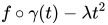
Convex A subset K of a Riemannian manifold M is called convex if for any two points in K there is a unique shortest path connecting them which lies entirely in K, see also totally convex.
Convexity radius at a point
p
{\textstyle p}

D
Diameter of a metric space is the supremum of distances between pairs of points.
Developable surface is a surface isometric to the plane.
Dilation same as Lipschitz constant.
E
Exponential map Exponential map (Lie theory), Exponential map (Riemannian geometry)
F
Finsler metric A generalization of Riemannian manifolds where the scalar product on the tangent space is replaced by a norm.
First fundamental form for an embedding or immersion is the pullback of the metric tensor.
G
Geodesic is a curve which locally minimizes distance.
Geodesic equation is the differential equation whose local solutions are the geodesics.
Geodesic flow is a flow on a tangent bundle TM of a manifold M, generated by a vector field whose trajectories are of the form
(
γ
(
t
)
,
γ
′
(
t
)
)
{\displaystyle (\gamma (t),\gamma '(t))}

Gromov-hyperbolic metric space
Geodesic metric space is a metric space where any two points are the endpoints of a minimizing geodesic.
H
Hadamard space is a complete simply connected space with nonpositive curvature.
Holonomy group is the subgroup of isometries of the tangent space obtained as parallel transport along closed curves.
Horosphere a level set of Busemann function.
Hyperbolic geometry (see also Riemannian hyperbolic space)
I
Injectivity radius The injectivity radius at a point p of a Riemannian manifold is the supremum of radii for which the exponential map at p is a diffeomorphism. The injectivity radius of a Riemannian manifold is the infimum of the injectivity radii at all points.[5] See also cut locus.
For complete manifolds, if the injectivity radius at p is a finite number r, then either there is a geodesic of length 2r which starts and ends at p or there is a point q conjugate to p (see conjugate point above) and on the distance r from p.[6] For a closed Riemannian manifold the injectivity radius is either half the minimal length of a closed geodesic or the minimal distance between conjugate points on a geodesic.
Infranilmanifold Given a simply connected nilpotent Lie group N acting on itself by left multiplication and a finite group of automorphisms F of N one can define an action of the semidirect product
N
⋊
F
{\displaystyle N\rtimes F}


Isometric embedding is an embedding preserving the Riemannian metric.
Isometry is a surjective map which preserves distances.
Isoperimetric function of a metric space
X
{\textstyle X}

J
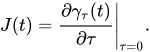
Jacobi field A Jacobi field is a vector field on a geodesic γ which can be obtained on the following way: Take a smooth one parameter family of geodesics
γ
τ
{\displaystyle \gamma _{\tau }}


-
J
(
t
)
=
∂
γ
τ
(
t
)
∂
τ
|
τ
=
0
.
{\displaystyle J(t)=\left.{\frac {\partial \gamma _{\tau }(t)}{\partial \tau }}\right|_{\tau =0}.}
K
L
Length metric the same as intrinsic metric.
Levi-Civita connection is a natural way to differentiate vector fields on Riemannian manifolds.
Lipschitz constant of a map is the infimum of numbers L such that the given map is L-Lipschitz.
Lipschitz convergence the convergence of metric spaces defined by Lipschitz distance.
Lipschitz distance between metric spaces is the infimum of numbers r such that there is a bijective bi-Lipschitz map between these spaces with constants exp(-r), exp(r).[9]
Logarithmic map, or logarithm, is a right inverse of Exponential map.[10][11]
M
Minimal surface is a submanifold with (vector of) mean curvature zero.
Mostow's rigidity In dimension
≥
3
{\textstyle \geq 3}

N
Natural parametrization is the parametrization by length.[12]
Net A subset S of a metric space X is called
ϵ
{\textstyle \epsilon }


Nilmanifold: An element of the minimal set of manifolds which includes a point, and has the following property: any oriented
S
1
{\displaystyle S^{1}}

Normal bundle: associated to an embedding of a manifold M into an ambient Euclidean space
R
N
{\textstyle {\mathbb {R} }^{N}}


Nonexpanding map same as short map.
O
Orthonormal frame bundle is the bundle of bases of the tangent space that are orthonormal for the Riemannian metric.
P
Polyhedral space a simplicial complex with a metric such that each simplex with induced metric is isometric to a simplex in Euclidean space.
Principal curvature is the maximum and minimum normal curvatures at a point on a surface.
Principal direction is the direction of the principal curvatures.
Proper metric space is a metric space in which every closed ball is compact. Equivalently, if every closed bounded subset is compact. Every proper metric space is complete.[14]
Q
Quasi-convex subspace of a metric space
X
{\textstyle X}


![{\textstyle [y,y']}](https://wikimedia.org/api/rest_v1/media/math/render/svg/0e2bde3957d7a803c920714de32591a5d266c308)
![{\textstyle z\in [y,y']}](https://wikimedia.org/api/rest_v1/media/math/render/svg/625ba2f7078116f17619abb6839dc25c48ee86d1)

Quasigeodesic has two meanings; here we give the most common. A map
f
:
I
→
Y
{\displaystyle f:I\to Y}


-
1
K
d
(
x
,
y
)
−
C
≤
d
(
f
(
x
)
,
f
(
y
)
)
≤
K
d
(
x
,
y
)
+
C
.
{\displaystyle {1 \over K}d(x,y)-C\leq d(f(x),f(y))\leq Kd(x,y)+C.}

Note that a quasigeodesic is not necessarily a continuous curve.
Quasi-isometry. A map
f
:
X
→
Y
{\displaystyle f:X\to Y}
-
1
K
d
(
x
,
y
)
−
C
≤
d
(
f
(
x
)
,
f
(
y
)
)
≤
K
d
(
x
,
y
)
+
C
.
{\displaystyle {1 \over K}d(x,y)-C\leq d(f(x),f(y))\leq Kd(x,y)+C.}
and every point in Y has distance at most C from some point of f(X). Note that a quasi-isometry is not assumed to be continuous. For example, any map between compact metric spaces is a quasi isometry. If there exists a quasi-isometry from X to Y, then X and Y are said to be quasi-isometric.
R
Radius of metric space is the infimum of radii of metric balls which contain the space completely.[16]
Ray is a one side infinite geodesic which is minimizing on each interval.[17]
Riemann The mathematician after whom Riemannian geometry is named.
Riemann curvature tensor is often defined as the (4, 0)-tensor of the tangent bundle of a Riemannian manifold
(
M
,
g
)
{\textstyle (M,g)}

![{\displaystyle R_{p}(X,Y,Z)W={g_{p}({\nabla _{X}\nabla _{Y}Z-\nabla _{Y}\nabla _{X}Z-\nabla _{[X,Y]}Z,W})},}](https://wikimedia.org/api/rest_v1/media/math/render/svg/ec2c9da51c8d3431192a550610b90c64aa75d141)


Riemannian submanifold A differentiable sub-manifold whose Riemannian metric is the restriction of the ambient Riemannian metric (not to be confused with sub-Riemannian manifold).
Riemannian submersion is a map between Riemannian manifolds which is submersion and submetry at the same time.
S
Second fundamental form is a quadratic form on the tangent space of hypersurface, usually denoted by II, an equivalent way to describe the shape operator of a hypersurface,
-
II
(
v
,
w
)
=
⟨
S
(
v
)
,
w
⟩
.
{\displaystyle {\text{II}}(v,w)=\langle S(v),w\rangle .}

It can be also generalized to arbitrary codimension, in which case it is a quadratic form with values in the normal space.
Sectional curvature at a point
p
{\textstyle p}


![{\textstyle R_{p}(X,Y,Z)W={g_{p}({\nabla _{X}\nabla _{Y}Z-\nabla _{Y}\nabla _{X}Z-\nabla _{[X,Y]}Z,W})}}](https://wikimedia.org/api/rest_v1/media/math/render/svg/7c8e0966f2568e2429337748d2327e937cf86872)

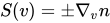
Shape operator for a hypersurface M is a linear operator on tangent spaces, Sp: TpM→TpM. If n is a unit normal field to M and v is a tangent vector then
-
S
(
v
)
=
±
∇
v
n
{\displaystyle S(v)=\pm \nabla _{v}n}
(there is no standard agreement whether to use + or − in the definition).
Short map is a distance non increasing map.
Sol manifold is a factor of a connected solvable Lie group by a lattice.
Submetry A short map f between metric spaces is called a submetry[18] if there exists R > 0 such that for any point x and radius r < R the image of metric r-ball is an r-ball, i.e.
f
(
B
r
(
x
)
)
=
B
r
(
f
(
x
)
)
.
{\displaystyle f(B_{r}(x))=B_{r}(f(x)).}

Symmetric space Riemannian symmetric spaces are Riemannian manifolds in which the geodesic reflection at any point is an isometry. They turn out to be quotients of a real Lie group by a maximal compact subgroup whose Lie algebra is the fixed subalgebra of the involution obtained by differentiating the geodesic symmetry. This algebraic data is enough to provide a classification of the Riemannian symmetric spaces.
Systole The k-systole of M,
s
y
s
t
k
(
M
)
{\textstyle syst_{k}(M)}

T
Thurston's geometries The eight 3-dimensional geometries predicted by Thurston's geometrization conjecture, proved by Perelman:
S
3
{\textstyle \mathbb {S} ^{3}}


Totally convex A subset K of a Riemannian manifold M is called totally convex if for any two points in K any geodesic connecting them lies entirely in K, see also convex.[19]
Totally geodesic submanifold is a submanifold such that all geodesics in the submanifold are also geodesics of the surrounding manifold.[20]
U
Uniquely geodesic metric space is a metric space where any two points are the endpoints of a unique minimizing geodesic.
V
W
Word metric on a group is a metric of the Cayley graph constructed using a set of generators.
References
- Kobayashi, Shōshichi; Nomizu, Katsumi (1963). "Chapter VII Submanifolds, 8. Autoparallel submanifolds and totally geodesic submanifolds". Foundations of differential geometry. Interscience Publishers, New York, NY. pp. 53–62. ISBN 978-0-471-15732-8. Zbl 0175.48504.
{{cite book}}: ISBN / Date incompatibility (help) - Mancinelli, Claudio; Puppo, Enrico (2023-06-01). "Computing the Riemannian center of mass on meshes". Computer Aided Geometric Design. 103 102203. doi:10.1016/j.cagd.2023.102203. ISSN 0167-8396.
- Gallot, Sylvestre; Hulin, Dominique; Lafontaine, Jacques (2004), "Riemannian metrics", in Gallot, Sylvestre; Hulin, Dominique; Lafontaine, Jacques (eds.), Riemannian Geometry, Berlin, Heidelberg: Springer, Remark after Proof of Corollary 2.89, p.87, doi:10.1007/978-3-642-18855-8_2, ISBN 978-3-642-18855-8, retrieved 2024-11-28
- Petersen, Peter (2016), "Sectional Curvature Comparison I", in Petersen, Peter (ed.), Riemannian Geometry, Graduate Texts in Mathematics, vol. 171, Cham: Springer International Publishing, Theorem 6.4.8, pp. 258-259, doi:10.1007/978-3-319-26654-1_6, ISBN 978-3-319-26654-1, retrieved 2024-11-29
- Lee, Jeffrey M. (2009). "13. Riemannian and Semi-Riemannian Geometry, Definition 13.141". Manifolds and differential geometry. Providence, RI: American Mathematical Society (AMS). p. 615. ISBN 978-0-8218-4815-9. Zbl 1190.58001.
- Gallot, Sylvestre; Hulin, Dominique; Lafontaine, Jacques (2004), "Curvature", in Gallot, Sylvestre; Hulin, Dominique; Lafontaine, Jacques (eds.), Riemannian Geometry, Berlin, Heidelberg: Springer, Scholium 3.78, doi:10.1007/978-3-642-18855-8_3, ISBN 978-3-642-18855-8, retrieved 2024-11-28
- Hirsch, Morris W. (1970). "Expanding maps and transformation groups". Global Analysis. Proceedings of Symposia in Pure Mathematics. Vol. 14. pp. 125–131. doi:10.1090/pspum/014/0298701. ISBN 978-0-8218-1414-7. Zbl 0223.58009.
- Bridson, Martin R.; Haefliger, André (1999), "δ-Hyperbolic Spaces and Area", in Bridson, Martin R.; Haefliger, André (eds.), Metric Spaces of Non-Positive Curvature, Berlin, Heidelberg: Springer, 2. Area and isoperimetric inequalities, pp. 414 – 417, doi:10.1007/978-3-662-12494-9_21, ISBN 978-3-662-12494-9, retrieved 2024-12-23
- Burago, Dmitri; Burago, Yurii; Ivanov, Sergei (2001). A course in metric geometry. Providence, RI: American Mathematical Society (AMS). Chapter 7, §7.2, pp. 249-250. ISBN 0-8218-2129-6. Zbl 0981.51016.
- Burago, Dmitri; Burago, Yurii; Ivanov, Sergei (2001). A course in metric geometry. Providence, RI: American Mathematical Society (AMS). Chapter 9, §9.1, pp. 321-322. ISBN 0-8218-2129-6. Zbl 0981.51016.
- Lang, Serge (1999). "Fundamentals of Differential Geometry". Graduate Texts in Mathematics. 191. Chapter XII An example of seminegative curvature, p. 323. doi:10.1007/978-1-4612-0541-8. ISBN 978-1-4612-6810-9. ISSN 0072-5285.
- Burago, Dmitri; Burago, Yurii; Ivanov, Sergei (2001). A course in metric geometry. Providence, RI: American Mathematical Society (AMS). Chapter 2, §2.5.1, Definition 2.5.7. ISBN 0-8218-2129-6. Zbl 0981.51016.
- Burago, Dmitri; Burago, Yurii; Ivanov, Sergei (2001). A course in metric geometry. Providence, RI: American Mathematical Society (AMS). Chapter 1, §1.6, Definition 1.6.1, p. 13. ISBN 0-8218-2129-6. Zbl 0981.51016.
- Bridson, Martin R.; Haefliger, André (1999), "Basic Concepts", in Bridson, Martin R.; Haefliger, André (eds.), Metric Spaces of Non-Positive Curvature, Berlin, Heidelberg: Springer, Chapter I.1, § Metric spaces, Definitions 1.1, p. 2, doi:10.1007/978-3-662-12494-9_1, ISBN 978-3-662-12494-9, retrieved 2024-11-29
- Bridson, Martin R.; Haefliger, André (1999), "Non-Positive Curvature and Group Theory", in Bridson, Martin R.; Haefliger, André (eds.), Metric Spaces of Non-Positive Curvature, Berlin, Heidelberg: Springer, Definition 3.4, p. 460, doi:10.1007/978-3-662-12494-9_22, ISBN 978-3-662-12494-9, retrieved 2024-12-23
- Burago, Dmitri; Burago, Yurii; Ivanov, Sergei (2001). A course in metric geometry. Providence, RI: American Mathematical Society (AMS). Chapter 10, §10.4, Exercise 10.4.5, p. 366. ISBN 0-8218-2129-6. Zbl 0981.51016.
- Petersen, Peter (2016). "Riemannian Geometry". Graduate Texts in Mathematics. 171. Chapter 7, §7.3.1 Rays and Lines, p. 298. doi:10.1007/978-3-319-26654-1. ISBN 978-3-319-26652-7. ISSN 0072-5285.
- Berestovskii, V. N. (1987-07-01). "Submetries of space-forms of negative curvature". Siberian Mathematical Journal. 28 (4): 552–562. Bibcode:1987SibMJ..28..552B. doi:10.1007/BF00973842. ISSN 1573-9260.
- Petersen, Peter (2016). "Riemannian Geometry". Graduate Texts in Mathematics. 171. Chapter 12, §12.4 The Soul Theorem, p. 463. doi:10.1007/978-3-319-26654-1. ISBN 978-3-319-26652-7. ISSN 0072-5285.
- Gallot, Sylvestre; Hulin, Dominique; Lafontaine, Jacques (2004). "Riemannian Geometry". Universitext. Chapter 2, §2.C.1, Definition 2.80 bis, p.82. doi:10.1007/978-3-642-18855-8. ISBN 978-3-540-20493-0. ISSN 0172-5939.