In mathematics, a nilmanifold is a differentiable manifold which has a transitive nilpotent group of diffeomorphisms acting on it. As such, a nilmanifold is an example of a homogeneous space and is diffeomorphic to the quotient space
N
/
H
{\displaystyle N/H}

In the Riemannian category, there is also a good notion of a nilmanifold. A Riemannian manifold is called a homogeneous nilmanifold if there exist a nilpotent group of isometries acting transitively on it. The requirement that the transitive nilpotent group acts by isometries leads to the following rigid characterization: every homogeneous nilmanifold is isometric to a nilpotent Lie group with left-invariant metric (see Wilson[2]).
Nilmanifolds are important geometric objects and often arise as concrete examples with interesting properties; in Riemannian geometry these spaces always have mixed curvature,[3] almost flat spaces arise as quotients of nilmanifolds,[4] and compact nilmanifolds have been used to construct elementary examples of collapse of Riemannian metrics under the Ricci flow.[5]
In addition to their role in geometry, nilmanifolds are increasingly being seen as having a role in arithmetic combinatorics (see Green–Tao[6]) and ergodic theory (see, e.g., Host–Kra[7]).
Compact nilmanifolds
One way to construct a compact nilmanifold is to start with a simply connected nilpotent Lie group N and a discrete subgroup
Γ
{\displaystyle \Gamma }


Such a subgroup
Γ
{\displaystyle \Gamma }
A compact Riemannian nilmanifold is a compact Riemannian manifold which is locally isometric to a nilpotent Lie group with left-invariant metric. These spaces are constructed as follows. Let
Γ
{\displaystyle \Gamma }

Compact nilmanifolds also arise as principal bundles. For example, consider a 2-step nilpotent Lie group N which admits a lattice (see above). Let
Z
=
[
N
,
N
]
{\displaystyle Z=[N,N]}
![{\displaystyle Z=[N,N]}](https://wikimedia.org/api/rest_v1/media/math/render/svg/1b95ccb1cd91491af5f851d7a26cf59723faa757)




As mentioned above, almost flat manifolds are intimately compact nilmanifolds. See that article for more information.
Complex nilmanifolds
Historically, a complex nilmanifold meant a quotient of a complex nilpotent Lie group over a cocompact lattice. An example of such a nilmanifold is an Iwasawa manifold. From the 1980s, another (more general) notion of a complex nilmanifold gradually replaced this one.
An almost complex structure on a real Lie algebra g is an endomorphism
I
:
g
→
g
{\displaystyle I:\;g\rightarrow g}


Let G be a real, nilpotent Lie group. A complex nilmanifold is a quotient of a complex group manifold (G,I), equipped with a left-invariant complex structure, by a discrete, cocompact lattice, acting from the right.
Complex nilmanifolds are usually not homogeneous, as complex varieties.
In complex dimension 2, the only complex nilmanifolds are a complex torus and a Kodaira surface.[10]
Properties
Compact nilmanifolds (except a torus) are never homotopy formal.[11] This implies immediately that compact nilmanifolds (except a torus) cannot admit a Kähler structure (see also [12]).
Topologically, all nilmanifolds can be obtained as iterated torus bundles over a torus. This is easily seen from a filtration by ascending central series.[13]
Examples
Nilpotent Lie groups
From the above definition of homogeneous nilmanifolds, it is clear that any nilpotent Lie group with left-invariant metric is a homogeneous nilmanifold. The most familiar nilpotent Lie groups are matrix groups whose diagonal entries are 1 and whose lower diagonal entries are all zeros.
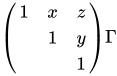
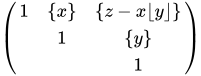
For example, the Heisenberg group is a 2-step nilpotent Lie group. This nilpotent Lie group is also special in that it admits a compact quotient. The group
Γ
{\displaystyle \Gamma }


Abelian Lie groups
A simpler example would be any abelian Lie group. This is because any such group is a nilpotent Lie group. For example, one can take the group of real numbers under addition, and the discrete, cocompact subgroup consisting of the integers. The resulting 1-step nilmanifold is the familiar circle
R
/
Z
{\displaystyle \mathbb {R} /\mathbb {Z} }

Generalizations
A parallel construction based on solvable Lie groups produces a class of spaces called solvmanifolds. An important example of a solvmanifolds are Inoue surfaces, known in complex geometry.
References
- Mal'cev, Anatoly Ivanovich (1951). "On a class of homogeneous spaces". American Mathematical Society Translations (39).
- Wilson, Edward N. (1982). "Isometry groups on homogeneous nilmanifolds". Geometriae Dedicata. 12 (3): 337–346. doi:10.1007/BF00147318. hdl:10338.dmlcz/147061. MR 0661539. S2CID 123611727.
- Milnor, John (1976). "Curvatures of left invariant metrics on Lie groups". Advances in Mathematics. 21 (3): 293–329. doi:10.1016/S0001-8708(76)80002-3. MR 0425012.
- Gromov, Mikhail (1978). "Almost flat manifolds". Journal of Differential Geometry. 13 (2): 231–241. doi:10.4310/jdg/1214434488. MR 0540942.
- Chow, Bennett; Knopf, Dan, The Ricci flow: an introduction. Mathematical Surveys and Monographs, 110. American Mathematical Society, Providence, RI, 2004. xii+325 pp. ISBN 0-8218-3515-7
- Green, Benjamin; Tao, Terence (2010). "Linear equations in primes". Annals of Mathematics. 171 (3): 1753–1850. arXiv:math.NT/0606088. doi:10.4007/annals.2010.171.1753. MR 2680398. S2CID 119596965.
- Host, Bernard; Kra, Bryna (2005). "Nonconventional ergodic averages and nilmanifolds". Annals of Mathematics. (2). 161 (1): 397–488. doi:10.4007/annals.2005.161.397. MR 2150389.
- Raghunathan, M. S. (1972). Discrete subgroups of Lie groups. Ergebnisse der Mathematik und ihrer Grenzgebiete. Vol. 68. New York-Heidelberg: Springer-Verlag. ISBN 978-3-642-86428-5. MR 0507234.
Chapter II
- Palais, R. S.; Stewart, T. E. Torus bundles over a torus. Proc. Amer. Math. Soc. 12 1961 26–29.
- Keizo Hasegawa (2005). "Complex and Kähler structures on Compact Solvmanifolds". Journal of Symplectic Geometry. 3 (4): 749–767. arXiv:0804.4223. doi:10.4310/JSG.2005.v3.n4.a9. MR 2235860. S2CID 6955295. Zbl 1120.53043.
- Keizo Hasegawa, Minimal models of nilmanifolds, Proc. Amer. Math. Soc. 106 (1989), no. 1, 65–71.
- Benson, Chal; Gordon, Carolyn S. (1988). "Kähler and symplectic structures on nilmanifolds". Topology. 27 (4): 513–518. doi:10.1016/0040-9383(88)90029-8. MR 0976592.
- Sönke Rollenske, Geometry of nilmanifolds with left-invariant complex structure and deformations in the large, 40 pages, arXiv:0901.3120, Proc. London Math. Soc., 99, 425–460, 2009