In mathematics, a sheaf of O-modules or simply an O-module over a ringed space (X, O) is a sheaf of abelian groups F such that, for any open subset U of X, F(U) is an O(U)-module and the restriction maps F(U) → F(V) are compatible with the restriction maps O(U) → O(V): the restriction of fs is the restriction of f times the restriction of s for any f in O(U) and s in F(U).
The standard case is when X is a scheme and O its structure sheaf. If O is the constant sheaf
Z
_
{\displaystyle {\underline {\mathbf {Z} }}}

If X is the prime spectrum of a ring R, then any R-module defines an OX-module (called an associated sheaf) in a natural way. Similarly, if R is a graded ring and X is the Proj of R, then any graded module defines an OX-module in a natural way. O-modules arising in such a fashion are examples of quasi-coherent sheaves, and in fact, on affine or projective schemes, all quasi-coherent sheaves are obtained this way.
Sheaves of modules over a ringed space form an abelian category.[1] Moreover, this category has enough injectives,[2] and consequently one can and does define the sheaf cohomology
H
i
(
X
,
−
)
{\displaystyle \operatorname {H} ^{i}(X,-)}


Examples
- Given a ringed space (X, O), if F is an O-submodule of O, then it is called the sheaf of ideals or ideal sheaf of O, since for each open subset U of X, F(U) is an ideal of the ring O(U).
- Let X be a smooth variety of dimension n. Then the tangent sheaf of X is the dual of the cotangent sheaf
Ω
X
{\displaystyle \Omega _{X}}
and the canonical sheaf ω X {\displaystyle \omega _{X}}
is the n-th exterior power (determinant) of Ω X {\displaystyle \Omega _{X}}
- A sheaf of algebras is a sheaf of modules that is also a sheaf of rings.
Operations
Let (X, O) be a ringed space. If F and G are O-modules, then their tensor product, denoted by
-
F
⊗
O
G
{\displaystyle F\otimes _{O}G}
or F ⊗ G {\displaystyle F\otimes G}
,
is the O-module that is the sheaf associated to the presheaf
U
↦
F
(
U
)
⊗
O
(
U
)
G
(
U
)
.
{\displaystyle U\mapsto F(U)\otimes _{O(U)}G(U).}


Similarly, if F and G are O-modules, then
-
H
o
m
O
(
F
,
G
)
{\displaystyle {\mathcal {H}}om_{O}(F,G)}

denotes the O-module that is the sheaf
U
↦
Hom
O
|
U
(
F
|
U
,
G
|
U
)
{\displaystyle U\mapsto \operatorname {Hom} _{O|_{U}}(F|_{U},G|_{U})}

-
H
o
m
O
(
F
,
O
)
{\displaystyle {\mathcal {H}}om_{O}(F,O)}

is called the dual module of F and is denoted by
F
ˇ
{\displaystyle {\check {F}}}

-
E
ˇ
⊗
F
→
H
o
m
O
(
E
,
F
)
{\displaystyle {\check {E}}\otimes F\to {\mathcal {H}}om_{O}(E,F)}
,
which is an isomorphism if E is a locally free sheaf of finite rank. In particular, if L is locally free of rank one (such L is called an invertible sheaf or a line bundle),[5] then this reads:
-
L
ˇ
⊗
L
≃
O
,
{\displaystyle {\check {L}}\otimes L\simeq O,}

implying the isomorphism classes of invertible sheaves form a group. This group is called the Picard group of X and is canonically identified with the first cohomology group
H
1
(
X
,
O
∗
)
{\displaystyle \operatorname {H} ^{1}(X,{\mathcal {O}}^{*})}

If E is a locally free sheaf of finite rank, then there is an O-linear map
E
ˇ
⊗
E
≃
End
O
(
E
)
→
O
{\displaystyle {\check {E}}\otimes E\simeq \operatorname {End} _{O}(E)\to O}

For any O-module F, the tensor algebra, exterior algebra and symmetric algebra of F are defined in the same way. For example, the k-th exterior power
-
⋀
k
F
{\displaystyle \bigwedge ^{k}F}

is the sheaf associated to the presheaf
U
↦
⋀
O
(
U
)
k
F
(
U
)
{\textstyle U\mapsto \bigwedge _{O(U)}^{k}F(U)}


-
⋀
r
F
⊗
⋀
n
−
r
F
→
det
(
F
)
.
{\displaystyle \bigwedge ^{r}F\otimes \bigwedge ^{n-r}F\to \det(F).}

Let f: (X, O) →(X', O') be a morphism of ringed spaces. If F is an O-module, then the direct image sheaf
f
∗
F
{\displaystyle f_{*}F}

If G is an O'-module, then the module inverse image
f
∗
G
{\displaystyle f^{*}G}

-
f
−
1
G
⊗
f
−
1
O
′
O
{\displaystyle f^{-1}G\otimes _{f^{-1}O'}O}

where
f
−
1
G
{\displaystyle f^{-1}G}


There is an adjoint relation between
f
∗
{\displaystyle f_{*}}


-
Hom
O
(
f
∗
G
,
F
)
≃
Hom
O
′
(
G
,
f
∗
F
)
{\displaystyle \operatorname {Hom} _{O}(f^{*}G,F)\simeq \operatorname {Hom} _{O'}(G,f_{*}F)}

as abelian group. There is also the projection formula: for an O-module F and a locally free O'-module E of finite rank,
-
f
∗
(
F
⊗
f
∗
E
)
≃
f
∗
F
⊗
E
.
{\displaystyle f_{*}(F\otimes f^{*}E)\simeq f_{*}F\otimes E.}

Properties
Let (X, O) be a ringed space. An O-module F is said to be generated by global sections if there is a surjection of O-modules:
-
⨁
i
∈
I
O
→
F
→
0.
{\displaystyle \bigoplus _{i\in I}O\to F\to 0.}

Explicitly, this means that there are global sections si of F such that the images of si in each stalk Fx generate Fx as Ox-module.
An example of such a sheaf is that associated in algebraic geometry to an R-module M, R being any commutative ring, on the spectrum of a ring Spec(R). Another example: according to Cartan's theorem A, any coherent sheaf on a Stein manifold is spanned by global sections. (cf. Serre's theorem A below.) In the theory of schemes, a related notion is ample line bundle. (For example, if L is an ample line bundle, some power of it is generated by global sections.)
An injective O-module is flasque (i.e., all restrictions maps F(U) → F(V) are surjective).[6] Since a flasque sheaf is acyclic in the category of abelian sheaves, this implies that the i-th right derived functor of the global section functor
Γ
(
X
,
−
)
{\displaystyle \Gamma (X,-)}
Sheaf associated to a module
Let
M
{\displaystyle M}


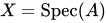


-
ρ
g
,
f
:
M
[
g
−
1
]
→
M
[
f
−
1
]
{\displaystyle \rho _{g,f}:M[g^{-1}]\to M[f^{-1}]}

having the property that
ρ
g
,
f
=
ρ
g
,
h
∘
ρ
h
,
f
{\displaystyle \rho _{g,f}=\rho _{g,h}\circ \rho _{h,f}}

-
D
(
f
)
↦
M
[
f
−
1
]
{\displaystyle D(f)\mapsto M[f^{-1}]}

is a contravariant functor from the category whose objects are the sets D(f) and morphisms the inclusions of sets to the category of abelian groups. One can show[8] it is in fact a B-sheaf (i.e., it satisfies the gluing axiom) and thus defines the sheaf
M
~
{\displaystyle {\widetilde {M}}}

The most basic example is the structure sheaf on X; i.e.,
O
X
=
A
~
{\displaystyle {\mathcal {O}}_{X}={\widetilde {A}}}


The construction has the following properties: for any A-modules M, N, and any morphism
φ
:
M
→
N
{\displaystyle \varphi :M\to N}

-
M
[
f
−
1
]
∼
=
M
~
|
D
(
f
)
{\displaystyle M[f^{-1}]^{\sim }={\widetilde {M}}|_{D(f)}}
.[9]
- For any prime ideal p of A,
M
~
p
≃
M
p
{\displaystyle {\widetilde {M}}_{p}\simeq M_{p}}
as Op = Ap-module.
-
(
M
⊗
A
N
)
∼
≃
M
~
⊗
A
~
N
~
{\displaystyle (M\otimes _{A}N)^{\sim }\simeq {\widetilde {M}}\otimes _{\widetilde {A}}{\widetilde {N}}}
.[10]
- If M is finitely presented,
Hom
A
(
M
,
N
)
∼
≃
H
o
m
A
~
(
M
~
,
N
~
)
{\displaystyle \operatorname {Hom} _{A}(M,N)^{\sim }\simeq {\mathcal {H}}om_{\widetilde {A}}({\widetilde {M}},{\widetilde {N}})}
.[10]
-
Hom
A
(
M
,
N
)
≃
Γ
(
X
,
H
o
m
A
~
(
M
~
,
N
~
)
)
{\displaystyle \operatorname {Hom} _{A}(M,N)\simeq \Gamma (X,{\mathcal {H}}om_{\widetilde {A}}({\widetilde {M}},{\widetilde {N}}))}
, since the equivalence between ModA and the category of quasi-coherent sheaves on X.
-
(
lim
→
M
i
)
∼
≃
lim
→
M
i
~
{\displaystyle (\varinjlim M_{i})^{\sim }\simeq \varinjlim {\widetilde {M_{i}}}}
;[11] in particular, taking a direct sum and ~ commute.
- A sequence of A-modules is exact if and only if the induced sequence by
∼
{\displaystyle \sim }
is exact. In particular, ( ker ( φ ) ) ∼ = ker ( φ ~ ) , ( coker ( φ ) ) ∼ = coker ( φ ~ ) , ( im ( φ ) ) ∼ = im ( φ ~ ) {\displaystyle (\ker(\varphi ))^{\sim }=\ker({\widetilde {\varphi }}),(\operatorname {coker} (\varphi ))^{\sim }=\operatorname {coker} ({\widetilde {\varphi }}),(\operatorname {im} (\varphi ))^{\sim }=\operatorname {im} ({\widetilde {\varphi }})}
.
Sheaf associated to a graded module
There is a graded analog of the construction and equivalence in the preceding section. Let R be a graded ring generated by degree-one elements as R0-algebra (R0 means the degree-zero piece) and M a graded R-module. Let X be the Proj of R (so X is a projective scheme if R is Noetherian). Then there is an O-module
M
~
{\displaystyle {\widetilde {M}}}
-
M
~
|
{
f
≠
0
}
≃
(
M
[
f
−
1
]
0
)
∼
{\displaystyle {\widetilde {M}}|_{\{f\neq 0\}}\simeq (M[f^{-1}]_{0})^{\sim }}

as sheaves of modules on the affine scheme
{
f
≠
0
}
=
Spec
(
R
[
f
−
1
]
0
)
{\displaystyle \{f\neq 0\}=\operatorname {Spec} (R[f^{-1}]_{0})}

Example: Let R(1) be the graded R-module given by R(1)n = Rn+1. Then
O
(
1
)
=
R
(
1
)
~
{\displaystyle O(1)={\widetilde {R(1)}}}

If F is an O-module on X, then, writing
F
(
n
)
=
F
⊗
O
(
n
)
{\displaystyle F(n)=F\otimes O(n)}

-
(
⨁
n
≥
0
Γ
(
X
,
F
(
n
)
)
)
∼
→
F
,
{\displaystyle \left(\bigoplus _{n\geq 0}\Gamma (X,F(n))\right)^{\sim }\to F,}

which is an isomorphism if and only if F is quasi-coherent.
Computing sheaf cohomology
Sheaf cohomology has a reputation for being difficult to calculate. Because of this, the next general fact is fundamental for any practical computation:
Theorem—Let X be a topological space, F an abelian sheaf on it and
U
{\displaystyle {\mathfrak {U}}}


-
H
i
(
X
,
F
)
=
H
i
(
C
∙
(
U
,
F
)
)
{\displaystyle \operatorname {H} ^{i}(X,F)=\operatorname {H} ^{i}(C^{\bullet }({\mathfrak {U}},F))}

where the right-hand side is the i-th Čech cohomology.
Serre's vanishing theorem[13] states that if X is a projective variety and F a coherent sheaf on it, then, for sufficiently large n, the Serre twist F(n) is generated by finitely many global sections. Moreover,
- For each i, Hi(X, F) is finitely generated over R0, and
- There is an integer n0, depending on F, such that
H
i
(
X
,
F
(
n
)
)
=
0
,
i
≥
1
,
n
≥
n
0
.
{\displaystyle \operatorname {H} ^{i}(X,F(n))=0,\,i\geq 1,n\geq n_{0}.}

Sheaf extension
Let (X, O) be a ringed space, and let F, H be sheaves of O-modules on X. An extension of H by F is a short exact sequence of O-modules
-
0
→
F
→
G
→
H
→
0.
{\displaystyle 0\rightarrow F\rightarrow G\rightarrow H\rightarrow 0.}

As with group extensions, if we fix F and H, then all equivalence classes of extensions of H by F form an abelian group (cf. Baer sum), which is isomorphic to the Ext group
Ext
O
1
(
H
,
F
)
{\displaystyle \operatorname {Ext} _{O}^{1}(H,F)}

In the case where H is O, we have: for any i ≥ 0,
-
H
i
(
X
,
F
)
=
Ext
O
i
(
O
,
F
)
,
{\displaystyle \operatorname {H} ^{i}(X,F)=\operatorname {Ext} _{O}^{i}(O,F),}

since both the sides are the right derived functors of the same functor
Γ
(
X
,
−
)
=
Hom
O
(
O
,
−
)
.
{\displaystyle \Gamma (X,-)=\operatorname {Hom} _{O}(O,-).}

Note: Some authors, notably Hartshorne, drop the subscript O.
Assume X is a projective scheme over a Noetherian ring. Let F, G be coherent sheaves on X and i an integer. Then there exists n0 such that
-
Ext
O
i
(
F
,
G
(
n
)
)
=
Γ
(
X
,
E
x
t
O
i
(
F
,
G
(
n
)
)
)
,
n
≥
n
0
{\displaystyle \operatorname {Ext} _{O}^{i}(F,G(n))=\Gamma (X,{\mathcal {Ext}}_{O}^{i}(F,G(n))),\,n\geq n_{0}}
,
where
E
x
t
O
{\displaystyle {\mathcal {Ext}}_{O}}


Locally free resolutions
E
x
t
(
F
,
G
)
{\displaystyle {\mathcal {Ext}}({\mathcal {F}},{\mathcal {G}})}


-
⋯
→
L
2
→
L
1
→
L
0
→
F
→
0
{\displaystyle \cdots \to {\mathcal {L}}_{2}\to {\mathcal {L}}_{1}\to {\mathcal {L}}_{0}\to {\mathcal {F}}\to 0}

then
-
R
H
o
m
(
F
,
G
)
=
H
o
m
(
L
∙
,
G
)
{\displaystyle {\mathcal {RHom}}({\mathcal {F}},{\mathcal {G}})={\mathcal {Hom}}({\mathcal {L}}_{\bullet },{\mathcal {G}})}

hence
-
E
x
t
k
(
F
,
G
)
=
h
k
(
H
o
m
(
L
∙
,
G
)
)
{\displaystyle {\mathcal {Ext}}^{k}({\mathcal {F}},{\mathcal {G}})=h^{k}({\mathcal {Hom}}({\mathcal {L}}_{\bullet },{\mathcal {G}}))}

Examples
Hypersurface
Consider a smooth hypersurface
X
{\displaystyle X}


-
O
(
−
d
)
→
O
{\displaystyle {\mathcal {O}}(-d)\to {\mathcal {O}}}

and find that
-
E
x
t
i
(
O
X
,
F
)
=
h
i
(
H
o
m
(
O
(
−
d
)
→
O
,
F
)
)
{\displaystyle {\mathcal {Ext}}^{i}({\mathcal {O}}_{X},{\mathcal {F}})=h^{i}({\mathcal {Hom}}({\mathcal {O}}(-d)\to {\mathcal {O}},{\mathcal {F}}))}

Union of smooth complete intersections
Consider the scheme
-
X
=
Proj
(
C
[
x
0
,
…
,
x
n
]
(
f
)
(
g
1
,
g
2
,
g
3
)
)
⊆
P
n
{\displaystyle X={\text{Proj}}\left({\frac {\mathbb {C} [x_{0},\ldots ,x_{n}]}{(f)(g_{1},g_{2},g_{3})}}\right)\subseteq \mathbb {P} ^{n}}

where
(
f
,
g
1
,
g
2
,
g
3
)
{\displaystyle (f,g_{1},g_{2},g_{3})}


-
O
(
−
d
−
e
1
−
e
2
−
e
3
)
→
[
g
3
−
g
2
−
g
1
]
O
(
−
d
−
e
1
−
e
2
)
⊕
O
(
−
d
−
e
1
−
e
3
)
⊕
O
(
−
d
−
e
2
−
e
3
)
→
[
g
2
g
3
0
−
g
1
0
−
g
3
0
−
g
1
g
2
]
O
(
−
d
−
e
1
)
⊕
O
(
−
d
−
e
2
)
⊕
O
(
−
d
−
e
3
)
→
[
f
g
1
f
g
2
f
g
3
]
O
{\displaystyle {\mathcal {O}}(-d-e_{1}-e_{2}-e_{3}){\xrightarrow {\begin{bmatrix}g_{3}\\-g_{2}\\-g_{1}\end{bmatrix}}}{\begin{matrix}{\mathcal {O}}(-d-e_{1}-e_{2})\\\oplus \\{\mathcal {O}}(-d-e_{1}-e_{3})\\\oplus \\{\mathcal {O}}(-d-e_{2}-e_{3})\end{matrix}}{\xrightarrow {\begin{bmatrix}g_{2}&g_{3}&0\\-g_{1}&0&-g_{3}\\0&-g_{1}&g_{2}\end{bmatrix}}}{\begin{matrix}{\mathcal {O}}(-d-e_{1})\\\oplus \\{\mathcal {O}}(-d-e_{2})\\\oplus \\{\mathcal {O}}(-d-e_{3})\end{matrix}}{\xrightarrow {\begin{bmatrix}fg_{1}&fg_{2}&fg_{3}\end{bmatrix}}}{\mathcal {O}}}

resolving
O
X
,
{\displaystyle {\mathcal {O}}_{X},}


See also
- D-module (in place of O, one can also consider D, the sheaf of differential operators.)
- fractional ideal
- holomorphic vector bundle
- generic freeness
Notes
- Vakil, Math 216: Foundations of algebraic geometry, 2.5.
- Hartshorne, Ch. III, Proposition 2.2.
- This cohomology functor coincides with the right derived functor of the global section functor in the category of abelian sheaves; cf. Hartshorne, Ch. III, Proposition 2.6.
- There is a canonical homomorphism:
-
H
o
m
O
(
F
,
O
)
x
→
Hom
O
x
(
F
x
,
O
x
)
,
{\displaystyle {\mathcal {H}}om_{O}(F,O)_{x}\to \operatorname {Hom} _{O_{x}}(F_{x},O_{x}),}
-
H
o
m
O
(
F
,
O
)
x
→
Hom
O
x
(
F
x
,
O
x
)
,
{\displaystyle {\mathcal {H}}om_{O}(F,O)_{x}\to \operatorname {Hom} _{O_{x}}(F_{x},O_{x}),}
- For coherent sheaves, having a tensor inverse is the same as being locally free of rank one; in fact, there is the following fact: if
F
⊗
G
≃
O
{\displaystyle F\otimes G\simeq O}
and if F is coherent, then F, G are locally free of rank one. (cf. EGA, Ch 0, 5.4.3.)
- Hartshorne, Ch III, Lemma 2.4.
- see also: https://math.stackexchange.com/q/447234
- Hartshorne, Ch. II, Proposition 5.1.
- EGA I 1971, Ch. I, Proposition 1.3.6.
- EGA I 1971, Ch. I, Corollaire 1.3.12.
- EGA I 1971, Ch. I, Corollaire 1.3.9.
- Hartshorne, Ch. II, Proposition 5.11.
- "Section 30.2 (01X8): Čech cohomology of quasi-coherent sheaves—The Stacks project". stacks.math.columbia.edu. Retrieved 2023-12-07.
- Costa, Miró-Roig & Pons-Llopis 2021, Theorem 1.3.1
- "Links with sheaf cohomology". Local Cohomology. Cambridge Studies in Advanced Mathematics. Cambridge University Press. 2012. pp. 438–479. doi:10.1017/CBO9781139044059.023. ISBN 9780521513630.
- Serre 1955, §.66 Faisceaux algébriques cohérents sur les variétés projectives.
- Hartshorne, Ch. III, Proposition 6.9.
- Hartshorne, Robin. Algebraic Geometry. pp. 233–235.

References
- Grothendieck, Alexandre; Dieudonné, Jean (1960). "Éléments de géométrie algébrique: I. Le langage des schémas". Publications Mathématiques de l'IHÉS. 4. doi:10.1007/bf02684778. MR 0217083.
- Hartshorne, Robin (1977), Algebraic Geometry, Graduate Texts in Mathematics, vol. 52, New York: Springer-Verlag, ISBN 978-0-387-90244-9, MR 0463157
- Costa, Laura; Miró-Roig, Rosa María; Pons-Llopis, Joan (2021). Ulrich Bundles. doi:10.1515/9783110647686. ISBN 9783110647686.
- "Links with sheaf cohomology". Local Cohomology. Cambridge Studies in Advanced Mathematics. Cambridge University Press. 2012. pp. 438–479. doi:10.1017/CBO9781139044059.023. ISBN 9780521513630.
- Serre, Jean-Pierre (1955), "Faisceaux algébriques cohérents (§.66 Faisceaux algébriques cohérents sur les variétés projectives.)" (PDF), Annals of Mathematics, 61 (2): 197–278, doi:10.2307/1969915, JSTOR 1969915, MR 0068874