In mathematics, and more specifically in commutative algebra and algebraic geometry, the prime spectrum (or simply the spectrum) of a commutative ring
R
{\displaystyle R}


Affine schemes are a basic tool of modern algebraic geometry, and specifically scheme theory. Indeed, schemes are built by "gluing together" affine schemes in a way that is very similar to the construction of manifolds by gluing together open subsets of a Euclidean space equipped with the ring of the continuous functions over them. The adjective "affine" in the phrase "affine scheme" comes from the fact that an affine algebraic variety can be identified with the affine scheme built over its ring of regular functions.
Historical motivation
The idea of the spectrum of a ring was introduced under that name by Alexander Grothendieck. It brought together several parallel historical threads. One, which motivates the use of the word "spectrum", comes from linear algebra and more general functional analysis, in which the spectrum is used to denote the eigenvalues of a linear transformation. The other came from commutative algebra, in which a topological space (the Zariski topology) had been in use to describe the structure of prime ideals. The final synthesis was the addition of a structure sheaf, which encodes local geometric information near each prime ideal.
The first motivation comes from linear algebra. A endomorphism
T
{\displaystyle T}


![{\displaystyle \mathbb {C} [T]}](https://wikimedia.org/api/rest_v1/media/math/render/svg/310099ec3c795ff8afd6e84e684d40fb79e0dc36)
![{\displaystyle \mathbb {C} [x]\to \mathbb {C} [T]}](https://wikimedia.org/api/rest_v1/media/math/render/svg/08e17fc9e4e686f2add5b578a1cc3a1a9c065811)

![{\displaystyle \mathbb {C} [x]}](https://wikimedia.org/api/rest_v1/media/math/render/svg/244ad3bb0a1d2ff11dde84c4edee1171f670fdb0)


![{\displaystyle \mathbb {C} [T].}](https://wikimedia.org/api/rest_v1/media/math/render/svg/6ef5fdfc3e0bc818b194a22b7a309518d0f17612)
One missing ingredient in the notion of spectrum is that it does not distinguish the multiplicity of the various eigenvalues. Thus the definition of a ring spectrum includes not only the bare set of prime ideals, but also structural information, carried by the ring
C
[
T
]
{\displaystyle \mathbb {C} [T]}


The modern notion of a spectrum thus includes a structure sheaf, which consists of a prescription of the functions that lie over each of the prime ideals. In the case of
C
[
x
]
/
(
x
k
)
{\displaystyle \mathbb {C} [x]/(x^{k})}
![{\displaystyle \mathbb {C} [x]/(x^{k})}](https://wikimedia.org/api/rest_v1/media/math/render/svg/282cae9176c2c4be5c497272b05bee0eecf1b363)
![{\displaystyle {\mathcal {O}}_{(x)}=\mathbb {C} [x]/(x^{k})}](https://wikimedia.org/api/rest_v1/media/math/render/svg/9624a3f1b11fbc883b81675215c7c8d29307e52d)
This linear algebra notion of spectrum was already widely used in the broader subject of spectral theory. In a unital complex Banach algebra A, the idea is extended by defining the spectrum of an element a to be the set of complex numbers λ such that a − λ1 is not invertible. In the commutative case, Israel Gelfand's theory of normed rings and Banach algebras made the space of maximal ideals, or equivalently multiplicative linear functionals, into a central object of study.[3]
The prime spectrum of a commutative ring also has a separate origin in commutative algebra and algebraic geometry. For an affine algebraic variety over an algebraically closed field, the Nullstellensatz identifies ordinary points with maximal ideals in its coordinate ring. More generally, irreducible subvarieties correspond to prime ideals. Passing from maximal ideals to all prime ideals therefore amounts to adjoining a generic point for each irreducible subvariety.[4]
The work of Wolfgang Krull anticipated the use of geometric points to describe prime ideals. His 1928 paper on chains of prime ideals was part of the development of dimension theory in general rings.[5] A related topological use of prime ideals appeared in Marshall Stone's work on Boolean algebras and distributive lattices: Stone introduced a topology on prime ideals of a distributive lattice, producing what is now called the spectrum of the lattice and leading to the notion of a spectral space.[6]
The modern construction of Spec R as a locally ringed space was introduced systematically by Alexander Grothendieck in scheme theory. In this form, the spectrum is not only a topological space of prime ideals, but is equipped with a structure sheaf, allowing affine schemes to be glued to form general schemes.[7]
Zariski topology
As a set, the spectrum
Spec
(
R
)
{\displaystyle \operatorname {Spec} (R)}


Given a closed set
V
⊆
S
p
e
c
(
R
)
{\displaystyle V\subseteq \mathrm {Spec} (R)}


Among the open sets, that is the sets of the form
Spec
(
R
)
∖
V
I
,
{\displaystyle \operatorname {Spec} (R)\setminus V_{I},}


Spec
(
R
)
{\displaystyle \operatorname {Spec} (R)}
Affine schemes
Construction of the structure sheaf
For every commutative ring
R
{\displaystyle R}
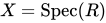

A sheaf of rings
O
X
{\displaystyle {\mathcal {O}}_{X}}


The first compatibility condition is that the canonical homomorphisms behave as expected with respect to composition of inclusions. This means that if
U
{\displaystyle {\mathcal {U}}}

The second compatibility condition is that
O
X
(
U
)
{\displaystyle {\mathcal {O}}_{X}(U)}


In the case of an affine scheme
X
=
Spec
(
R
)
{\displaystyle X=\operatorname {Spec} (R)}




For the other open sets,
O
X
(
U
)
{\displaystyle {\mathcal {O}}_{X}(U)}

For a ringed space
(
X
,
O
X
)
{\displaystyle (X,{\mathcal {O}}_{X})}


Category equivalence between rings and affine schemes
Affine schemes form a category whose morphisms are morphisms of ringed spaces. In this context,
Spec
{\displaystyle \operatorname {Spec} }


Morphisms of affine schemes
A morphism of ringed spaces from
f
:
(
X
,
O
X
)
→
(
Y
,
O
Y
)
{\displaystyle f:(X,{\mathcal {O}}_{X})\to (Y,{\mathcal {O}}_{Y})}



For making
Spec
{\displaystyle \operatorname {Spec} }
So, let
f
:
R
→
S
{\displaystyle f:R\to S}


To have a morphism of ringed spaces, one must define for each open subset
U
{\displaystyle U}


Affine algebraic varieties
Affine algebraic varieties give foundational examples of affine schemes in the sense that Alexandre Grothendieck introduced scheme theory to provide a setting to clearly and precisely reformulate and resolve problems that were badly or inelegantly handled by the classical theory of varieties. Some of the issues that were addressed include dealing with multiplicities, developing a coordinate-free approach, studying the rational points over a field that is not algebraically closed, and establishing a single framework for affine, projective and abstract algebraic varieties.
An affine algebraic set
V
{\displaystyle V}


![{\displaystyle \mathbb {C} [X_{1},\ldots ,X_{n}]}](https://wikimedia.org/api/rest_v1/media/math/render/svg/96f6e2275968debe0e54b7e32e63d2096332d802)
![{\displaystyle R=\mathbb {C} [X_{1},\ldots ,X]/I}](https://wikimedia.org/api/rest_v1/media/math/render/svg/c1c3b3b28a4d461db17553f39247d5abe4117f8e)
In short, every statement about affine algebraic sets and affine algebraic varieties may be translated in the language of affine schemes. This has many advantages; in particular:
- There is no need to suppose the base field is algebraically closed, and even to suppose the existence of a ground field (when dealing with
Spec
(
R
)
{\displaystyle \operatorname {Spec} (R)}
- There is no need to suppose that
R
{\displaystyle R}
and the line x = 1 {\displaystyle x=1}
is Spec ( [ x , y ] / ⟨ y 2 ⟩ ) {\displaystyle \operatorname {Spec} ([x,y]/\langle y^{2}\rangle )}
, and the intersection is encoded in the affine scheme, while it is not in the set-theoretical definition of algebraic sets.
Motivation from algebraic geometry
Following on from the example, in algebraic geometry one studies algebraic sets, i.e. subsets of
K
n
{\displaystyle K^{n}}


The spectrum of
R
{\displaystyle R}
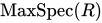
One can thus view the topological space
Spec
(
R
)
{\displaystyle \operatorname {Spec} (R)}
Examples
- The spectrum of integers: The affine scheme
Spec
(
Z
)
{\displaystyle \operatorname {Spec} (\mathbb {Z} )}
is the final object in the category of affine schemes since Z {\displaystyle \mathbb {Z} }
is the initial object in the category of commutative rings.
- The scheme-theoretic analogue of
C
n
{\displaystyle \mathbb {C} ^{n}}
. From the functor of points perspective, a point ( α 1 , … , α n ) ∈ C n {\displaystyle (\alpha _{1},\ldots ,\alpha _{n})\in \mathbb {C} ^{n}}
can be identified with the evaluation morphism C [ x 1 , … , x n ] → e v ( α 1 , … , α n ) C {\displaystyle \mathbb {C} [x_{1},\ldots ,x_{n}]{\xrightarrow[{ev_{(\alpha _{1},\dots ,\alpha _{n})}}]{}}\mathbb {C} }
. This fundamental observation allows us to give meaning to other affine schemes.
- The cross:
Spec
(
C
[
x
,
y
]
/
(
x
y
)
)
{\displaystyle \operatorname {Spec} (\mathbb {C} [x,y]/(xy))}
looks topologically like the transverse intersection of two complex planes at a point (in particular, this scheme is not irreducible), although typically this is depicted as a + {\displaystyle +}
, since the only well defined morphisms to C {\displaystyle \mathbb {C} }
.
- The prime spectrum of a Boolean ring (e.g., a power set ring) is a compact totally disconnected Hausdorff space (that is, a Stone space).[11]
- (M. Hochster) A topological space is homeomorphic to the prime spectrum of a commutative ring (i.e., a spectral space) if and only if it is compact, quasi-separated and sober.[12]
Non-affine examples
Here are some examples of schemes that are not affine schemes. They are constructed from gluing affine schemes together.
- The projective
n
{\displaystyle n}
over a field k {\displaystyle k}
is not affine as the ring of global sections of P k n {\displaystyle \mathbb {P} _{k}^{n}}
is k {\displaystyle k}
- Affine plane minus the origin.[13] Inside
A
k
2
=
Spec
k
[
x
,
y
]
{\displaystyle \mathbb {A} _{k}^{2}=\operatorname {Spec} k[x,y]}
are distinguished open affine subschemes D x , D y {\displaystyle D_{x},D_{y}}
. Their union D x ∪ D y = U {\displaystyle D_{x}\cup D_{y}=U}
is the affine plane with the origin taken out. The global sections of U {\displaystyle U}
, which can be shown to be k [ x , y ] {\displaystyle k[x,y]}
, the global sections of A k 2 {\displaystyle \mathbb {A} _{k}^{2}}
. U {\displaystyle U}
in U {\displaystyle U}
Non-Zariski topologies on a prime spectrum
Some authors (notably M. Hochster) consider topologies on prime spectra other than the Zariski topology.
First, there is the notion of constructible topology: given a ring A, the subsets of
Spec
(
A
)
{\displaystyle \operatorname {Spec} (A)}


In Hochster (1969), Hochster considers what he calls the patch topology on a prime spectrum.[16][17][18] By definition, the patch topology is the smallest topology in which the sets of the forms
V
(
I
)
{\displaystyle V(I)}

Global or relative Spec
There is a relative version of the functor
Spec
{\displaystyle \operatorname {Spec} }






Global Spec has a universal property similar to the universal property for ordinary Spec. More precisely, just as Spec and the global section functor are contravariant right adjoints between the category of commutative rings and schemes, global Spec and the direct image functor for the structure map are contravariant right adjoints between the category of commutative
O
S
{\displaystyle {\mathcal {O}}_{S}}
-
Hom
O
S
-alg
(
A
,
π
∗
O
X
)
≅
Hom
Sch
/
S
(
X
,
S
p
e
c
(
A
)
)
,
{\displaystyle \operatorname {Hom} _{{\mathcal {O}}_{S}{\text{-alg}}}({\mathcal {A}},\pi _{*}{\mathcal {O}}_{X})\cong \operatorname {Hom} _{{\text{Sch}}/S}(X,\mathbf {Spec} ({\mathcal {A}})),}

where
π
:
X
→
S
{\displaystyle \pi \colon X\to S}

Example of a relative Spec
The relative spec is the correct tool for parameterizing the family of lines through the origin of
A
C
2
{\displaystyle \mathbb {A} _{\mathbb {C} }^{2}}


![{\displaystyle {\mathcal {A}}={\mathcal {O}}_{X}[x,y],}](https://wikimedia.org/api/rest_v1/media/math/render/svg/f9212c4736a6da50754e9fcd8892091c0f22f840)
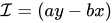


![{\displaystyle [\alpha :\beta ]}](https://wikimedia.org/api/rest_v1/media/math/render/svg/3bd37b8e47cf3a1da623799a4852b1310de1ce5c)


-
Spec
(
C
[
x
,
y
]
(
y
−
β
α
x
)
)
→
Spec
(
C
[
b
a
]
[
x
,
y
]
(
y
−
b
a
x
)
)
→
Spec
_
X
(
O
X
[
x
,
y
]
(
a
y
−
b
x
)
)
↓
↓
↓
Spec
(
C
)
→
Spec
(
C
[
b
a
]
)
=
U
a
→
P
a
,
b
1
{\displaystyle {\begin{matrix}\operatorname {Spec} \left({\frac {\mathbb {C} [x,y]}{\left(y-{\frac {\beta }{\alpha }}x\right)}}\right)&\to &\operatorname {Spec} \left({\frac {\mathbb {C} \left[{\frac {b}{a}}\right][x,y]}{\left(y-{\frac {b}{a}}x\right)}}\right)&\to &{\underline {\operatorname {Spec} }}_{X}\left({\frac {{\mathcal {O}}_{X}[x,y]}{\left(ay-bx\right)}}\right)\\\downarrow &&\downarrow &&\downarrow \\\operatorname {Spec} (\mathbb {C} )&\to &\operatorname {Spec} \left(\mathbb {C} \left[{\frac {b}{a}}\right]\right)=U_{a}&\to &\mathbb {P} _{a,b}^{1}\end{matrix}}}
![{\displaystyle {\begin{matrix}\operatorname {Spec} \left({\frac {\mathbb {C} [x,y]}{\left(y-{\frac {\beta }{\alpha }}x\right)}}\right)&\to &\operatorname {Spec} \left({\frac {\mathbb {C} \left[{\frac {b}{a}}\right][x,y]}{\left(y-{\frac {b}{a}}x\right)}}\right)&\to &{\underline {\operatorname {Spec} }}_{X}\left({\frac {{\mathcal {O}}_{X}[x,y]}{\left(ay-bx\right)}}\right)\\\downarrow &&\downarrow &&\downarrow \\\operatorname {Spec} (\mathbb {C} )&\to &\operatorname {Spec} \left(\mathbb {C} \left[{\frac {b}{a}}\right]\right)=U_{a}&\to &\mathbb {P} _{a,b}^{1}\end{matrix}}}](https://wikimedia.org/api/rest_v1/media/math/render/svg/d17e7179354e0368a3badb92f28da6025bf880f6)
where the composition of the bottom arrows
-
Spec
(
C
)
→
[
α
:
β
]
P
a
,
b
1
{\displaystyle \operatorname {Spec} (\mathbb {C} ){\xrightarrow {[\alpha :\beta ]}}\mathbb {P} _{a,b}^{1}}
![{\displaystyle \operatorname {Spec} (\mathbb {C} )\xrightarrow {[\alpha :\beta ]} \mathbb {P} _{a,b}^{1}}](https://wikimedia.org/api/rest_v1/media/math/render/svg/45aecb664a5205b200a26620e8038d3a899a7a23)
gives the line containing the point
(
α
,
β
)
{\displaystyle (\alpha ,\beta )}


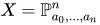
![{\displaystyle {\mathcal {A}}={\mathcal {O}}_{X}[x_{0},...,x_{n}]}](https://wikimedia.org/api/rest_v1/media/math/render/svg/668023c32052cf2313b22e41999d11551437c06e)

Representation theory perspective
From the perspective of representation theory, a prime ideal I corresponds to a module R/I, and the spectrum of a ring corresponds to irreducible cyclic representations of R, while more general subvarieties correspond to possibly reducible representations that need not be cyclic. Recall that abstractly, the representation theory of a group is the study of modules over its group algebra.
The connection to representation theory is clearer if one considers the polynomial ring
R
=
K
[
x
1
,
…
,
x
n
]
{\displaystyle R=K[x_{1},\dots ,x_{n}]}
![{\displaystyle R=K[x_{1},\dots ,x_{n}]}](https://wikimedia.org/api/rest_v1/media/math/render/svg/da7b1e5e0dfdba12801510fccf2552d400795c1d)
![{\displaystyle R=K[V].}](https://wikimedia.org/api/rest_v1/media/math/render/svg/f169f8ccc5cc8aa42a7efda92b52681fe5b3b245)


In the case that the field is algebraically closed (say, the complex numbers), every maximal ideal corresponds to a point in n-space, by the Nullstellensatz (the maximal ideal generated by
(
x
1
−
a
1
)
,
(
x
2
−
a
2
)
,
…
,
(
x
n
−
a
n
)
{\displaystyle (x_{1}-a_{1}),(x_{2}-a_{2}),\ldots ,(x_{n}-a_{n})}


![{\displaystyle K[V]}](https://wikimedia.org/api/rest_v1/media/math/render/svg/ec5fddcd6d55d1d9c792a53117274e8637be0e33)


Thus, points in n-space, thought of as the max spec of
R
=
K
[
x
1
,
…
,
x
n
]
,
{\displaystyle R=K[x_{1},\dots ,x_{n}],}
![{\displaystyle R=K[x_{1},\dots ,x_{n}],}](https://wikimedia.org/api/rest_v1/media/math/render/svg/d630104cd2585c892fe7736d9da610505b71e1bc)
Functional analysis perspective
The term "spectrum" comes from the use in operator theory. Given a linear operator T on a finite-dimensional vector space V, one can consider the vector space with operator as a module over the polynomial ring in one variable R = K[T], as in the structure theorem for finitely generated modules over a principal ideal domain. Then the spectrum of K[T] (as a ring) equals the spectrum of T (as an operator).
Further, the geometric structure of the spectrum of the ring (equivalently, the algebraic structure of the module) captures the behavior of the spectrum of the operator, such as algebraic multiplicity and geometric multiplicity. For instance, for the 2×2 identity matrix has corresponding module:
-
K
[
T
]
/
(
T
−
1
)
⊕
K
[
T
]
/
(
T
−
1
)
{\displaystyle K[T]/(T-1)\oplus K[T]/(T-1)}
![{\displaystyle K[T]/(T-1)\oplus K[T]/(T-1)}](https://wikimedia.org/api/rest_v1/media/math/render/svg/484a2680f1ed41b64bb3627113da5e9190d84891)
the 2×2 zero matrix has module
-
K
[
T
]
/
(
T
−
0
)
⊕
K
[
T
]
/
(
T
−
0
)
,
{\displaystyle K[T]/(T-0)\oplus K[T]/(T-0),}
![{\displaystyle K[T]/(T-0)\oplus K[T]/(T-0),}](https://wikimedia.org/api/rest_v1/media/math/render/svg/ae7794f232b91cfcead80e0b02d4d049fb388c09)
showing geometric multiplicity 2 for the zero eigenvalue, while a non-trivial 2×2 nilpotent matrix has module
-
K
[
T
]
/
T
2
,
{\displaystyle K[T]/T^{2},}
![{\displaystyle K[T]/T^{2},}](https://wikimedia.org/api/rest_v1/media/math/render/svg/54c16d35b08f09c504bb0a6b0b77655e6257e37b)
showing algebraic multiplicity 2 but geometric multiplicity 1.
In more detail:
- the eigenvalues (with geometric multiplicity) of the operator correspond to the (reduced) points of the variety, with multiplicity;
- the primary decomposition of the module corresponds to the unreduced points of the variety;
- a diagonalizable (semisimple) operator corresponds to a reduced variety;
- a cyclic module (one generator) corresponds to the operator having a cyclic vector (a vector whose orbit under T spans the space);
- the last invariant factor of the module equals the minimal polynomial of the operator, and the product of the invariant factors equals the characteristic polynomial.
Similar concepts
The spectrum can also be considered for C*-algebras in operator theory, yielding the notion of the spectrum of a C*-algebra. Notably, for a compact Hausdorff space
X
{\displaystyle X}


See also
Notes
- The algebraic geometry literature usually refers to a space that is compact (in the general topology sense of every open cover having a finite subcover) without necessarily being Hausdorff (e.g.,
Spec
(
R
)
{\displaystyle \operatorname {Spec} (R)}
- Everything what is said here remains valid if
C
{\displaystyle \mathbb {C} }
Citations
- Hartshorne (1977), p. 70. sfnp error: multiple targets (2×): CITEREFHartshorne1977 (help)
- Sharp (2001), p. 44, def. 3.26.
- Gelfand, I. M. (1941). "Normierte Ringe". Matematicheskii Sbornik. New Series. 9 (51): 3–24.
- Hartshorne, Robin (1977). Algebraic Geometry. Springer-Verlag. pp. 70–71. ISBN 978-0-387-90244-9.
- Krull, Wolfgang (1928). "Primidealketten in allgemeinen Ringbereichen". Sitzungsberichte der Heidelberger Akademie der Wissenschaften, Mathematisch-Naturwissenschaftliche Klasse (7): 3–14. doi:10.11588/diglit.43549.
- Dickmann, Max; Schwartz, Niels; Tressl, Marcus (2019). Spectral Spaces. Cambridge University Press. pp. xiii–xiv. ISBN 978-1-107-14672-3.
- Grothendieck, Alexander (1960). "Éléments de géométrie algébrique I: Le langage des schémas". Publications Mathématiques de l'IHÉS. 4: 5–228. doi:10.1007/BF02684778.
- Vakil, ch.3, section 3.5. sfnp error: no target: CITEREFVakil (help)
- Goertz, Ulrich; Wedhorn, Torsten. Algebraic Geometry 1. p. 43.
- Arkhangel'skii & Pontryagin (1990), ex. 21, sec. 2.6.
- Atiyah & Macdonald (1969), ch. 1, exercise 23 (iv).
- Hochster (1969)
- Vakil, ch. 4, ex. 4.4.1. sfnp error: no target: CITEREFVakil (help)
- Atiyah & Macdonald (1969), ch. 5, exercise 27.
- Tarizadeh (2019)
- Kock (2007)
- Fontana & Loper (2008)
- Brandal (1979)
References
- Atiyah, M. F.; Macdonald, I. G. (1969). Introduction to Commutative Algebra. London: Addison-Wesley. ISBN 0-201-00361-9.
- Arkhangel’skii, A. V.; Pontryagin, L. S., eds. (1990). General Topology I. Encyclopaedia of Mathematical Sciences. Vol. 17. Springer Berlin, Heidelberg. ISBN 978-3-642-64767-3.
- Brandal, Willy (1979). Commutative Rings whose Finitely Generated Modules Decompose. Lecture Notes in Mathematics. Vol. 723. Springer Berlin, Heidelberg. ISBN 978-3-540-09507-1.
- Cox, David; Little, John; O'Shea, Donal (2016) [1997]. Ideals, Varieties, and Algorithms. Undergraduate Texts in Mathematics (4th ed.). Springer Cham. ISBN 978-3-031-91840-7.
- Eisenbud, David; Harris, Joe (2000). The Geometry of Schemes. Graduate Texts in Mathematics. Vol. 197. Springer New York. ISBN 978-0-387-98638-8. MR 1730819.
- Fontana, Marco; Loper, K. Alan (2008). "The patch topology and the ultrafilter topology on the prime spectrum of a commutative ring". Communications in Algebra. 36 (8): 2917–2922. doi:10.1080/00927870802110326.
- Hartshorne, Robin (1977). Algebraic Geometry. Graduate Texts in Mathematics. Vol. 52. Springer New York. ISBN 978-0-387-90244-9. MR 0463157.
- Hochster, M. (1969). "Prime ideal structure in commutative rings" (PDF). Transactions of the American Mathematical Society. 142: 43–60. doi:10.1090/S0002-9947-1969-0251026-X.
- Kock, Joachim (2007). "Remarks on spectra, supports, and Hochster duality" (PDF). S2CID 54501563.
- Sharp, R. Y. (2001) [1990]. Steps in Commutative Algebra. London Mathematical Society Student Texts. Vol. 51 (2nd ed.). Cambridge University Press. ISBN 978-0-511-62368-4.
- Mumford, David (1999) [1988]. The Red Book of Varieties and Schemes. Lecture Notes in Mathematics. Vol. 1358 (2nd expanded ed.). Springer Berlin, Heidelberg. ISBN 978-3-540-63293-1.
- Tarizadeh, Abolfazl (2019). "Flat topology and its dual aspects". Communications in Algebra. 47 (1): 195–205. doi:10.1080/00927872.2018.1469637.
- Vakil, Ravi (n.d.). "Foundations Of Algebraic Geometry". math.stanford.edu.
Further reading
External links
- Kevin R. Coombes: The Spectrum of a Ring
- The Stacks Project authors. "27.3 Relative spectrum via glueing".