In algebraic geometry, the Zariski tangent space is a construction that defines a tangent space at a point P on an algebraic variety V (and more generally). It does not use differential calculus, being based directly on abstract algebra, and in the most concrete cases just the theory of a system of linear equations.
Motivation
For example, suppose C is a plane curve defined by a polynomial equation
- F(X,Y) = 0
and take P to be the origin (0,0). Erasing terms of higher order than 1 would produce a 'linearised' equation reading
- L(X,Y) = 0
in which all terms XaYb have been discarded if a + b > 1.
We have two cases: L may be 0, or it may be the equation of a line. In the first case the (Zariski) tangent space to C at (0,0) is the whole plane, considered as a two-dimensional affine space. In the second case, the tangent space is that line, considered as affine space. (The question of the origin comes up, when we take P as a general point on C; it is better to say 'affine space' and then note that P is a natural origin, rather than insist directly that it is a vector space.)
It is easy to see that over the real field we can obtain L in terms of the first partial derivatives of F. When those both are 0 at P, we have a singular point (double point, cusp or something more complicated). The general definition is that singular points of C are the cases when the tangent space has dimension 2.
Definition
The cotangent space of a local ring R, with maximal ideal
m
{\displaystyle {\mathfrak {m}}}

-
m
/
m
2
{\displaystyle {\mathfrak {m}}/{\mathfrak {m}}^{2}}
where
m
{\displaystyle {\mathfrak {m}}}
This definition is a generalization of the above example to higher dimensions: suppose given an affine algebraic variety V and a point v of V. Morally, modding out
m
{\displaystyle {\mathfrak {m}}}
The tangent space
T
P
(
X
)
{\displaystyle T_{P}(X)}


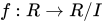



-
m
P
/
m
P
2
{\displaystyle {\mathfrak {m}}_{P}/{\mathfrak {m}}_{P}^{2}}
-
≅
(
m
f
−
1
P
/
I
)
/
(
(
m
f
−
1
P
2
+
I
)
/
I
)
{\displaystyle \cong ({\mathfrak {m}}_{f^{-1}P}/I)/(({\mathfrak {m}}_{f^{-1}P}^{2}+I)/I)}
-
≅
m
f
−
1
P
/
(
m
f
−
1
P
2
+
I
)
{\displaystyle \cong {\mathfrak {m}}_{f^{-1}P}/({\mathfrak {m}}_{f^{-1}P}^{2}+I)}
-
≅
(
m
f
−
1
P
/
m
f
−
1
P
2
)
/
K
e
r
(
k
)
.
{\displaystyle \cong ({\mathfrak {m}}_{f^{-1}P}/{\mathfrak {m}}_{f^{-1}P}^{2})/\mathrm {Ker} (k).}




Since this is a surjection, the transpose
k
∗
:
T
P
(
Y
)
→
T
f
−
1
P
(
X
)
{\displaystyle k^{*}:T_{P}(Y)\rightarrow T_{f^{-1}P}(X)}

(One often defines the tangent and cotangent spaces for a manifold in the analogous manner.)
Analytic functions
If V is a subvariety of an n-dimensional vector space, defined by an ideal I, then R = Fn / I, where Fn is the ring of smooth/analytic/holomorphic functions on this vector space. The Zariski tangent space at x is
- mn / (I+mn2),
where mn is the maximal ideal consisting of those functions in Fn vanishing at x.
In the planar example above, I = (F(X,Y)), and I+m2 = (L(X,Y))+m2.
Properties
If R is a Noetherian local ring, the dimension of the tangent space is at least the dimension of R:
-
dim
m
/
m
2
≥
dim
R
{\displaystyle \dim {{\mathfrak {m}}/{\mathfrak {m}}^{2}\geq \dim {R}}}

R is called regular if equality holds. In a more geometric parlance, when R is the local ring of a variety V at a point v, one also says that v is a regular point. Otherwise it is called a singular point.
The tangent space has an interpretation in terms of K[t]/(t2), the dual numbers for K; in the parlance of schemes, morphisms from Spec K[t]/(t2) to a scheme X over K correspond to a choice of a rational point x ∈ X(k) and an element of the tangent space at x.[3] Therefore, one also talks about tangent vectors. See also: tangent space to a functor.
In general, the dimension of the Zariski tangent space can be extremely large. For example, let
C
1
(
R
)
{\displaystyle C^{1}(\mathbf {R} )}


See also
Notes
Citations
- Eisenbud & Harris 1998, I.2.2, pg. 26.
- James McKernan, Smoothness and the Zariski Tangent Space, 18.726 Spring 2011 Lecture 5
- Hartshorne 1977, Exercise II 2.8.
Sources
- Eisenbud, David; Harris, Joe (1998). The Geometry of Schemes. Springer-Verlag. ISBN 0-387-98637-5 – via Internet Archive.
- Hartshorne, Robin (1977). Algebraic Geometry. Graduate Texts in Mathematics. Vol. 52. New York: Springer-Verlag. ISBN 978-0-387-90244-9. MR 0463157.
- Zariski, Oscar (1947). "The concept of a simple point of an abstract algebraic variety". Transactions of the American Mathematical Society. 62: 1–52. doi:10.1090/S0002-9947-1947-0021694-1. MR 0021694. Zbl 0031.26101.
External links
- Zariski tangent space Archived 2014-12-05 at the Wayback Machine. V.I. Danilov (originator), Encyclopedia of Mathematics.